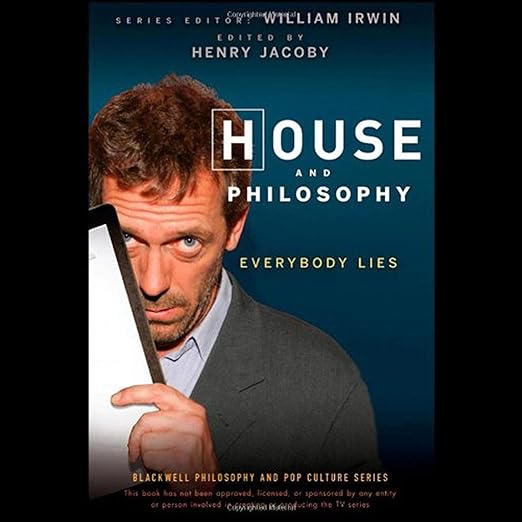
- Read by: Henry Jacoby self-narrates the edited volume with a competent academic delivery; the multiple essay-authors translate into slightly uneven tonal variety, but Jacoby's consistent voice provides a coherent frame.
- At its heart: medical ethics, Sherlock Holmes and epistemology, misanthropy as philosophical position
- Vibe: Intellectually playful, with a dry academic wit running beneath the fan enthusiasm
- Short version: The Blackwell Pop Culture series delivers on its promise with this one; 'House' and Philosophy is serious philosophy made accessible through a beloved show, and Jacoby's academic credentials ensure the analysis holds up.
The Blackwell Philosophy and Pop Culture series occupies a specific and useful niche: it takes television, film, and cultural phenomena seriously as vehicles for philosophical inquiry, rather than using them as mere bait for reluctant readers. Henry Jacoby's edited audiobook 'House' and Philosophy, which Jacoby also narrates across eight hours and eighteen minutes, brings that mission to one of TV's most philosophically loaded medical dramas. A show that pulled more than 19 million viewers per episode at its peak, it succeeded in part because Dr. Gregory House was not just a diagnostician but an argument.
House and Holmes, Both Prizing Puzzles Over People
House the character is extraordinarily well-suited to philosophical treatment because his entire method is philosophical. He is a diagnostician who reasons from evidence to conclusions that feel counterintuitive to his colleagues, who prizes uncomfortable truth over comfortable relationship, and who operates from a position of principled misanthropy that creates ethical friction in almost every episode. The book examines these qualities not as character quirks but as positions, on ethics, epistemology, and the limits of evidence-based reasoning, and it has enough material to work with that the essays rarely feel like they are stretching.
Reviewer LPower Inkhorn NLP Trainer identifies what may be the book's best insight: the comparison between House and Sherlock Holmes. Both are consulting experts, both value puzzle-solving over people, both use unconventional and occasionally illegal methods to reach truth, and both rely on a loyal companion whose moral conventionality functions as a counterpoint. The reviewer notes the shared "love of puzzle solving, house breaking, using Machiavellian means to get at the truth, drug use, and deductive abilities." The parallels are not superficial, and the essays that develop this comparison do so with enough rigor to produce genuine insight about what the detective-physician archetype is actually doing culturally and philosophically.
Contested Diagnoses as Genuine Ethical Territory
The Emmy Award-winning show provided rich ethical territory: contested diagnoses, experimental treatments, patient autonomy, the ethics of deception when truth-telling seems to require it. The book's contributors work through this territory with the Blackwell series' characteristic balance between academic credibility and accessibility. You do not need prior philosophy training to follow the arguments; you do need to be willing to take them seriously.
More Animated Than Most Academic Audiobooks
Jacoby's self-narration carries the advantage and the limitation of academic authorship reading its own work. The advantage is accuracy; the arguments are delivered with exactly the emphasis and qualification the author intended, and there are no moments where a narrator's misread of tone distorts a technical point. The limitation is that academic prose, when read by an academic, can occasionally fall into a cadence that favors correctness over engagement. Jacoby avoids the worst of this tendency; the narration is competent throughout and more animated than many academic audiobooks of this kind.
The pop culture framing is genuinely useful for accessing philosophical content that might otherwise feel inaccessible. House provides concrete examples of abstract ethical questions: when is deception justified in medicine? What does it mean to know something based on incomplete evidence? Can a person be simultaneously brilliant and ethically deficient in ways that do not invalidate their contributions? The show's fan audience has already been primed by eight seasons to have views on these questions, and the book gives those views a more rigorous framework.
For People Who Are Already Devoted Viewers
As an edited volume, the book has the structural characteristic of all such collections: the essays vary in quality and focus, and the coherence of the whole depends on how well the editor has sequenced pieces with different orientations. Some essays take a primarily analytical approach to House's reasoning methods; others are more focused on specific ethical case studies from the show; others address the character's relationships through a philosophical lens. The variety is a feature for casual listeners but means some sections will be more compelling than others depending on your interests.
The book is entirely dependent on familiarity with the show. Unlike some philosophy-and-pop-culture books that recapitulate enough of the source material to orient unfamiliar readers, this one assumes you have watched House and remember the cases and characters being analyzed. Listeners who are not fans of the show will find the philosophical arguments abstractly interesting but will miss the texture that makes the analysis land. Reviewer Sharrie Sanders captures this in the clearest possible terms: the book is for people who are already devoted viewers.
About Beliefs, Not About How It Was Made
House fans who have thought seriously about what the show was doing with its central character's ethical framework, and who want those thoughts to be systematically engaged, will find this audiobook delivers exactly that. It is also well-suited to philosophy students or general readers who want an accessible entry point into applied ethics, epistemology, or the philosophy of medicine and prefer a culturally engaging frame for those topics. The Blackwell series has established a reliable quality standard across many television and film subjects, and this entry holds to that standard.
Skip this one if you have never watched the show and have no intention of doing so; the analysis presupposes the case material. Also less useful for listeners who want their television criticism focused on narrative craft, production quality, or cultural context rather than philosophical content. This is a book about what House believes and whether those beliefs are defensible, not about how the show was made or what it means culturally, and arriving with that understanding will set up the right expectations.
Do you need to have watched the House TV series before listening to this audiobook?
Strongly yes. The book assumes detailed familiarity with the show, its recurring characters, and specific case episodes. Unlike some pop culture philosophy books that summarize the source material, this one proceeds from shared fan knowledge. Listeners who have not watched House will follow the philosophical arguments but miss the concrete context that makes them work.
Is this audiobook academic philosophy or more of a fan companion?
It is both. The Blackwell Pop Culture series deliberately bridges the two. The philosophical content is rigorous enough to hold up to academic scrutiny, with real arguments rather than surface-level references to famous philosophers. But it is written to be accessible to engaged non-specialists, which means it does not assume prior philosophy training.
How does Henry Jacoby's self-narration work for an edited volume with multiple essay contributors?
Jacoby narrates all the essays himself rather than using different voices for different authors. This creates coherence but also means the tonal variation you might expect from different contributors is smoothed out. The delivery is academic throughout, competent and clear, occasionally more formal in cadence than a hired fiction narrator would be.
Does the audiobook cover the Sherlock Holmes comparison that fans of both properties often notice?
Yes. Reviewers identify the House-Holmes comparison as one of the book's most compelling areas. The essays explore shared characteristics including deductive reasoning, unconventional methods, drug use, and the Watson-Wilson parallel in considerable depth, treating the parallels as philosophically productive rather than merely coincidental.