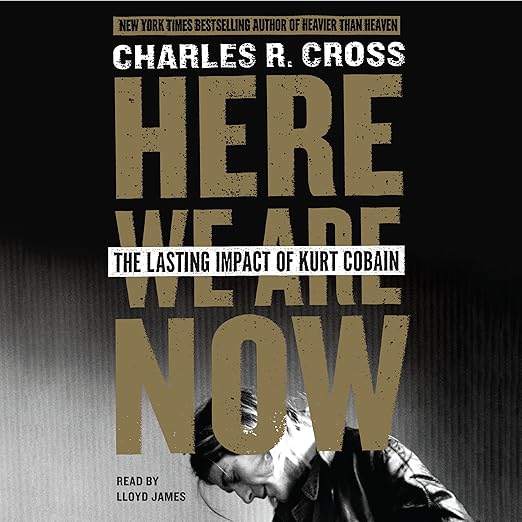
Kurt Cobain never lived to see thirty, yet the Here We Are Now audiobook argues his shadow only grows longer with each passing decade. Charles R. Cross already wrote the definitive Cobain biography, Heavier Than Heaven, so this shorter follow-up isn't interested in retracing the Aberdeen childhood or the Rome overdose again. It wants to know why a musician who hated fame still shapes fashion racks, film scripts, and pop culture two decades after his death. Lloyd James narrates a tight four-hour argument rather than a sprawling life story, and that compression turns out to be the most interesting choice Cross makes here.
Thrift Store Silk as a Cobain Tribute
Cross positions this book as a legacy study rather than a biography, and the synopsis is explicit about the question driving it: why does Kurt Cobain still matter so much, twenty years after his death? The answer he builds runs through fashion, film, and music rather than through a chronological retelling of Nirvana's rise. One listener review gets specific about what that means in practice: it notes that Marc Jacobs at one point 'sidelined his own career at one time by designing thrift store styles made of silk' in homage to Cobain's look, a detail that says more about the singer's cultural gravity than another rehash of the In Utero tour ever could.
Cross has the standing to make these connections; Heavier Than Heaven remains the gold standard of Cobain biographies, and Here We Are Now reads like the scholarly appendix he never got to write. Because this book already assumes listeners know the outline of Cobain's life, it moves fast through territory a first-time listener might want more grounding on. A second review, from carline lew, credits Cross with tracing something more concrete than nostalgia, 'the dramatic impact his death had in spawning better suicide awareness and help,' and ties that cultural shift to improvements in substance abuse treatment that Cobain himself never had access to. That's a heavier thread than the fashion chapters, and Cross earns it by keeping the tone clear-eyed rather than mournful.
That eye for the overlooked detail is Cross's specialty. He edited The Rocket, Seattle's music magazine, through the years grunge broke locally before the rest of the world had heard of Nirvana, and later wrote for Rolling Stone and Billboard. Here We Are Now draws on that ground-level vantage point even when it's reaching well past music into fashion and film, the same instinct for noticing what a scene is actually wearing and watching rather than just what it's playing on stage.
James Keeps a Measured, Unhurried Pace
None of the attached listener reviews single out Lloyd James by name, which is common for narrated nonfiction where the writing carries the weight, but the format itself plays to his strengths. A four-hour cultural essay needs a narrator who can shift between reporting voice and cultural criticism without either sounding like a lecture or a eulogy, and James keeps a measured, unhurried pace that treats the subject seriously without slipping into reverence. For a book explicitly built around the question of why a decades-dead musician still matters, that restraint matters more than it would in a straight biography, where a narrator has more license to lean into drama.
At just over four hours, Here We Are Now is roughly half the length of Heavier Than Heaven, and that brevity is a genuine selling point for anyone who already owns the full biography or has read it in print. Cross isn't trying to out-report himself; he's asking a narrower, more interesting question about influence and afterlife, the kind of thing that suits a tighter audio format better than a much longer biography would. Listeners who gravitate toward music-culture writing in the vein of Chuck Klosterman or Jon Savage will recognize the move here: treating a musician's death date as a starting point for cultural analysis rather than an ending.
Listeners who prefer documentary-style nonfiction, essayistic, thematic, comfortable circling a subject from multiple angles rather than marching through it start to finish, will find the format especially natural in audio, where Cross's own authorial voice comes through more clearly than a straight biographical timeline would allow.
81 Ratings, Only a Handful of Reviews
The biggest caveat is built into the premise: this is not the book to start with if you don't already know who Kurt Cobain was or why Nirvana mattered. Cross writes for an audience already invested in the mythology, and four hours isn't enough time to also cover the band's formation, the grunge scene in Seattle, and Courtney Love's role in the story the way a full biography would. Listeners hoping for fresh reporting or newly unearthed details about Cobain's death itself should also recalibrate; this is a synthesis and interpretation book, built from existing research and cultural observation rather than new investigative work.
The listing's written reviews are thinner than the 81-rating count might suggest; only a handful of full-text reviews are attached, and they skew toward readers who already loved Cross's earlier book rather than newcomers discovering him here for the first time. That makes it hard to gauge from the data alone how the book lands for someone with no prior investment in Cross's writing. Listeners should also know this book leans harder into cultural analysis than into on-the-ground reporting; anyone hoping for new interview material or freshly unearthed details about Cobain's final months will find this book more interested in aftermath than in event.
The book is organized thematically rather than chronologically, separate stretches on music, fashion, film, and broader culture rather than a single unbroken narrative arc. That structure suits a listener who wants to dip into, say, the fashion chapter specifically, but it also means some jumping around in time as Cross circles back to different eras of Cobain's afterlife from each new angle.
Completists Yes, Newcomers Should Start Elsewhere
Cobain completists and anyone who has already read Heavier Than Heaven and wants the next layer of the conversation are the clearest audience here. So are listeners generally interested in how a musician's death becomes a cultural industry, the kind of listener who enjoyed books tracing Amy Winehouse's or Prince's posthumous influence. Cross writes with the confidence of someone who has spent decades in this material, and that confidence carries a four-hour runtime easily.
Newcomers to Nirvana's story should start with Heavier Than Heaven or a general grunge-era history first; this shorter book assumes too much background to work as an introduction. Anyone looking for strictly musical analysis, chord progressions, studio sessions, the mechanics of Cobain's songwriting, will also find the scope here pointed elsewhere, toward fashion racks and film reels rather than sheet music.
Good to Know
Do I need to read Charles R. Cross's Heavier Than Heaven before this audiobook?
Not strictly, but it helps. Here We Are Now assumes a working knowledge of Cobain's life and moves quickly into legacy and influence rather than retelling the biography from scratch.
Does this audiobook cover new details about Kurt Cobain's death?
No. This is a synthesis and cultural-analysis book built from existing research, not an investigative account with newly unearthed reporting.
How long is the Here We Are Now audiobook?
Four hours and six minutes, roughly half the length of Cross's full Cobain biography.
Is Here We Are Now mostly about Nirvana's music or Cobain's cultural impact?
Cultural impact. The book traces Cobain's influence through fashion, film, and pop culture more than through musical analysis of Nirvana's catalog.