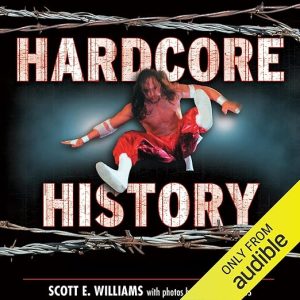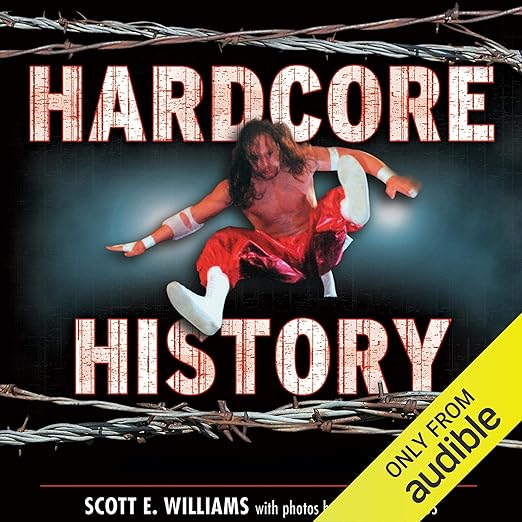
Eastern Championship Wrestling opened its doors in a Philadelphia warehouse in 1992 with no money and no national television deal, so how did a company that never turned a profit end up reshaping an entire industry before it died nine years later? That is the puzzle Scott E. Williams sets out to solve in the Hardcore History audiobook, and he does not pretend the answer is simple. ECW sold itself as pure anti-authority rebellion while its leadership quietly cut deals with the two promotions it claimed to be fighting, the World Wrestling Federation and World Championship Wrestling. Williams spent years chasing that contradiction through company records and dozens of interviews with fans, executives, business partners, and the wrestlers themselves, and the result is less a highlight reel than an autopsy.
Built Around Accusations, Not a Timeline
Williams structures the book around a handful of specific accusations rather than a simple beginning-to-end timeline, and that choice pays off. Did World Championship Wrestling try to strangle ECW by poaching its top talent? Was Vince McMahon, publicly ECW's rival, secretly propping the company up behind the scenes? Those are the two threads Williams keeps circling back to, and he resists handing listeners a tidy verdict on either one. The approach treats ECW's collapse as a genuine historical mystery with competing, credible answers rather than a story with one obvious villain.
Who Lied to Whom, Left Unanswered
What comes through most clearly is Williams's interest in ECW as a case study in self-deception. The wrestlers, the promoters, and even the diehard fans who thought they were in on a subversive secret all get treated as participants in the same con, one that eventually consumed the company that started it. Justin Swift's five-star review captures the nostalgia angle, the sense of revisiting a chaotic, underfunded golden age before its stars scattered into the more sanitized wrestling world that followed, calling out the inside details about WWE's eventual revival as a particular highlight.
The synopsis poses its central question bluntly: who lied to whom? Williams never fully answers it, and that restraint is deliberate. Rather than picking a single villain between WCW's front office and WWF's, he lets the book's title do double duty; the extremely unauthorized framing applies as much to the wrestlers who believed their own outlaw mythology as it does to the corporate rivals working against ECW from the shadows. The effect is a history that keeps implicating everyone a little, including the fans who wanted to believe ECW really was as dangerous and independent as it claimed.
Miller Doesn't Try to Impersonate the Wrestlers
Karl Miller reads the material with the steady, unshowy clarity a research-heavy oral history needs. He does not attempt to impersonate the dozens of wrestlers, promoters, and business partners Williams quotes throughout, which is the right call for a book built on competing accounts rather than dramatized scenes. Miller's pacing lets dense stretches of company history, contract disputes, and behind-the-curtain politics land clearly without ever rushing past the details that make the account credible.
As a Journalist, Not an Insider Settling Scores
The audiobook format suits a story built on interviews and firsthand testimony more than it might suit a straightforward wrestling record book. Williams walks listeners from ECW's scrappy beginnings as Eastern Championship Wrestling through its rebrand and its final collapse in 2001, and hearing the contradictions read aloud, the anti-authority image set against covert cooperation with bigger promotions, sharpens just how strange the company's identity really was. Eleven hours is a real commitment, but Miller's evenness keeps the material moving even through chapters focused on business structure rather than in-ring action.
Williams approaches ECW as a journalist rather than as a former insider settling scores, which separates Hardcore History from the glut of self-serving wrestler autobiographies covering similar ground. That outsider vantage point, built on records and interviews rather than personal grievance, gives the account a credibility a memoir from any single wrestler or promoter could not match on its own, even when, as reviewers note, some individual details slip.
Interesting Material, One More Proofread Short
Not every listener will come away impressed by the production polish. Virtual Rocker's three-star review points directly at editing problems, describing interesting behind-the-scenes material undercut by a text that reads like it needed one more proofreading pass. That critique is about the source manuscript rather than Miller's narration, but it is worth knowing going in, since some sentences and transitions feel rougher than the subject matter deserves.
Three Reviews, Five Stars Down to Three
Devin de Gruyl's review flags a handful of factual slips, including details around the Barely Legal pay-per-view, enough to suggest a listener with deep ECW knowledge should treat some specifics with caution. That same review, along with Virtual Rocker's, notes that longtime fans who already followed the wrestling dirt sheets and shoot interviews of the era will recognize a fair amount of this material, lowering the surprise factor for the most obsessive segment of the audience even as the book remains valuable as a single organized source.
The book's 4.2 rating across 211 ratings reflects real range rather than uniform enthusiasm: the three visible reviews run from five stars down to three, covering nostalgia, factual quibbles, and editing complaints in roughly equal measure. That spread is a more honest signal than a wall of five-star reviews would be, suggesting a book that genuinely divides opinion on execution even among readers who agree the subject matter is worth covering.
For Sports-Business Readers, Not Just Wrestling Fans
Fans of 1990s professional wrestling, and anyone curious about how a chronically unprofitable regional promotion ended up influencing WWE's entire modern presentation style, will find plenty to chew on here. The book also works for readers of backstage sports-business narratives more broadly, the kind of story where the product on stage is only half of what is actually happening.
The book also earns a place alongside general sports-business documentaries and behind-the-scenes journalism, not just wrestling-specific reading lists, since Williams frames ECW's collapse as an industry cannibalizing itself under its own financial pressure. Anyone who enjoys stories about scrappy companies punching above their weight before financial reality catches up will find something recognizable here even without deep prior wrestling knowledge. The synopsis promises a story sure to be controversial for fans and critics of both ECW and professional wrestling generally, and the book delivers on that promise by refusing to let any single faction, promoters, wrestlers, or rival companies, off the hook entirely.
Anyone allergic to minor factual imprecision in nonfiction, or hoping for a tightly edited, magazine-polished production, should adjust expectations before starting, since both de Gruyl and Virtual Rocker flag rough patches in the source text itself. For everyone else, particularly anyone who only knows ECW by reputation, Karl Miller's measured narration turns a genuinely strange chapter of sports entertainment history into a coherent account.
A Few Questions About Hardcore History
Does the Hardcore History audiobook cover ECW's entire run from founding to collapse?
Yes. Scott E. Williams traces the company from its 1992 origins as Eastern Championship Wrestling in Philadelphia through its rebrand and its 2001 death, drawing on company records and dozens of interviews with wrestlers, executives, and business partners.
Are the factual errors reviewers mention in Hardcore History a dealbreaker?
Reviewer Devin de Gruyl flags a handful of slips, including details around the Barely Legal pay-per-view. They are minor enough not to undermine the book's overall value, but worth knowing about going in.
Is the Hardcore History audiobook worth it if I already followed ECW dirt sheets and shoot interviews?
Reviewer Virtual Rocker notes that longtime, deeply engaged fans may recognize over half the material already. It still works well as a single organized account rather than scattered interviews and forum posts.
Does Karl Miller's narration voice individual wrestlers and executives differently in Hardcore History?
No. Miller reads in a consistent, neutral register rather than differentiating the many people Williams quotes, which suits the book's journalistic approach but not competing dramatized testimony.