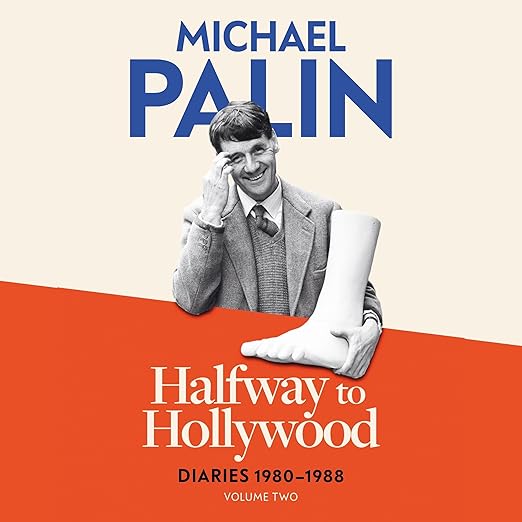
- Narration: Michael Palin self-narrates his own diaries with the ease of a practiced raconteur, conversational and dry, exactly the register these pages require.
- Themes: Creative reinvention in the shadow of Python, the unexpected arc of a film career, family life as anchor
- Mood: Warm and self-deprecating, with a persistent sense of wonder beneath the wit
- Verdict: A rewarding audiobook for anyone who wants to understand what the 1980s looked like from inside the mind of one of its most interesting working artists.
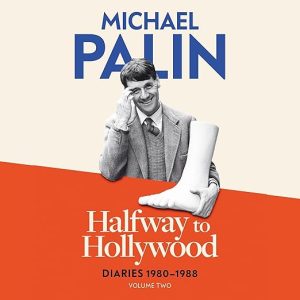
Palin's 1980s, heard in Palin's own voice: the audiobook edition of Halfway to Hollywood gets this exactly right by putting the author at the microphone. These are diaries, which means they were written to be read back, and when Michael Palin reads them back himself, 40 years on, the distance between the man writing and the man narrating produces something genuinely interesting. He is both the person navigating the decade and the person who knows, now, how it came out. That doubled awareness runs quietly throughout, and it is always present even when unacknowledged.
The volume covers the bulk of the 1980s, a period during which the Monty Python bonds loosened after the group made The Meaning of Life in 1983. What follows for Palin personally is an unexpectedly rich film decade: co-writing and acting in Terry Gilliam's Time Bandits and Brazil, producing and starring in The Missionary alongside Maggie Smith, and then the role that changed public perception of him in the UK, his BAFTA-winning supporting turn as the hapless, stuttering Ken in A Fish Called Wanda. The decade closes with preparations for Around the World in 80 Days, the documentary that recast him from comedian to traveler in the popular imagination. It is a substantial transformation, and the diary entries capture it happening in real time.
In Palin's Own Voice, Uncertain What's Next
Diary form suits Palin. He has a gift for the observed detail: the small frustration, the unexpected pleasure, the meeting that goes sideways. Diary writing rewards exactly that gift. These are not retrospective essays shaped by hindsight but daily notes from a person genuinely uncertain what will come next. He did not know, writing in 1983, that A Fish Called Wanda would be what it became. He did not know that Around the World in 80 Days would redefine him entirely. Listening to him navigate toward those outcomes with no knowledge of their significance is one of the pleasures of this format and one that audio serves particularly well.
The Python shadow is handled with care. Palin does not treat the post-group years as a fall or a freedom; it is more complicated than either. The bonds loosened, but they did not break. His solo career is pursued alongside ongoing friendship and occasional collaboration, and the decade's record shows someone discovering what he is when he is not primarily a Python, which turns out to be quite a lot. A working actor. A writer. A television personality before he quite realized it. A husband and father who charts his family life with equal attention to his professional one. Helen and the children appear throughout, providing ballast against the industry noise that fills the other pages.
He Reads Them, Rather Than Performs Them
The self-narration is the argument for the audiobook. Palin reads with a light touch and an absence of self-importance that is rare in celebrity memoir audio. He does not perform the diaries; he reads them, which is a different thing. The dry wit that built the Python persona is present, but it is deployed at conversational volume, the kind you catch in a throwaway line rather than a set piece. At just under three hours, this is an unusually short audiobook for a decade's worth of diary, which tells you something about the editing. These are highlights and selected passages rather than complete journals, and the curation is good.
The entry point matters here. This is the second volume of Palin's diaries, following The Python Years. You do not need that volume to follow this one; the period covered is self-contained and the context provided is sufficient. Listeners who have spent time with the first volume will have a richer reading of how the decade in Halfway to Hollywood represents a kind of earned independence from the group identity that defined the 1970s and gave Palin his initial public profile.
The Missionary and Brazil Get Short Shrift
The abridged nature of the selection means that some transitions feel abrupt. A film appears, runs for a paragraph, and then is over. The chapters on The Missionary and Brazil are notably thin given how significant both productions were to Palin's development as a filmmaker and actor. Listeners who want detailed production memoir will not find it here. The diary form gives you the texture of a working life rather than a making-of account, which is a different kind of value but requires adjusted expectations before you begin.
The references to East of Ipswich, Palin's television work for the BBC, and his involvement with Transport 2000 land differently depending on how well-acquainted you are with British cultural and public life of the period. American listeners will get the broad picture without losing the thread, but some texture will be unavailable. The Python and film material translates without difficulty; A Fish Called Wanda and Brazil need no introduction on either side of the Atlantic, and the scenes surrounding them are the most fully drawn sections of the book.
Fragmentary by Design, and That's the Point
The ideal listener has genuine affection for Palin and some curiosity about what it was actually like to work in British film and television during the 1980s. Fans of diary-form memoir who like their narrators to self-narrate will find this especially satisfying. Those looking for backstage detail on A Fish Called Wanda or the Python years will get glimpses but not deep coverage. Skip this one if you want comprehensive career biography; it is fragmentary by design, and the fragments are its point and its pleasure.
Frequently Asked Questions
Do I need to have listened to the first volume of Palin's diaries before this audiobook?
No. Halfway to Hollywood covers a self-contained period (the 1980s) and provides enough context to follow without the earlier volume. Familiarity with Monty Python and Palin's general career helps, but is not required.
Is this audiobook abridged, and does it matter?
Yes, at under three hours for a decade's worth of diaries, this is clearly a selection rather than complete journals. The curation is tight and the editing is good, but listeners expecting a day-by-day account of the decade will not find one here.