
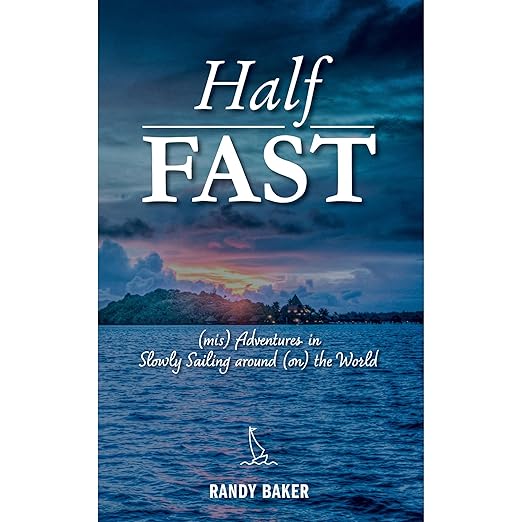
Virtual Voice is what the narrator field says on this audiobook, and that one line should change how you audition the nine hours and ten minutes behind it. Randy Baker's account of leaving Arkansas on a small sailboat with Cheryl, very little money and, in the description's own doubled-word phrasing, even even less nautical experience, was published independently on January 27, 2024. What began as a plan for a year or two became a quarter-century at sea across twenty-nine countries. The story is real. The reader is not a person.
Nothing in the listing explains what an automated voice does to a first-person adventure memoir at this length, and the five written responses cannot help, because every one of them is describing a printed book. Lorine Rosenthal calls it a well written book of beautifully described adventures. Thomas Wikman writes as a fellow cruiser who identified with a lot of the experiences. A Sailing guy in Michigan enjoyed the proper sailing terms and, just as much, the explanation of the terms, then types red where read belongs. None of that tells you whether a machine can hold a hurricane sequence together, which is the one question a sample answers in ninety seconds.
MARK OOSTHUIZEN's four-star note contains the strangest sentence on the record. It praises the story of Caribee and her owners, then reports that John was not short in his supply of detail and terminology. No John appears anywhere else on this page. The byline reads Randy Baker, the boat is Caribee, and the sign-off thanks "you guys for sharing" in the plural. Either a collaborator went uncredited on the listing or that response drifted in from a different book, and nothing here settles it. The note is also dated January 8, 2022, two years before this recording was published, which means at minimum it was written about something other than the audio.
Highlights
Twenty-nine countries is the figure the description gives, spread across the Caribbean, Central and South America and the South Pacific, and the incident list underneath it is not decoration: hurricanes, thieves, drug smugglers, a disastrous tsunami. Set against that is the domestic scale of the operation. Two people in their thirties, a small boat, a plan that family and friends judged a half-assed scheme, and no easy way back once the lines are off. The appeal sits in that gap: modest equipment, an enormous map. Hence the copy's insistence that the voyage was never meant to last in the first place.
Cruisers vouch for it, which on a book like this is the endorsement that counts. Thomas Wikman recognizes the harrowing experiences alongside the good ones as ordinary parts of cruising life. A Sailing guy in Michigan praises not only the correct terminology but the fact that it gets explained, and says anyone can read the book and enjoy the story. MARK OOSTHUIZEN, byline confusion aside, credits accurate accounts of the sailing, the destinations and the events. All five responses sit at four stars or five, and the enthusiasm converges on the same quality: the detail survives contact with people who have actually done this.
Adventure of the kind you would rather read than survive is how Lorine Rosenthal frames it, describing episodes that fully engage your attention and that you hope never to experience yourself. BluWater1der supplies the fuller inventory: far away adventure, true love, tragedies, catastrophe, and the perseverance required to live a life less ordinary. Between them those two responses catch the book's real register, which is neither a how-to nor a travelogue but a long marriage tested by weather and by strangers. The description's own bargain, hardship as the toll and freedom as the return, is the thesis the reviewers keep confirming in their own vocabulary.
Weak Spots in Half Fast
Automated narration is the risk to weigh, and at this length it is a live one. A memoir of near-misses depends on pacing, on a reader knowing to slow down for the tsunami and to throw away a line about customs paperwork. A synthesis engine makes no such decisions. It also mispronounces at a steady rate, and this is a book carrying twenty-nine countries' worth of place names plus the technical vocabulary two reviewers single out for praise. Nine hours and ten minutes is a long stretch with a voice that cannot choose anything. Audition it before you commit.
Figures on this page disagree with one another, and the disagreement is worth seeing in advance. The description sells a quarter-century voyage across twenty-nine countries spanning half the world. BluWater1der records the Bakers sailing half way around the world on a 32 foot sailing vessel over 27 years. A quarter-century and 27 years can be the same voyage counted from different dates, but only the reviewer supplies the size of the boat, and only the reviewer says half way where the copy says half. Small distances, and the sort a listener ends up carrying instead of the copy.
The rating widget is the last oddity. It displays 4.5 above a vote counter reading 1, and a single whole-star vote cannot land on a half point by any arithmetic, so the badge is not describing the vote it claims to count. Five written responses sit directly beneath that counter. Their stars, read off the page in order, run five, four, five, five and four. The page has its own small proofreading failures as well, starting with that doubled word in the second sentence of the description. Independently Published is the imprint, which is consistent with both the synthesis credit and the stray typography.
Is This One for You?
Sailors and would-be sailors are the target, and the column suggests the aim is good, since the people who liked this most are the ones who have handled a boat. Anyone drawn to the cut-the-lines fantasy in its small-boat form, not its yacht form, gets a quarter-century of consequences instead of a brochure: the friendships, and also the thieves. Travel listeners who want destinations chosen by wind and season will find twenty-nine of them, none arrived at by itinerary.
Machine narration is a dealbreaker for plenty of listeners, and anyone in that group should leave this file alone; so should anyone hoping for a prose stylist, or for a reader who can act a storm. BluWater1der says the first part plainly: this was not written by Hemingway, and the book earns its keep on the exceptional journey and not on the narrative. The credit line does the rest of the deciding for you, because everything those five reviewers admired belongs to the book, and not one of them was listening to this file when they wrote.
- Big ideas: Cutting the dock lines, long-haul cruising, hurricanes and thieves, a marriage lived at sea.
- Atmosphere: Plainspoken and weathered.
- Worth it?: The voyage is real; the voice reading it was generated, not hired.
Before You Listen
Who reads the Half Fast audiobook?
The narrator field carries no human name. It reads Virtual Voice, the label for machine-generated narration, across nine hours and ten minutes. That is the single most important thing on the listing for a buyer, since it decides how the storm passages, the twenty-nine sets of place names and the technical sailing vocabulary will actually sound.
Which name belongs on this book, Randy Baker or the John a reviewer credits?
MARK OOSTHUIZEN praises the story of Caribee and her owners, then writes that John supplied the detail and terminology, and thanks the authors in the plural. The byline names only Randy Baker. Either an uncredited collaborator exists or the response belongs to another book. Nothing else on the record resolves the question.
Nine hours for a quarter-century voyage: what gets left out of the audiobook?
The description frames the whole quarter-century, from the departure out of Arkansas through the islands and on into the Pacific. Nine hours and ten minutes cannot cover that year by year, so expect selected episodes instead: the hurricanes, the thieves, the drug smugglers, the tsunami, and the friendships formed with local people along the route.







