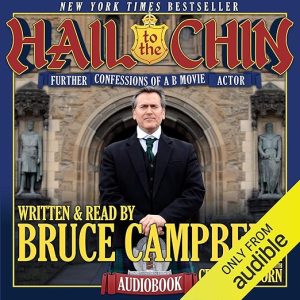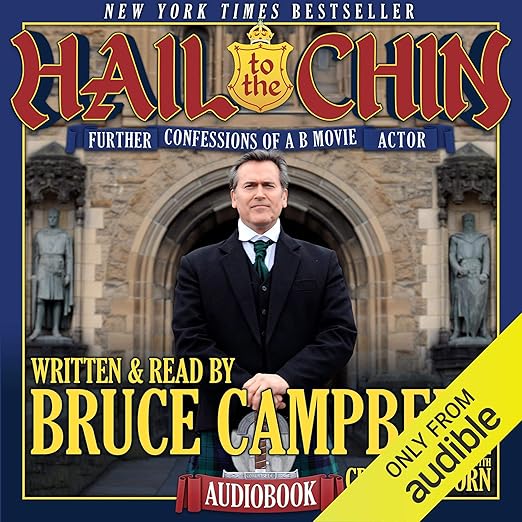
Bruce Campbell narrating his own memoir is, as advertised on the cover, Bruce Campbell narrating his own memoir. Hail to the Chin, his second autobiographical audiobook following If Chins Could Kill from 2001, arrives in seven hours and forty-nine minutes of the specific voice that spent decades fighting Deadites, playing Sam Axe on Burn Notice, and doing things in Bulgaria that nobody planned for. The narration is the review, in a sense: if you find Campbell's voice and sensibility appealing, this audiobook will justify every minute of its runtime.
The book covers the years between his first memoir and this recording, which Campbell describes as his maturing years in show business, the period when he began saying no more often, generating his own material, and eventually departing Los Angeles for a remote part of Oregon. That arc from B-movie actor taking whatever work arrived to an artist with more deliberate editorial control over his own output is the structural spine of the book, and Campbell's self-assessment is characteristically unsparing.
The Verdict, Briefly
Campbell's writing voice and his spoken voice are nearly identical, which is either a result of writing with performance in mind or of a personality so consistent that the distinction collapses. Either way, the audiobook format suits the material almost perfectly. The anecdotes, hovering above Baghdad in a Blackhawk helicopter, facing a pack of wild dogs in Bulgaria, playing an aging Elvis with a distinctly specific cancer, land better spoken because the delivery calibrates the tone before the content arrives. You know from the first syllable whether you are about to hear something self-deprecating, affectionate, or absurd, and Campbell's comic timing manages that signaling efficiently.
Reviewer Yodamazon's description of Campbell as B-budget to some but A-ok to others captures the audiobook's implicit argument about what constitutes a successful career. Campbell built a genuinely devoted audience through work that the mainstream industry dismissed, and the memoir is partly an argument that the metrics by which Hollywood measures success are not the only available metrics. That argument is made through anecdote rather than thesis, which is the right approach for memoir, and the specific anecdotes Campbell chooses to include all illustrate some version of the same point: the sheer lunacy of show business, as he calls it, is not a bug but a feature. The Bulgaria sequence is a particularly good illustration of this, because the gap between the ambitions of the production and the reality on the ground, the wild dogs, the logistical chaos, the improvised solutions, is presented not as a cautionary tale but as the actual substance of an interesting life. Campbell's delivery of these sequences has the timing of someone who has told these stories enough to know where the laughter should arrive, which is exactly what you want from a self-narrated memoir.
Why Hail to the Chin Works as an Audiobook
The audiobook works for listeners who know Campbell's work and for those encountering him here for the first time. Reviewer Stephen Staver found the book after discovering the Evil Dead films relatively recently and found it deepened his appreciation for Campbell's specific approach to his career. For longtime fans, the memoir provides context for the creative decisions behind the work they already know, and the Oregon move section in particular explains the deliberate choice to prioritize quality of life over career momentum in a way that the public record of his work does not fully convey.
Co-written with Craig Sanborn and recorded with sound design by Sean McCoy at Oregon Sound Recording, the audiobook has a production quality that matches its performance quality. Campbell's voice is recorded cleanly, and the sound design choices are present enough to add texture without distracting from the narration. The New York Times bestseller designation attached to the print edition indicates the book reached an audience well beyond the cult fanbase, which is appropriate given that the filmmaking career observations and reflections on mid-career reinvention generalize past the Evil Dead context to anyone navigating the relationship between their professional identity and their actual life.
Points to Consider
The audiobook is explicitly positioned as a sequel to If Chins Could Kill, and while it functions as a standalone given that the content covers a distinct period, familiarity with the earlier memoir adds context for understanding what Campbell is measuring his maturation against. References to projects and relationships established in the first book appear without detailed reintroduction, and listeners new to Campbell's career history may occasionally find themselves without enough background to appreciate the full significance of certain anecdotes.
The humor is also tonally specific to Campbell's persona, which combines genuine self-deprecation with enough confidence to make the self-deprecation readable as performance rather than insecurity. Listeners who find that register, the B-movie actor who knows exactly what he is and finds it genuinely funny, grating rather than charming should calibrate expectations accordingly. The memoir is not trying to rehabilitate his reputation or claim unrecognized significance; it is celebrating the specific life he actually had, with all its deliberate departures from conventional career wisdom.
Who Should Listen to Hail to the Chin
Evil Dead fans, Burn Notice viewers, and anyone who has found Campbell's public persona appealing will find the audiobook a direct delivery of more of exactly that quality. Independent filmmaking enthusiasts will find the career navigation sections instructive regardless of genre interest. Listeners who want a celebrity memoir that does not pretend the career was more conventionally successful than it was will find Campbell's candor refreshing. Those who require straightforward narrative biography without comic framing will find the tone incompatible with their preferences.