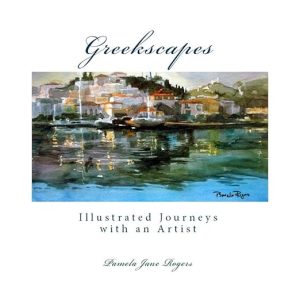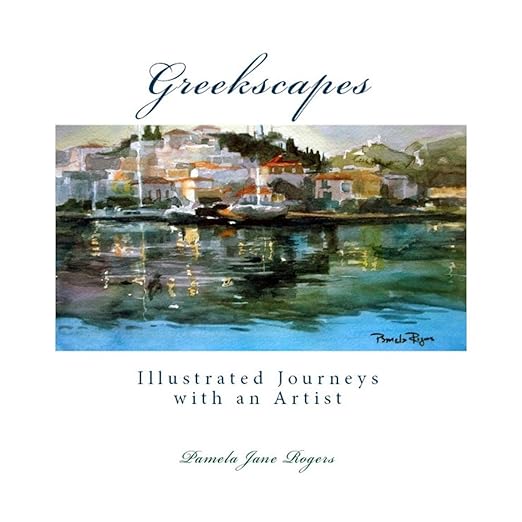
Pamela Jane Rogers' GREEKSCAPES Illustrated audiobook arrives with an intrinsic tension built into its format. The book exists as an illustrated edition, Rogers is a painter, her paintings are part of the text's identity, and readers of the print edition have access to visual work that the audio simply cannot transmit. What remains when you strip the canvas from an artist's memoir is the story itself: a middle-aged American woman, a 1982 painting workshop in Greece, an epiphany in an olive grove, a troubled marriage, and a question that took years to answer. That story, it turns out, carries considerable weight on its own.
Rogers' arc spans nearly a decade of annual art workshops abroad, beginning with that first Aegean summer and ending with a devastating loss, the death of her mentor, and the practical dismantling of a life she had built. The synopsis describes her facing divorce, a planned career pivot into interior design, and a continued pull toward Greece that most rational observers in her life categorized as irrational. For a middle-aged woman with minimal financial resources to relocate abroad alone, they were probably right. Rogers is clear-eyed enough to acknowledge that, and honest enough not to resolve the tension cheaply.
The memoir operates in the tradition of books about following creative impulse past the point where it is sensible, not a triumphant entrepreneurial narrative, but an account of someone testing what she actually values against what she had built. The olive grove epiphany Rogers describes is not presented as mystical certainty but as the beginning of a long interrogation. She spends years returning to Greece in the contained, bounded form of workshops, painting and learning, before the question of whether to live there permanently becomes unavoidable. That slow accumulation of longing is the book's emotional engine, and it is handled without sentimentality.
Readers who have responded most strongly to GREEKSCAPES Illustrated point to its dual register: the specific physical pleasure of Greece, the light, the turquoise water, the olive trees, the generous culture, rendered through a painter's eye, and the harder, less photogenic material of a marriage ending, a mentor dying, and a future being rebuilt from uncertain elements. Elizabeth Haskin described the book as 'warm, friendly and inviting' with 'charming and funny anecdotes,' while Erin Dertner pointed to its ability to make a 'heart come truly alive.' These are not contradictory responses, Rogers manages affection for her subject alongside genuine honesty about its difficulties, which is harder than either sentiment or bleakness alone.
Functional Narration, Missing an Interpretive Performance
At 12 hours and 6 minutes, the audio covers the full memoir with reasonable pacing for a reflective personal narrative. The Virtual Voice narration is functional, it conveys the text clearly, but it does not bring an interpretive performance to Rogers' voice, and memoir is one of the genres where authorial narration typically adds the most. The self-narrated version, if one existed, would almost certainly carry more intimacy and texture in the passages about creative vulnerability and loss. Listeners who have no access to the illustrated print edition should know that the audio version is working from the same text but without the visual dimension that reviewers like Mary Horner specifically celebrated in the print edition's inclusion of Rogers' paintings.
That said, Greece as a subject carries its own audio advantages. Rogers' descriptions of the Aegean light, the landscape during workshop sessions, the social texture of expatriate life on a Greek island, these translate well to heard prose. The book is atmospheric in the way good travel-inflected memoir tends to be, and listening while commuting or in quiet domestic hours suits the material's contemplative pace. The 12-hour runtime is unhurried rather than padded; Rogers is a precise enough writer that the length reflects genuine content rather than repetition.
Will the Enchantment Last?
This is the second Greekscapes book, Rogers' first, simply titled Greekscapes, preceded this illustrated edition, and at least one reviewer noted that reading the original made them hungry for this follow-up. New listeners can enter here without prior knowledge of the first book, but the illustrated edition draws on a continuing relationship with Greece and with the reader's familiarity with Rogers' visual work. The 'illustrated' designation in the title refers to the inclusion of Rogers' paintings in the print edition, which represent a significant portion of the book's emotional and artistic argument. In audio, those paintings are absent, which is worth knowing before purchase.
The memoir's emotional honesty about mid-life reinvention, specifically the social pressure against it, the financial precarity involved, and the cost of following creative impulse, makes this book more substantive than the warm Mediterranean-light cover might suggest. Rogers does not pretend the choice to 'simply follow her heart' was easy or consequence-free. The question she ends the synopsis with, 'Will the enchantment last?', is more unsettled than rhetorical, and the book takes that uncertainty seriously.
Substantial and Worth the Twelve-Hour Investment
This audiobook will most reward listeners who are interested in creative memoir, mid-life reinvention, or the specific texture of expatriate life in Greece, particularly those who can supplement the audio with the print illustrated edition to access Rogers' paintings. Listeners drawn primarily to the visual-arts angle will find the audio version incomplete on its own. Those who respond to honest, warmly-written accounts of following an artistic calling past conventional advice will find the memoir substantial and worth the twelve-hour investment. The Virtual Voice narration is functional but not a performance highlight, so format-flexible listeners may prefer the print edition for this particular title.
Frequently Asked Questions
Does the audiobook include Rogers' paintings, or are those only in the print edition?
The paintings are only in the print illustrated edition. The audiobook delivers the memoir text via Virtual Voice narration, but the visual art that reviewers specifically praised in the illustrated edition is absent from the audio format.
Do I need to have read the first Greekscapes audiobook before this one?
No prior reading is required. New listeners can enter the GREEKSCAPES Illustrated memoir without knowing the first book. However, at least one reviewer noted that reading the original made them hungry for this follow-up, so the two books do connect thematically.
Is this audiobook suitable for someone who wants a travel memoir rather than an art memoir?
It serves both interests. Rogers describes the landscape, culture, and daily texture of Greece with a painter's precision, making it genuinely appealing as a Greece travel memoir. But the artistic and personal reinvention dimensions are equally central, neither strand is secondary.
How does the Virtual Voice narration affect the listening experience for this memoir?
The narration is functional and clear but lacks the interpretive warmth that author-narrated memoirs typically provide. Listeners sensitive to synthetic narration will notice it. Those primarily interested in the story content will find it adequate, though the print edition may be the stronger format choice for this particular title.