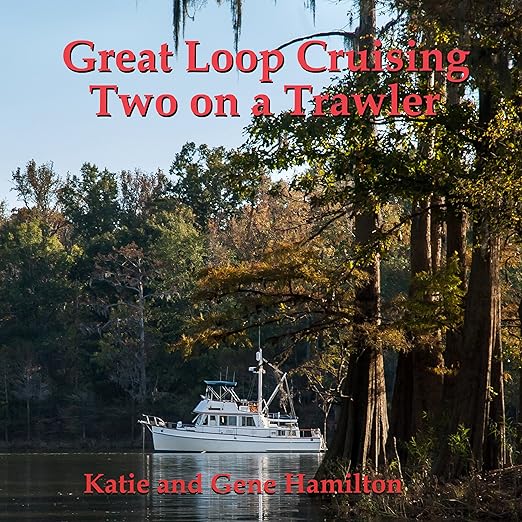
Could you cruise your own boat around an entire continent? For most people the question stays hypothetical, filed somewhere between "learn to sail" and "retire early." But Katie Hamilton and her partner actually did it, logging more than 5,000 miles aboard their 36-foot trawler High Life on the Great American Loop, and this audiobook is their account of what that journey looked like from the helm.
I came to this one as someone who grew up near the water but whose boating experience tops out at a rental pontoon. The appeal of the Great Loop has always been abstract for me, a kind of permanent wandering that sounds romantic until you start thinking about lock systems and canal fees and weather windows. What Hamilton offers here is something concrete: a chronicle of actually doing it, narrated by Joyce Porter in a manner that feels like getting a letter from a friend who happens to know a lot about tidal currents.
What Katie Hamilton Delivers
This audiobook works best as an invitation. Hamilton is upfront that she and her crew are travelers first and sailors second in terms of their priorities, which means the narrative leans heavily on the people they meet, the towns they pass through, and the accumulated texture of moving through both the Gulf Intracoastal Waterway and the Erie Canal in the same continuous voyage. The route itself, which stitches together the Atlantic Intracoastal, the Great Lakes, inland rivers, and Canadian Heritage Canals into one unbroken 5,000-plus-mile loop, is extraordinary on paper. Hamilton does a solid job of making it feel navigable rather than mythic.
One of the quieter pleasures here is the cast of characters the Hamiltons accumulate along the way: other Loopers they meet at various anchorages and locks, fishing community locals, marina owners with opinions about everything. The reviewer who called it "entertaining and enjoyable" and noted it reads as a worthwhile experience for "loopers or dreamers" has the calibration about right. This is not a technical sailing manual. It is a travel narrative that happens to take place on the water, and it treats that distinction honestly.
What Katie Hamilton Gets Right
Joyce Porter's narration is warm and conversational, a good fit for material that is fundamentally about hospitality, curiosity, and the pleasures of slow travel. She does not impose drama where none exists, which is appropriate for a book that is more reflective than high-stakes. Some listeners may find the pacing gentle to the point of unhurried, but that rhythm mirrors the experience Hamilton is describing. The Loop is not a race.
The audiobook draws on Hamilton's chronicle of the voyage with a clear eye for the diversity of the route: historic seaport towns, natural wilderness corridors, coastal fishing communities. She covers the practical realities of navigating a 36-foot trawler through commercial lock systems designed for much larger vessels, without turning the book into a technical manual. That balance is harder to achieve than it looks.
Where Katie Hamilton Loses Some Ground
Reviewers have flagged, fairly, that the book is "short on detail" in places, and that it "seems to skip over places and time." This is a real limitation. At just over three hours of listening time, Great Loop Cruising is a brisk account of a journey that took months to complete. Certain stretches of the route receive only cursory treatment, and listeners hoping for deep-dive coverage of specific segments like the Tennessee-Tombigbee Waterway or the North Channel of Lake Huron may finish feeling that those sections deserved more room.
The trade-off is accessibility. By keeping the account personal and anecdotal rather than encyclopedic, Hamilton ensures the material stays engaging for listeners who are not already steeped in cruising culture. The book functions well as a first-contact experience with the Loop concept. Those wanting more granular logistical coverage will need to supplement with dedicated cruising guides or the Great Loop community resources online.
For listeners considering the Great American Loop seriously, the audiobook also functions as an argument for why the route's community dimension matters as much as the navigation. Hamilton repeatedly returns to the culture that forms among Loopers, the informal radio check-ins at anchorages, the shared knowledge about lock timing and tidal windows, and the way a 5,000-mile continuous waterway creates a moving neighborhood of people doing the same improbable thing at the same time. That social texture is not something a cruising guide can provide, and it is one of the genuinely distinctive elements of what Hamilton and Joyce Porter deliver here.
The diversity of the route's geography is one of the audiobook's consistent pleasures. Hamilton moves from the protected saltwater passages of the Atlantic Intracoastal to the inland freshwater of the Great Lakes and Canadian Heritage Canals, and she notes how different those environments feel at the helm. The weather patterns, wildlife, shoreline character, and local culture shift dramatically across a route that passes through some of the most distinct regional landscapes in North America. Condensed into three hours, those transitions feel impressionistic, but the impressions themselves are vivid enough to sustain interest.
Who Should Pick Up Great Loop Cruising
Sailors and powerboaters who have heard of the Great American Loop but have not yet committed to attempting it will find this audiobook genuinely useful as a motivator and a realistic preview. It demystifies the route without sanitizing the challenges. Armchair adventurers with a taste for slow travel narratives, particularly those who enjoyed books like Maiden Voyage or similar firsthand accounts of extended boat journeys, will also find it rewarding. Listeners seeking technical sailing instruction or a comprehensive geographic guide to the Loop will need to look elsewhere, but as a personal account of what the journey actually feels like from the inside, this delivers what it promises.