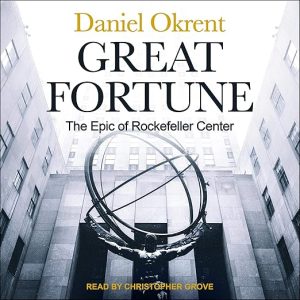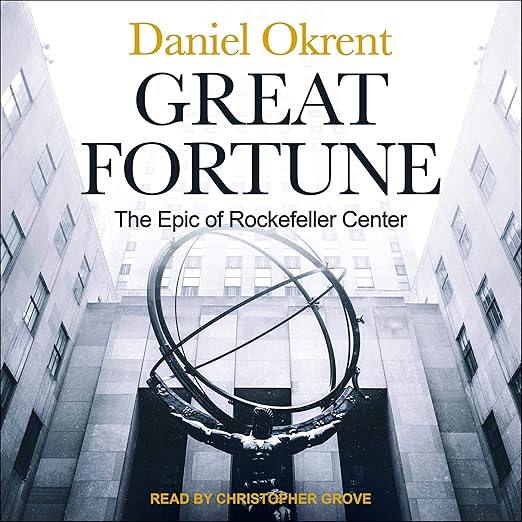
Four men built Rockefeller Center, and Daniel Okrent spends twenty-two hours making the case that none of them could have pulled it off alone. This audiobook follows tycoon John D. Rockefeller, his son Nelson, real estate strategist John R. Todd, and architect Raymond Hood through the Depression-era gamble that filled fourteen midtown Manhattan acres with limestone towers, a sunken skating rink, and Diego Rivera's short-lived mural. Okrent was a Pulitzer finalist for this book, and the scope shows: money, architecture, politics, and a healthy amount of backstage gossip all get equal billing.
I came to this one after finishing Ron Chernow's Titan, curious whether Okrent could sustain that same density of character and consequence across a single building project rather than a single life. He can, though the shape of the achievement is different. Titan has one protagonist to organize around. Great Fortune has four overlapping careers, a shifting cast of architects and lawyers, and a site that changes hands and purpose more than once before ground is even broken, and the audiobook format asks a listener to hold all of that in mind without a chapter heading to glance back at.
Grove Trusts the Prose Instead of Performing It
Narrator Christopher Grove has the kind of measured, intelligent delivery this material needs and rarely gets enough credit for supplying. He does not perform Okrent's prose so much as trust it, letting the wit land on its own timing rather than italicizing every punchline about Rockefeller's thrift or Todd's ruthlessness. Twenty-two hours is a long haul for any narrator, and Grove's steadiness is what keeps the fourth hour of financing disputes as legible as the first hour of Rockefeller family history. A showier reading would have tired me out well before the George Washington Bridge shows up as a competing Depression-era spectacle.
One five-star review from listener Robert Ginsberg praises exactly this quality, calling it 'a wonderful book filled with history, personalities, and gossip' and noting that despite the story's real complexity, every chapter stays well-focused around its own wealth of anecdotes and memorable figures. That matches my own experience. Okrent structures this less like a straight timeline and more like a group biography that happens to orbit one construction site, cutting between the Rockefeller family's finances, Todd's brutal management style, and Hood's design compromises without ever losing the reader's footing.
Twenty Pounds of Gum Under Radio City's Fixtures
The book earns its place next to the comp titles named right in the synopsis, David McCullough's The Great Bridge and Robert Caro's The Power Broker, because it shares their appetite for treating a physical structure as a lens onto an entire era's politics and ego. Reviewer Bruce Loveitt's review title alone, 'Rockefellers, Rockettes, Radio City And Diego Rivera,' gives a sense of how much ground gets covered, and he specifically praises how Okrent balances 'the big picture' of history, architecture, and economics against 'the little picture' of small human details, like the twenty pounds of chewing gum maintenance workers scraped from the underside of fixtures in the Radio City auditorium decades after opening night.
Fortune as Money, and Fortune as Timing
What kept me listening past the hour mark where a lesser corporate history would have lost me is how unresolved the whole project feels while it is happening. Nelson Rockefeller is barely out of his twenties for much of this. Todd is simultaneously building the largest private real estate development in American history and fighting off lawsuits and labor disputes. Hood is designing skyscrapers he is not sure anyone can afford to finish. Okrent never smooths this uncertainty into inevitability the way a lot of corporate-triumph nonfiction does, and Grove's narration honors that by never sounding more confident about the outcome than the historical actors themselves were.
The title itself is worth pausing on. Great Fortune reads first as literal wealth, the Rockefeller money bankrolling all of this, but Okrent is clearly also pointing at fortune in the older sense of luck and timing. Ground broke on a luxury office and entertainment complex just as the country slid into the Depression, a decision that looked reckless in the moment and only reads as visionary in hindsight, and Okrent lets that tension sit rather than rushing to declare the gamble obviously brilliant from the outset.
Hard to Track Buildings by Ear Alone
A four-hundred-plus-page architectural and financial history read aloud over twenty-two hours is simply going to contain a lot of buildings, lawyers, and lease negotiations, and a second listener, Stephen, flags exactly this in an otherwise positive four-star review, noting that the book held his interest for roughly ninety percent of its length but that he found the frequent references to buildings both inside and outside the Center occasionally hard to track by ear. I felt this most in the middle stretch covering RCA, RKO, and the various theater tenants, where the audiobook format's lack of a visual map or timeline becomes a real, if minor, handicap.
Todd's Leasing Strategy Kept the Towers Solvent
This is a book about power and money first, entertainment history second. Listeners expecting a Radio City Music Hall showbiz memoir, heavy on Rockettes anecdotes and light on financing structures, will find those details present but subordinate to a much larger story about real estate speculation, Rockefeller family dynamics, and Depression-era urban ambition. The Diego Rivera mural controversy, where Rockefeller had a completed fresco destroyed because Rivera refused to remove a portrait of Lenin, gets real attention, but it is one episode inside a much longer financial and architectural saga rather than the book's center of gravity.
It helps to remember, listening now, that Rockefeller Center's survival as a financial model depended almost entirely on John R. Todd's leasing strategy, anchoring the complex around RCA and its broadcasting operations before a single tower was fully rented, a decision Okrent treats with the same close attention he gives the architecture, and rightly so, since a beautiful, empty office tower in the middle of the Depression would have bankrupted the whole Rockefeller family rather than cementing its legacy.
A Poor Choice for a Casual Weekend Listen
Readers who loved Chernow's Titan or Caro's The Power Broker and want the same scale of ambition applied to a single Manhattan complex are exactly the audience Okrent is writing for, and Grove's narration will feel familiar territory if you have any experience with long-form popular history audiobooks. Anyone with a personal connection to New York City, whether current resident or someone who has just walked past Rockefeller Center's skating rink at Christmas without knowing the story behind it, will get an extra layer of pleasure out of hearing the site's origin laid out this thoroughly.
Anyone hoping for a breezier, more anecdote-driven listen should reconsider the twenty-two-hour commitment before starting. The density that makes this book rewarding for readers who want real financial and political context is the same density that makes it a poor choice for a casual weekend listen, and the building-by-building detail Stephen flagged above rewards patience more than it rewards multitasking. Set aside real, focused listening time for this one rather than treating it as background noise for a long drive.
The Short Version
- Read by: Christopher Grove brings measured, intelligent steadiness to a sprawling 22-hour history, trusting Okrent's wit rather than performing it.
- At its heart: Depression-era ambition, real estate and family power struggles, architecture as historical evidence
- Vibe: Dense and absorbing, built for focused long-haul listening
- Short version: A rewarding but demanding listen for readers who loved Titan or The Power Broker and want that same scale applied to Rockefeller Center.
Common Questions
Is the Great Fortune audiobook narration easy to follow across 22 hours?
Christopher Grove's steady, unhurried delivery holds up well across the full runtime, though the sheer number of buildings and side characters means this audiobook rewards focused listening over background play.
Is this audiobook better suited to a single deep listen or shorter daily sessions?
Given the density of buildings, names, and financial detail, shorter, focused daily sessions work better than one long continuous sitting, especially through the middle stretch covering RCA and RKO's tenancy.