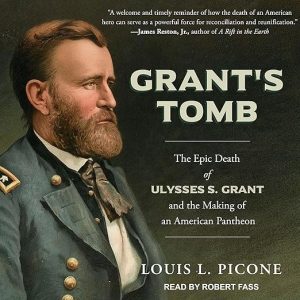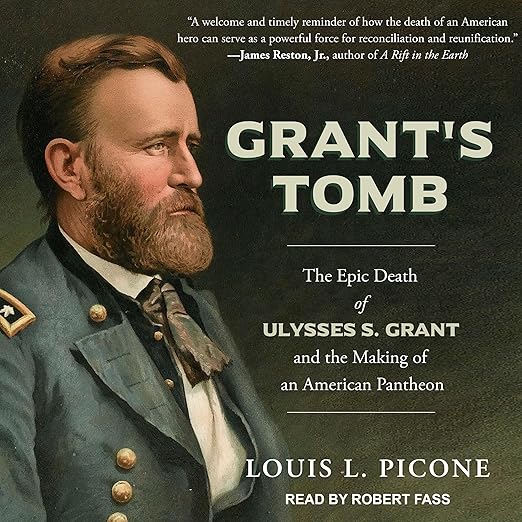
Why is Ulysses S. Grant's final resting place larger than any other American's, president or otherwise? Louis L. Picone spends this audiobook answering that question through the specific twelve-year saga of financing, designing, and building the monument itself, rather than through a standard cradle-to-grave presidential biography.
Racing Death to Finish the Memoirs First
Picone opens with Grant's actual final battle: writing his memoirs while dying of throat cancer, racing to finish before the disease killed him so his family would not be left destitute. He succeeded days before his death, Mark Twain published the result, and the memoirs became an immediate bestseller, a detail that reframes everything that follows. The tomb project only exists because a nation was already primed by that deathbed heroism to treat Grant's passing as a genuine collective loss, not a routine presidential funeral. That single detail, a dying man racing a fatal illness to protect his family financially, does more to explain the tomb's eventual scale than any later chapter on architecture alone could.
Cities Compete for the Right to Bury Him
From there, the book tracks the practical, occasionally unglamorous mechanics of turning national grief into a permanent monument: the competition among cities and sites for the honor of holding Grant's remains, the design process that produced a neoclassical structure larger than any other tomb in the country, and the twelve years it actually took to finance and complete construction. Picone treats bureaucratic and financial detail as part of the story rather than an obstacle to it, which is the right instinct for a book ultimately about how a monument gets built, not just why one was proposed.
That competition for Grant's remains says something revealing about Gilded Age America's relationship to public memory: cities understood a presidential tomb as genuine civic capital, a permanent draw for visitors and prestige, not just a solemn duty. Picone treats that unglamorous, almost commercial dimension of monument-building as worth taking seriously rather than an embarrassing footnote to an otherwise dignified story, which gives the book real texture beyond straightforward hagiography. Readers who enjoy that specific intersection of civic ambition and public grief, cities competing openly over the right to bury a national hero, will find this thread as compelling as anything in the book's more solemn passages.
No Vocal Fireworks, Even for Grant's Death
Robert Fass narrates with the kind of measured professionalism that serious presidential history calls for: no vocal fireworks, no overplaying the emotional beats, just clear, well-paced delivery that lets Picone's research carry its own weight. That restraint suits material that shifts constantly between registers, the raw emotion of Grant's final months, the dry mechanics of monument financing, the political maneuvering behind site selection, without needing narration to manufacture drama the story does not require.
Fortunes Rise and Fall With a Century
The book's most interesting throughline is the one implied by the synopsis but developed at length inside: the tomb's condition and popularity over the decades has tracked the fortunes of New York City and the Union itself, rising and falling with the country's own relationship to Grant's legacy. Reviewer Ulmsey called it 'a great lesson about history itself' for exactly this reason, since the monument's afterlife says as much about shifting American memory as the original construction does.
Because the book moves across more than a century, from Grant's 1885 death through the tomb's fluctuating reputation deep into the twentieth century, Fass has to signal chronological jumps clearly enough that listeners never lose track of which decade's political and cultural context is under discussion. He handles those transitions with simple, unforced pacing changes rather than any gimmicky vocal cue, trusting Picone's own prose to mark the shifts. That steadiness across such a long historical span is a real narration skill, easy to undervalue until a lesser performance loses the thread somewhere in the middle decades.
A Narrow Focus That Rewards a Second Listen
This is history built around a single structure, and that focus is both the book's discipline and its limit. Listeners expecting a full Grant biography, the Civil War campaigns, the presidency, the scandals, will find those covered only as necessary context; the tomb itself, its architecture, its funding, its cultural reception, stays the fixed center of attention for all nine hours. That narrow focus also means the book rewards a second listen better than most single-subject histories, since details about financing and design that feel incidental on a first pass gain new weight once a listener already knows how the larger story of the tomb's declining and reviving popularity eventually plays out.
Reviewer John B. Sinclair situates the book against a genuinely crowded recent field of major Grant biographies, noting how much rehabilitation work full-length biographers have already done for Grant's reputation over the last twenty years. Picone's book is not competing directly with those; it is a narrower, more specific study that leans on a listener already having some grounding in Grant's basic biography and spends its own runtime on the one part of the story those bigger books typically treat as an epilogue.
Listeners drawn in specifically by the Architecture tag should know the book discusses the tomb's neoclassical design in real but not exhaustively technical detail; this is cultural and political history with architecture as one recurring thread, not a specialist's study of columns, proportion, and period design theory. Readers wanting that deeper architectural-history register may find themselves wanting a bit more than Picone's more general-audience approach delivers. Anyone hoping specifically for blueprints-and-materials level detail should adjust expectations before starting, though the design competition itself is covered with real narrative interest.
Riverside Park Regulars Will Learn Something New
Civil War history buffs, presidential history completists, and anyone with a soft spot for the strange sub-genre of books about monuments and memorials will find nine hours well spent here. New Yorkers in particular, or anyone who has walked past the actual tomb in Riverside Park without knowing its backstory, will get a genuinely new appreciation for a landmark most people register only in passing.
Fans of history podcasts and documentary series built around a single object or place, a format that has become genuinely popular in recent years, will recognize the same appeal here: a manageable, well-bounded subject explored with real depth rather than a sprawling survey trying to cover too much ground at once. Nine hours is a comfortable commitment for that audience, long enough for real depth without demanding the weeks a full presidential biography would. That comfortable scope is part of the book's appeal, not a limitation.
Skip It for a Full Military Biography
First-time readers of Grant's life looking for a comprehensive military and political biography need a different book entirely, since the presidency and the war years appear here only in service of explaining the memorial that followed them.