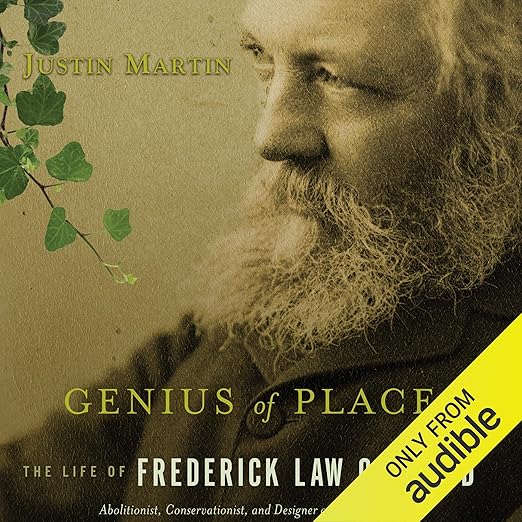
Central Park exists because one man argued, against nearly everyone else's judgment, that a Manhattan grid packed with people needed a deliberately wild-looking green interruption, and this audiobook tells the story of how Frederick Law Olmsted spent a career making that same argument over and over in different cities. Justin Martin's biography follows Olmsted from Central Park through Boston's Emerald Necklace and Stanford University's campus, but Genius of Place insists, correctly, that landscape architecture was only one part of a bigger life; Olmsted was also a working journalist, an early environmental voice, and an abolitionist the book credits with helping dissuade England from joining the South during the Civil War. Richard Ferrone narrates all eighteen hours and forty-seven minutes, carrying listeners through both the professional triumphs and what the book calls a shadowed, tragic personal life underneath them.
More Relevant Now Than in His Lifetime
Martin's real argument is that Olmsted deserves broader recognition than the label landscape architect alone suggests. He was, in the book's own framing, a social reformer first, someone who didn't simply create places that were beautiful in the abstract but designed with an awesome and timeless intent, which the book argues is exactly why his work has survived to the present day rather than aging into irrelevance.
The book pushes that argument into the present tense directly, framing Olmsted's urban green space work as more relevant now than during his own lifetime, given today's urgent need to revitalize cities and a widespread modern yearning for accessible green space. Martin makes that case explicitly rather than leaving it implied, positioning Olmsted as a genuinely contemporary figure rather than a purely historical one.
One Coherent Worldview, Four Different Careers
Boston's Emerald Necklace gets real attention alongside the more famous Central Park, and it deserves it, an entire connected chain of parks and parkways designed to function as one continuous system rather than isolated green patches scattered across a city. Placing that project next to Stanford's campus design in the same chapter shows how far Olmsted's actual design language traveled beyond the one park most people already know him for.
The word genius in the title is doing real work rather than sitting there as flattery, since the book's whole argument is that Olmsted possessed something close to a unified theory connecting landscape design, journalism, environmental thinking, and abolitionist politics, one coherent worldview expressed across several different careers rather than four unrelated talents that happened to live inside one person by coincidence.
Ferrone Sustains Tone Across Eighteen-Plus Hours
Richard Ferrone's narration is a proven match for exactly this kind of material. He's one of the more distinguished nonfiction narrators working in American history and biography, bringing measured elegance to long-form biography and sustaining tone across eighteen-plus-hour listens without fatigue sneaking into the delivery, especially suited to subjects combining landscape beauty with real political and social drama, precisely what Olmsted's life offers in abundance.
The book's own description calls its research abundant and new, and the sheer range of Olmsted's activity, park design, journalism, environmental advocacy, abolitionism, gives Ferrone genuine tonal variety to work with across nearly nineteen hours rather than a single flat register stretched thin over a long runtime.
The abolitionist thread specifically deserves attention on its own terms, separate from the parks work most listeners come in expecting. Olmsted's journalism and advocacy writing, credited in the book with helping keep England out of the Civil War on the Confederacy's side, reframes him as someone shaping national politics directly through the written word, long before a single tree got planted in Central Park.
Justin Martin frames his own research as abundant and new, which matters for a subject as thoroughly claimed by popular history as Frederick Law Olmsted already is; Central Park alone has generated decades of books and documentaries, and a biography earning fresh attention this long after its subject's death needs a genuine reason beyond simply retelling the familiar Central Park origin story one more time.
No Reviews Back Up the 4.7 Rating
No listener reviews accompany this particular title in what's available here, so the 4.7-star average across 259 ratings functions as the main outside signal beyond the book's own synopsis and Ferrone's track record on comparable American biographies.
This is a dense, nearly nineteen-hour single-subject biography spanning parks, journalism, and politics all at once, so listeners wanting a tight, single-thread narrative should know upfront that Martin's approach is deliberately expansive, tracking Olmsted across several parallel careers rather than just one.
The book is also candid, per its own framing, about a personal life it calls shadowed and tragic underneath the public achievement, without spelling out specifics in the synopsis itself. Listeners who prefer their historical biographies to stay focused strictly on professional accomplishment, without the darker personal material woven directly through it, should know Martin's approach keeps both threads running together rather than separating triumph from struggle into different sections.
The Title Borrows an Eighteenth-Century Phrase
Richard Ferrone's extensive American history and biography catalog means he's narrated multiple subjects whose achievements reshaped how ordinary Americans experience public space and civic life, and that accumulated familiarity with the genre shows in how confidently he moves through Olmsted's specific working vocabulary, sight lines, pastoral effect, the deliberate illusion of untouched wilderness sitting inside a carefully planned and engineered park.
The book's own title borrows a much older phrase, consult the genius of the place, drawn from eighteenth-century garden-design writing, and Martin's choice to reclaim it for a title says something about his argument: Olmsted wasn't inventing landscape philosophy from nothing so much as finally giving an old European design principle its fullest, most consequential American expression, at civic scale rather than on a single aristocratic estate.
Not Just a Book About Park Layouts
Recommended for landscape architecture and urban planning readers, Central Park and American parks history fans, biography listeners drawn to a subject with a shadowed personal story underneath very public achievement, and Civil War-era history readers interested in abolitionist figures outside conventional politics.
City planners, parks department staff, and anyone currently arguing for green space investment in their own community will also find real ammunition here, since Martin's central case for why cities need deliberately designed public space now, not just as historical preservation, is essentially a ready-made argument for exactly that kind of present-day civic advocacy.
Listeners who enjoy American biography generally, even without a specific prior interest in parks or landscape design, should still find plenty to hold their attention, since Olmsted's own life story, self-taught, restless, moving between careers most people would consider entirely unrelated, carries real narrative momentum on its own terms independent of the subject-matter appeal.
This isn't the pick if you want a narrowly focused design-and-aesthetics book about park layouts specifically, since Martin's real interest, and Ferrone's real narration challenge, is the full sweep of one unusually multi-career American life.