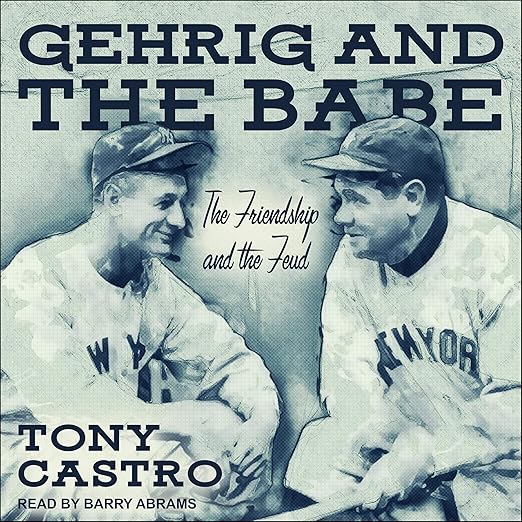
Key Details
- Voice: Barry Abrams reads with measured authority, comfortable with both stadium statistics and the more personal dimensions of two men's friendship.
- Big ideas: The Ruth-Gehrig friendship and feud, Yankees dynasty baseball, loyalty and rivalry in the golden age of American sport
- Atmosphere: Considered and historically detailed, more elegiac than sensational
- Worth it?: Tony Castro's decade of research produces a genuinely relational account of Ruth and Gehrig, strongest for listeners who already know the individual biographies and want the friendship filled in.
The friendship between Lou Gehrig and Babe Ruth is one of the great unfinished stories in American sports history, and Tony Castro's Gehrig and The Babe is the rare account that treats it as its own subject rather than a sidebar in individual biographies. I came to this audiobook knowing the standard outlines: the Iron Horse, the Sultan of Swat, the Yankees dynasty years, and the eventual bitter rupture that was never repaired before Gehrig's ALS diagnosis. What Castro does is fill in the decade of genuine friendship and professional partnership that made the feud's bitterness coherent, which is the part that usually gets lost between competing hagiographies.
Barry Abrams narrates across a runtime of seven hours and 52 minutes, covering Tony Castro's decade of research: hundreds of interviews with surviving teammates, associates, and friends of both men, extensive archival newspaper research, and the geographical spread of their lives in New York, Baltimore, Boston, and Los Angeles. The Wall Street Journal's comparison of the Gehrig-Ruth dynamic to Butch Cassidy and the Sundance Kid, which Castro quotes, captures something real about the complementary nature of the two men's personalities before the relationship collapsed.
Where This One Lands
The book's strongest contribution is the attempt to reconstruct the friendship itself rather than simply cataloguing the feud. One reviewer, a "lifelong baseball fan," noted that aside from the "mama's boy" narrative around Gehrig, there "wasn't a great deal of new info re the famous feud," which is a fair assessment if you come in hoping for revelations about the specific breaking point. What Castro is actually doing is something different and, I think, more valuable: restoring the full relationship to view so that the feud's eventual bitterness makes emotional sense rather than appearing as a historical footnote.
ESPN's Jeremy Schaap, who called this "a fascinating story told in full really for the first time, seventy-plus years after their death," has the calibration right in terms of scope. This is not a revisionist account of either man; it is a relational account that takes seriously the years when these two men were, by all surviving testimony, genuinely close.
Why Listen to Gehrig and The Babe
Barry Abrams narrates with the kind of measured authority that suits baseball history: unhurried but not ponderous, clear on names and statistics without letting the numbers dominate the emotional texture of the story. The rhythm Abrams establishes works well for a narrative that moves between the stadium and the personal lives of the two men, requiring shifts between the public spectacle of Yankee dynasty baseball and the more private dimensions of friendship and family.
For listeners who are already invested in the Ruth and Gehrig stories from individual biographies, the audiobook offers genuine additional dimension. Castro draws on sources that had not previously been brought together in a single account, and the archival newspaper research from the era gives the narrative period texture that secondary sources alone cannot supply.
What Gives Us Pause
The expectation gap worth flagging is the one between the title and the book's actual emphasis. Gehrig and The Babe suggests a book structured around conflict and its causes. Castro is more interested in the friendship's architecture than in the forensics of the rupture, which means listeners expecting a detailed investigation of what specifically broke the two men apart may feel the book delivers less than its premise promises on that front. The feud is present, but it is the destination rather than the subject.
At just under eight hours, the runtime is appropriate for the depth Castro brings to the research, though a few sections in the middle of the book, particularly in the earlier career years before the friendship fully formed, can feel slightly more encyclopedic than narratively propelled. These sections matter for context, but listeners accustomed to a faster pace in sports narrative nonfiction may find them slower than the book's better stretches.
The archival depth Castro brings to the project is audible in the specificity of certain scenes, particularly those drawn from newspaper accounts of games, social occasions, and off-field episodes that the surviving first-person sources either did not remember or remembered differently. Castro's skill is in triangulating between competing accounts without imposing a single definitive narrative where the record is genuinely ambiguous. Barry Abrams's narration gives that scholarly care an appropriate register, neither sensationalizing the conflict nor flattening it.
Castro's decade of research, interviewing hundreds of surviving teammates, associates, and friends of both Ruth and Gehrig, is what gives the book its comparative advantage over shorter accounts. The Wall Street Journal comparison to Butch Cassidy and the Sundance Kid, which Castro includes in his promotional framing, is apt in the sense that both pairings involve complementary personalities whose combined force exceeded what either could have achieved separately, and whose rupture carried a particular sadness precisely because of what the partnership had been.
Who Should Listen to Gehrig and The Babe
Listeners who already love Ruth and Gehrig as historical figures and have read the standard individual biographies will find Castro's relational account offers genuine new perspective, particularly on the friendship years. Old Yankees fans, as one reviewer described themselves, for whom these two names carry real weight, will find the audiobook both substantive and satisfying. General baseball history readers with an interest in the 1920s and 30s Yankees dynasty will get appropriate context for both men's careers alongside the relationship narrative. Listeners looking primarily for a clear account of what caused the feud's specific breaking point should know the book provides context rather than forensic answers.
Good to Know
Does the audiobook reveal what specifically caused the feud between Ruth and Gehrig?
Castro provides context and the emotional architecture of the friendship that preceded the rupture, but the book is more interested in reconstructing the relationship as a whole than in forensically identifying a single cause. Listeners expecting a reveal may find the answer more contextual than definitive.
Is this audiobook suitable for baseball fans who are not specifically Yankees historians?
Yes. Castro provides enough context about the 1920s and 30s Yankees and the era of American baseball that general fans without specialized knowledge of the dynasty years will follow the narrative without difficulty.
How does this audiobook compare to individual biographies of Ruth and Gehrig?
The individual biographies tend to treat the friendship as a subplot within a single man's story. Castro's book is specifically structured around the relationship between the two men, which means it fills in territory that the individual accounts typically compress or omit.
Does Barry Abrams' narration handle the statistical and period-detail sections as well as the narrative sections?
Abrams manages the transition between archival baseball statistics and personal narrative effectively. The pacing slows appropriately for denser research sections without losing momentum across the full eight-hour runtime.