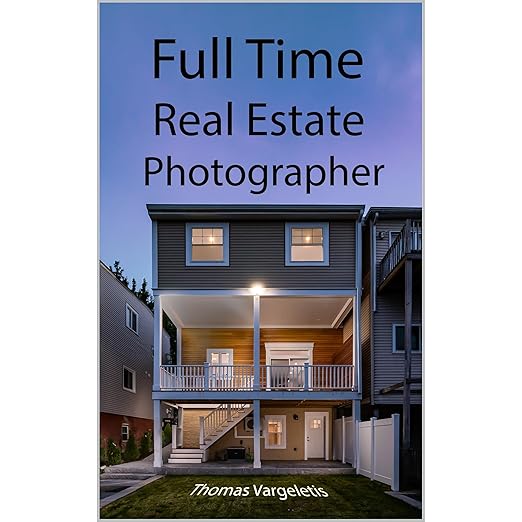
- Voice: No reader is credited at all, with Virtual Voice standing in the place where a name would be.
- Big ideas: Starting a service business, gear on a budget, client acquisition, professional presentation
- Atmosphere: Blunt, practical, unglamorous
- Worth it?: A genuinely useful business primer for photographers who can shoot but cannot yet sell, best paired with a text edition.
A photography manual with no photographs is a strange object, and this one is stranger still as an audiobook. The most detailed review on the page reports flatly that the book contains no pictures, is not heavy on theory, and will not teach you composition or editing. What it teaches, according to the same notice, is a business. Thomas Vargeletis wrote it, the recording runs four hours and forty-six minutes, it was independently published in March 2024, and Virtual Voice occupies the slot a human credit normally fills.
Not all five written notices here are what they appear. One of them, eight words long, reads "I wrote it, so my opinion is biased" and is signed with the author's own first name and initial. Another is a testimonial from someone who describes six years of hiring Vargeletis as a real estate photographer and closes by telling you to buy his book, without discussing the book itself. That leaves three independent responses from people writing about what they read.
No Fat, Just Meat, According to One Reviewer
Those three are consistent, and they describe a narrower and more useful book than the description promises. The publisher's copy claims coverage of "what equipment to use, how to shoot, light, edit, and so much more", which sounds like a craft manual. The reviewer who spent the most words on it says otherwise, and lists what is actually inside: "No fat, just meat: where to buy cheap, quality used gear, how to talk to office admins, goal setting and planning, even tips for building a professional wardrobe." That is a trade book about starting a service business that happens to involve cameras.
What makes it worth buying is the honesty about what it is not. Books in this category routinely promise craft and business and deliver neither, and this one has a reader publicly stating that it "won't teach you to take and edit photos" and offering advice that "isn't for the best case scenario" but reads as "a realistic guide for someone looking to bootstrap, build and grow a photography business". A second notice agrees in fewer words, saying you can follow the book and set up your business. A third, coming from outside the trade, credits it with "an in-depth look into the industry's nuances" without feeling overwhelmed.
A Rare How-To With Nothing Lost in Audio
Few instructional books survive the move to audio as cleanly as this one should. The usual objection to a how-to in audio is that the diagrams, screenshots and worked examples are gone. Here the print edition apparently has no images to lose, so the recording is not a degraded version of anything. That is a rare and genuine advantage, and it applies to the whole of the material: pricing conversations, gear sourcing, how to approach an agency office, what to wear. None of it needs a picture, and none of it is lost. For once, the audio edition of a technical book is the complete article rather than an abridgement by circumstance.
Set against that is the Virtual Voice credit, and its cost here is specific. This is list-shaped content. The reviewer's own summary arrives as a run of items, and a listener needs a beat between each one to file it. A synthetic reading does not signal where a list starts, where an item ends or which of two clauses carries the emphasis, so a run of practical steps can arrive as one flat sentence. Sample a passage where advice is being enumerated rather than explained, since that is where the format either holds up or blurs.
The specificity is the last reason to consider it. Advice about buying used equipment cheaply, about talking to office administrators rather than agents, and about the clothes you turn up in is the kind of thing people usually learn by getting it wrong for two years. A book that hands it over in under five hours is buying back a real quantity of somebody's time, and the notices that praise it most warmly are praising exactly that practicality rather than any writing. One of them says everything you need to know is in there, which is the highest compliment a trade manual can receive and the least literary.
Every Notice Predates the March 2024 Recording
Every written response on this page predates the recording. The five notices run from February 2019 to November 2023, and the audio edition arrived in March 2024, so none of them is describing this production. That also means an average of 4.6 from 18 ratings belongs to a text already five years in circulation before the recording arrived, rather than to a reading, and a page carrying an author's own five-star notice alongside a client testimonial is a page where the aggregate should be treated cautiously in any case.
Retention is the second issue. Practical business advice delivered as spoken lists is hard to hold, and this book has no companion document mentioned anywhere on the listing, so a listener has nowhere to look up the gear recommendations later. One reviewer says you can read the whole thing in an afternoon, which is worth setting against a recording of nearly five hours. If you intend to act on this rather than absorb the general shape of it, buy the text as well, or plan to stop and take notes.
Photographers Who Can Shoot but Can't Yet Sell
Photographers who can already shoot and cannot yet sell are the exact audience. So are hobbyists weighing whether real estate work is a realistic income, since the book is unusually blunt about what the work involves and what it does not. Working professionals in other specialties considering adding property to their offer will find the market-entry material directly transferable. And estate agents curious about what they are paying for will get a clear view of the other side of the transaction, including why the photographer arrives dressed the way they do.
Anyone hoping to learn photography should start elsewhere; the most thorough reviewer on this page says so before I do. Listeners who want a polished narrated performance should sample first, given the synthetic reading. And anyone allergic to a page where the author has posted a five-star review, however cheerfully labeled as biased, should know it is there before buying. Read as what it is, a short and unglamorous business primer from someone a six-year client hired to do exactly this work, it earns its running time twice over.
Does this audiobook teach photography technique?
No, and its most detailed reviewer says so directly: the book will not teach you to take or edit photos, and it is not heavy on theory. What it covers is the business of real estate photography, from sourcing cheap used gear to approaching agency offices and setting goals.
Does the audiobook lose anything compared with the print edition?
Less than you would expect. A reviewer reports that the book contains no images at all, so the usual objection to instructional audio does not apply here. The real cost is retention, since the practical advice arrives as lists that are harder to hold by ear.
Why is one of the reviews written by the author?
He labels it himself, in eight words, saying he wrote the book so his opinion is biased. A second notice comes from a long-standing client of his photography services rather than a reader. That leaves three genuinely independent responses on the page.
How current is the advice?
The written responses run from 2019 to 2023, all of them before the March 2024 audio release, and they praise the same practical core: used equipment, office relationships, planning and presentation. That material ages slowly. Anything platform-specific or price-specific should be checked against today.