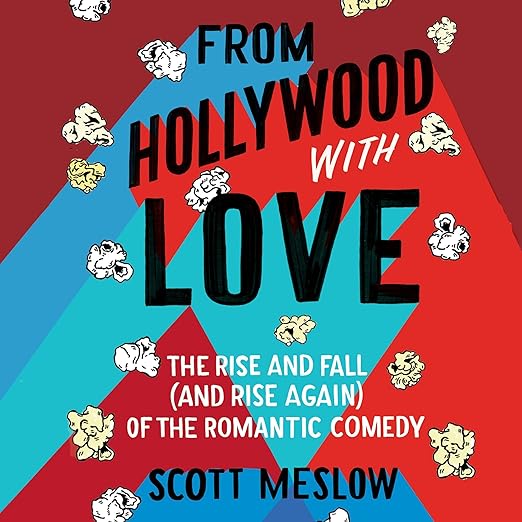
Nora Ephron's script for When Harry Met Sally sits at the exact center of the story this audiobook wants to tell, the moment a scrappy, often dismissed genre found its most confident voice. Scott Meslow's history of the romantic comedy opens from the premise that no Hollywood genre has been more consistently underrated by critics and awards bodies while simultaneously being more reliably beloved by audiences, and the book spends its runtime making that contradiction the whole point rather than a throwaway complaint. Jeremy Arthur narrates roughly ten and a half hours of cultural history that moves from the genre's late eighties and nineties golden age through its rough 2000s decline and into its unexpected streaming era revival.
Julia Roberts and Matthew McConaughey's Launching Pad
What distinguishes this from a simple nostalgia trip through favorite movies is the reporting underneath it. Meslow, a GQ contributor and culture writer, conducted what the synopsis describes as exclusive interviews with directors, writers, and stars behind some of the genre's most beloved films, and the resulting oral history format gives the book real texture beyond plot summary and critical opinion. The book traces how rom-coms launched major careers, citing Julia Roberts and Matthew McConaughey specifically, and how the genre offered some of the only consistent creative opportunities available to women in studio filmmaking during periods when other genres offered far fewer.
One listener review calls the book both entertaining and educational, specifically praising the inside scoop and insightful details about writers, directors, and actors and how the genre developed across decades. That combination, breezy enough to enjoy casually but substantive enough to teach you something, is the balance the book is clearly aiming for, and based on the available reviews it largely lands it.
Ephron herself went on to write and direct several more genre landmarks, Sleepless in Seattle and You've Got Mail among them, before her death in 2012, and Meslow's decision to keep circling back to her specific body of work gives the book a throughline beyond a simple decade-by-decade survey. Rather than treating every film as an equally weighted data point, the book lets a handful of pivotal figures like Ephron carry outsized narrative weight, the same way a well-constructed oral history should.
Clueless as Emma, Reset in Beverly Hills
Two of the genre's most enduring tricks get specific, well-chosen examples across the book: the Austen and Shakespeare rewrites Meslow traces include titles like Clueless, which transplants Jane Austen's Emma into a 1990s Beverly Hills high school, and 10 Things I Hate About You, which does something similar with The Taming of the Shrew. Watching Meslow connect those specific adaptations back to centuries-old source material is one of the more satisfying threads running through the book, a reminder that the genre's tropes are often much older and more literary than its critics tend to give it credit for.
Landing that level of cooperation from the industry itself is not a small feat for a genre history like this, and it shows in how specific the anecdotes get compared to a book built purely from archival research and old press clippings. That access is really the throughline connecting the book's two halves, functioning as both a serious critical reassessment and a fond, well-sourced oral history at the same time.
Crazy Rich Asians as Reinvention, Not Nostalgia
The book's structural arc, tracking decline and revival rather than simple chronology, gives Arthur's narration something to build toward. The 2000s slump gets treated seriously as an actual industry phenomenon rather than a footnote, and the recovery, anchored by films like Crazy Rich Asians and its explicit push for more diverse leads and stories, gets framed as a genuine creative reinvention rather than just box office nostalgia cashing in. Meslow also digs into the persistence of the love triangle as one of the genre's most durable storytelling devices, tracing how differently it functions across decades of otherwise very different films.
Abandoning the Happy Ending as Maturity
The synopsis specifically flags the genre's occasional willingness to abandon a guaranteed happy ending as one of its more mature late-era developments, a shift Meslow treats as evidence the form was maturing rather than simply repeating itself. That willingness to occasionally subvert its own most reliable convention is presented as a sign of genuine creative confidence, not exhaustion, and it lands as one of the book's more persuasive small arguments precisely because it stays granular rather than reaching for a sweeping claim.
A reviewer named Kris Ueda frames the book plainly as a strong pick for movie lovers generally, not just genre die-hards, calling it very informative and packed with good insider info. Another listener, Kristy, calls the read easy and entertaining while noting that Meslow is obviously knowledgeable about films, which matters for a book built substantially on interview material. A narrator working through hours of specific film titles, studio history, and named industry figures needs to move with real fluency rather than treating each reference as a speed bump, and Arthur's pacing here seems built for exactly that kind of dense, reference-heavy cultural history.
Arthur Smooths the Transitions Between Voices
Because the book is structured as an oral history built from interviews rather than a single authorial argument, the tone shifts periodically as different voices, filtered through Meslow's own prose, take over a chapter. Listeners used to a single, consistent narrative throughline in nonfiction audio might notice these shifts more than print readers would, though Arthur's steady delivery does real work smoothing the transitions between reported material and Meslow's own critical analysis.
This is also a book aimed squarely at people who already have some affection for the genre, or at minimum curiosity about it. Meslow is not trying to convert skeptics who consider rom-coms fundamentally lightweight; he is building a case for critical respect aimed at an audience broadly sympathetic to the premise already. Anyone hoping for a takedown of the genre's weaker entries, or a more skeptical outside perspective, will find the book's sympathies clearly and consistently on the side of the form itself.
Only 141 Ratings Behind That 4.2
Film buffs with a soft spot for the genre are the most obvious audience, but the book's reach is wider than that description suggests. Anyone interested in how Hollywood careers actually get built, in the industry mechanics behind what gets greenlit and why, or in the specific creative opportunities the studio system did and did not offer women across four decades will find substantial material here well beyond simple movie trivia.
One caveat worth naming directly: with only 141 ratings behind the 4.2 average, this is a title that has not yet built the kind of broad review base that makes a purchase decision feel fully settled. The three available reviews are consistent and specific enough to inspire real confidence, but anyone wanting a wider sample of listener reaction before committing eleven hours should treat that thinner data as a genuine, if minor, consideration rather than a dealbreaker.
Before You Listen
Does the audiobook cover recent romantic comedies or mostly the classic era?
Both. It traces the genre from its late 1980s and 1990s golden age through its 2000s decline and into its streaming-era resurgence, including films like Crazy Rich Asians.
Is this audiobook mostly movie trivia or real critical analysis?
It leans toward genuine critical and cultural analysis, examining why the genre has been historically undervalued alongside specific storytelling tropes and industry history.
Do I need to have seen every movie mentioned to enjoy this audiobook?
No, though familiarity with major genre touchstones like When Harry Met Sally will deepen the listening experience considerably.