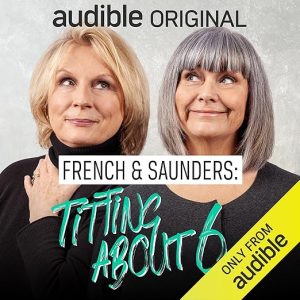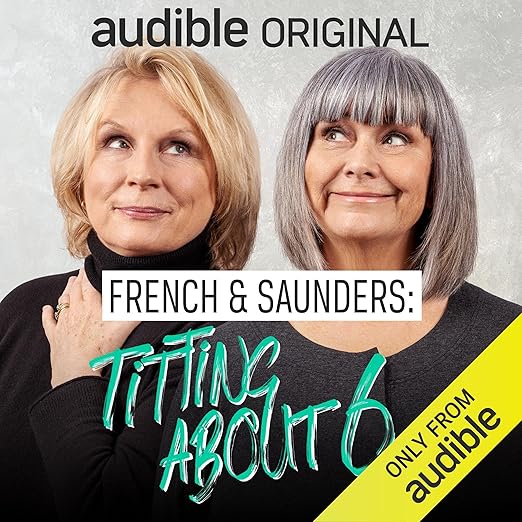
Dawn French and Jennifer Saunders have been making each other laugh in public for long enough that their chemistry is no longer something they need to perform. Series 6 of their audio production is available as this audiobook running three hours and nine minutes across six episodes, and the pleasure of it is exactly that quality: two people who find each other genuinely funny, talking about subjects they have scant expertise in, and being more illuminating about those subjects than most experts would be precisely because of that scant expertise. Dawn French narrates the production herself, which is fitting, because she is the one who sounds most clearly like she is enjoying herself at all times.
The format is consistent across episodes: French and Saunders gather in the studio, choose a topic, and then, in their own description, tit about with it. Technology. Stress. Time travel. Manners. A gap year. A general catch-up in the opener. Each episode runs roughly thirty minutes and operates less as a structured podcast and more as a recorded conversation between two people whose instinct for comic digression is so well-developed that the digressions are usually more interesting than the ostensible topic.
The AI Sketch Episode's Real Authorship Question
The technology episode, in which they discuss subjects they have scant knowledge of, including smart toilets, Dawn creating a robot Jen, and a French and Saunders sketch generated by AI, is one of the series' sharper installments. The humor comes from French and Saunders treating technological bewilderment not as embarrassment but as material, which is a distinctly experienced-generation comic approach that feels genuinely affectionate rather than curmudgeonly. The AI-generated sketch conceit is particularly clever because it raises real questions about authorship and comedy while being funny about doing so, which is harder than it looks.
The opening episode, which involves catching up since the last series and updating listeners on the ongoing bet about whether Saunders has written an Ab Fab related script, sets the tone for the whole series. This is a production built on continuity. Series 6 is not designed as a discovery point for new listeners. It assumes familiarity with the dynamic, the in-jokes, and the recurring motifs, including the snacks available in the studio, which are mentioned with a consistency that suggests they are a genuine priority for both parties rather than a running bit.
The Olive Stone Dilemma, Handled With Total Solemnity
The stress episode is the one that earns its topic most fully. French and Saunders approach stress through personal anecdote rather than advice, which is the right call for a comedy production, and the specificity of their examples is funnier than any general claim about stress reduction would be. Adopting chickens as a stress management strategy and plucking each other's facial hairs are presented with enough personal detail that the humor accumulates through the specificity rather than through any single punchline. The episode also has a structural cleverness to it: the conversation about stress is delivered in a way that is itself slightly chaotic, which is either a coincidence or a deliberate joke and strongly feels like the latter.
The manners episode contains what may be the funniest sustained sequence in this series, a consideration of when hugging has gotten out of control and the question of which hand you should spit an olive stone into, which is presented with the solemnity of a genuine etiquette dilemma. French and Saunders treat these questions with enough mock-seriousness that the jokes accumulate over the course of the conversation rather than landing as individual punchlines, which is the comic rhythm they have always been best at.
Why the Time Travel Episode Runs Too Long
The time travel episode is the weakest of the six, not because the concept is wrong but because the French and Saunders Time Travel Agency conceit runs slightly longer than the material fully supports. The jokes are there, but the episode does not reach the comic density of the best installments, and the structural premise of the travel agency feels more labored than the looser conversational format that works so well elsewhere in the series. This is a small complaint about a production that is otherwise consistently entertaining.
New listeners to the French and Saunders audio universe should also be aware that this is an audio studio production rather than a traditional audiobook in the narrative or informational sense. It is a comedy production featuring two established performers working in a format they have clearly made entirely their own. The comparisons to their television work are relevant but not perfect: this is more relaxed, more conversational, and significantly more willing to go nowhere in particular if nowhere in particular is where the conversation wants to go. That quality is a feature rather than a bug for their existing audience.
The 5.0 Score Reflects Loyal Existing Listeners
This production is made for existing fans of Dawn French and Jennifer Saunders. The pleasure of it depends on already caring about the two of them as performers and personalities, which means the investment accumulates across the series rather than being available in full from the first episode. The 5.0 rating across 95 reviews reflects the enthusiasm of that existing audience responding to more of what they already love. Listeners who come to British comedy through the more structured end of the form may find the freewheeling format unsatisfying. For longtime admirers of their work, Series 6 is exactly what it promises, and that is a genuine recommendation.
At a Glance
- Narrator: Dawn French narrates with exactly the timing and warmth you would expect from someone who has been making people laugh professionally for four decades.
- Subjects: Female friendship and creative longevity, the absurdity of modern life, celebrity and self-deprecation
- Tone: Warm and sharply funny, with the intimacy of a conversation between two people who genuinely enjoy each other
- Bottom line: A delightful production for existing fans of Dawn French and Jennifer Saunders, strongest when the two are riffing rather than monologuing.
A Few Questions About French & Saunders Titting About (Series 6)
How does Dawn French's narration in this audiobook compare to the chemistry of watching them perform on screen?
The audio format captures their conversational dynamic rather than their performance dynamic. French narrates with warmth and timing, but the comedy depends on the dialogue exchanges between both of them. Existing fans tend to find the transition to audio natural, while newcomers expecting sketch-comedy energy may find the conversational format more understated.
Which episodes of this French and Saunders audiobook series are the strongest if I only have time for a few?
The technology and stress episodes are the most consistently funny and structurally tight. The manners episode also has some of the sharpest comic sequences. The time travel episode is the weakest of the six, though still enjoyable for established fans of the format and the dynamic between the two performers.