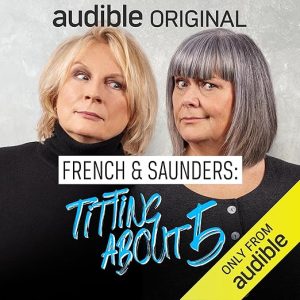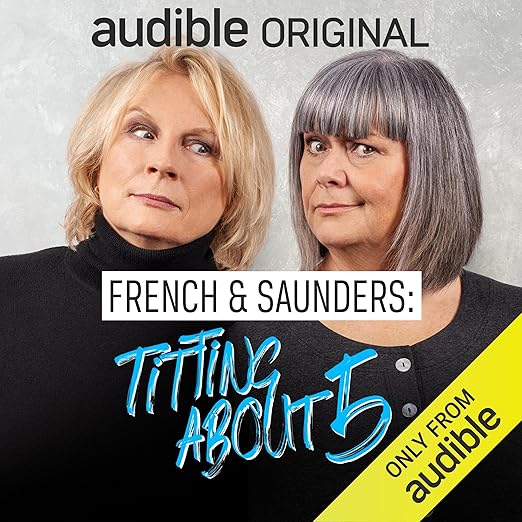
Six episodes, two comedians and a list of topics they treat as a pure formality. This audiobook is not a book read aloud in any recognizable sense: it is a recording of Dawn French and Jennifer Saunders sitting down to address six subjects and then, exactly as the title promises, titting about instead. Three hours and one minute, produced by Listen Entertainment, and carrying an adult language and content warning right at the head of the description.
Six Topics That Exist Only to Be Abandoned
The format is the joke and the description knows it. The pair are said to unearth "six vitally important subjects" and then decline to treat a single one of them seriously, which is a fair account of what actually happens across the running time. Each episode has a nominal heading and each heading functions as a diving board rather than a syllabus. Anyone who has spent time with conversational comedy will recognize the shape immediately: the topic exists to be abandoned, and the abandoning is the entertainment.
This is series five, and it behaves like a fifth series. The opening episode includes an update on a bet the two of them made during series four, which is a small continuity thread but a real one, and the whole thing carries the relaxed assumption that you already know these two and their rhythms. That assumption is mostly harmless. You can start here without being lost, though a first-time listener will spend the first stretch working out how much of the friction is genuine and how much is performance.
A 4.9 Average With Not One Written Review
The numbers are unusual and worth noting. A 4.9 average across 133 ratings is a very high score for anything, and not a single listener has written a review to accompany it. My reading is that a fifth series sells almost entirely to people who bought the first four, and a score built that way measures loyalty far more than it measures this particular run. Nobody has written anything that would test that either way.
Jennifer Saunders Is Alarmingly Convincing as a Surgeon
The episode breakdown does the recommending better than any summary I could write. The opener covers what the two of them have been doing since the last series, taking in a run in Peter Pan, a new knee, and Jennifer's account of being eaten alive on stage, while Dawn reports on touring and a considerable amount of television. The second episode has them role-playing proper jobs, with a farmer, a surgeon and a politician of whom the description dryly notes that "Jen is alarmingly convincing".
The middle of the run is the strongest stretch on paper. The survival episode is introduced with a warning that it is emphatically not a practical guide, which is the correct disclaimer, and then works through their approach to a desert island. The art episode takes in bumping into Gilbert and George in Paris and a negotiation over a naked self-portrait, and the description itself mocks the number of times Dawn mentions visiting New York in her early twenties. A show that flags its own running gag is a show in control of itself.
The last two episodes are where the anecdote density peaks. One is a confessional about bad habits, covering cheating at board games, telling fibs, urinating in the garden and being talked into buying strongly scented pheromones online. The finale collects stories from two careers that have brushed against the Spice Girls, the Royal Opera House, Dolly Parton, David Beckham and King Charles, usually, as the copy puts it, "whilst involuntarily enacting fairly major breaches of social etiquette".
Timing and Interruption Native to the Recording
One structural point sits firmly in its favor: this was made as a recording rather than adapted from a page, which is a meaningful distinction on a shelf largely filled with printed books converted into audio. Nothing has had to survive a translation. Timing, interruption, the pause before somebody decides against saying the obvious thing, all of it is native to the form, and all of it is where conversational comedy actually lives. The episode divisions are baked into the release, and that six-part shape points to something built for episodic listening rather than one unbroken three-hour sitting.
Dawn French's Solo Credit Hides a Two-Hander
One listing detail is worth clearing up before you buy. The narrator credit names Dawn French alone, and the recording is a two-hander from beginning to end. Jennifer Saunders is named in every one of the six episode summaries, alongside Dawn French each time. That is not a fault in the product, just a quirk of how a conversation between two performers gets filed under a single name, and it would be a shame to skip this thinking you were getting a solo memoir.
Not a Family Listen, and Definitely Not Scripted
The adult content warning is the first line of the description rather than small print at the bottom, and it earns its position. This is not a family listen, and the confessional episode in particular is exactly as unguarded as its title suggests. If you are looking for something to put on with children in the car, look somewhere else entirely.
The larger caveat concerns expectations. The pair are billed as a legendary comedy duo, and nothing on offer here is presented as scripted material. No sketch structure, no punchlines arriving on a timetable, just six topics and two people walking away from them. Comedy of digression is a genuine skill and they are very good at it, but if you arrive wanting punchlines arriving on schedule, three hours of two friends deliberately failing to stay on topic will feel shapeless. The shapelessness is the entire design.
A Relaxed, Rude Conversation Between Old Friends
Put simply, this is for people who already enjoy these two together and want three unstructured hours of it, plus anyone who likes conversation formats and is happy for the pleasure to come from company rather than construction. Existing followers will need no persuading, and the episode list here is dense with anecdote from first to last.
Hold off if you are meeting them for the first time and expecting the sketch work, if you need comedy with visible architecture, or if adult language in the room is a problem. Judged as what it actually is, a relaxed and rude conversation between two people with a very long shared history to draw on, it does the job with real warmth. Judged as a comedy album, it will feel like an extended digression that never arrives anywhere.
A Few Questions About French & Saunders Titting About (Series 5)
Is Jennifer Saunders in this audiobook, or is it Dawn French alone?
Both of them, throughout. The credit lists one name and the recording has two people in it, which is a filing quirk rather than a warning. If the double act is what you want, that is exactly what arrives, and the credit is the only misleading thing about the listing.
Is this audiobook suitable for a family listen?
No. The description opens with a warning about adult language and content, and it is accurate. The confessional episode in particular is unguarded about subjects most family listening avoids. Treat it as adult comedy for solo or grown-up company, not as something to put on with children present.