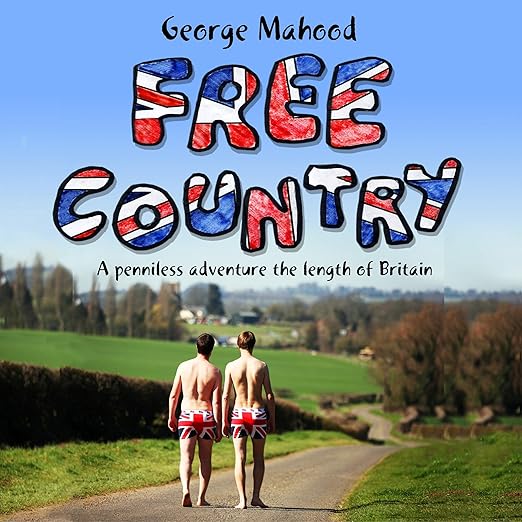
George Mahood has a particular gift for the kind of writing that makes readers feel implicated in the stupidity of what they are reading about, as if they too would have set off in Union Jack boxer shorts with no bikes, no money, and no plan, and would have somehow ended up waving at the Loch Ness monster from a borrowed canoe. Free Country, his account of cycling one thousand miles from the bottom of England to the top of Scotland on pure goodwill, is an audiobook that earns its comedy through specificity rather than exaggeration. The situations do not need embellishment; they are already absurd.
Kris Dyer's narration is a good match for the material. He captures Mahood's self-deprecating wit without mugging, and his English delivery gives the British landscape and the array of eccentric locals a natural register that a more neutral voice might flatten. One reviewer described the feeling of finishing the book as though 'I've just had the adventure of a lifetime with my new pal,' and Dyer's performance has something to do with that: he makes George and Ben feel like people you would actually choose to hear from for ten hours.
Why Free Country Works as an Audiobook
The challenge Mahood and his friend Ben set themselves is deceptively simple: cycle the Land's End to John O'Groats route, known as LEJOG, in three weeks, relying entirely on strangers for food, transport, accommodation, and equipment. They start with nothing but the mentioned boxer shorts. What follows is an extended study in the generosity of ordinary British people, and Mahood is honest enough to let that generosity be surprising rather than assumed.
The book's best moments are its accidental ones. Washing dishes at a pub in exchange for a meal. Descending Cornish hills on children's bikes. Singing Christmas carols out of season for food. Spending the night in a greenhouse, a canal boat, a barn with a bull. Each of these episodes has its own comic logic, but they also build into something cumulative: a portrait of a country that, at human scale, is more generous and more eccentric than its public image suggests. One reviewer called it 'truly inspiring,' noting that they could not have survived the journey as effectively as George and Ben did, and that sense of admiration for the pair's audacity is the book's consistent emotional note.
At over ten hours, the audiobook has room to breathe. Mahood does not rush through episodes to get to the next one. The journey's geography unfolds at a pace that mirrors the cycling itself: sometimes slow and frustrating, sometimes unexpectedly beautiful, frequently involving hills that seemed unnecessary.
Weak Spots in Free Country
This is fundamentally a comedy of goodwill, not a cycling guide or a travel memoir with serious social observation ambitions. Listeners who come to it expecting sharp cultural commentary or technical cycling content will be mildly disappointed. The book does not pretend to be those things, but its genre classification under sports and travel can attract listeners expecting a different register.
The episodic structure, one adventure followed by the next, means the book does not build to a traditional narrative climax in the way that story-driven memoirs do. The endpoint is geographic rather than emotional. Some listeners may find the cumulative looseness of the structure slightly unsatisfying by the final chapters, though Mahood's voice is consistent enough that most will simply enjoy the company through to the end.
The production quality noted by reviewers is solid. One reader specifically commended the writing and editing as clean and free of the problems that can plague self-published travel memoirs. In audio form, this translates to Dyer having well-crafted prose to work with throughout.
The book's treatment of the people George and Ben encounter along the way is as interesting as the physical challenge itself. Mahood resists the temptation to treat the generosity they receive as material for comedy at the donors' expense. The greenhouse owners, the pub that feeds them in exchange for washing dishes, the woman who drives them thirty miles because they looked cold: each of these encounters is rendered with genuine gratitude rather than ironic distance. That warmth is what separates Free Country from travel writing that uses its subjects as background color for the author's self-presentation.
The audio format captures something specific about Mahood's prose that might be slightly muted in print: the pace of the storytelling matches the pace of cycling itself. Long stretches of not much happening, punctuated by sudden encounters that change everything. Dyer understands this rhythm and does not try to artificially elevate the quiet sections. The result is an audiobook that genuinely recreates something of the experience of long-distance cycling in its rhythmic alternation between monotony and surprise.
The Right Listener for Free Country
This audiobook is ideal for listeners who enjoy British travel and adventure writing in the comedic-misadventure tradition, think Bill Bryson's Notes from a Small Island or Alastair Humphreys's microadventure writing, but with more chaotic energy. It suits long drives, extended commutes, or any listening context where you want company that is consistently cheerful without being saccharine.
Listeners looking for serious athletic achievement narrative, structured travel journalism, or social commentary will find the book too light. But for anyone who wants ten hours of well-written, genuinely funny adventure in good company, Free Country is a pleasure from the first hill to the Scottish border and beyond.
At a Glance
- Narrator: Kris Dyer's English delivery suits Mahood's self-deprecating wit well; he sounds like a reliable companion across 10 hours without ever wearing thin.
- Subjects: Bicycle adventure, the generosity of strangers, British landscape and character
- Tone: Consistently cheerful and comedic
- Bottom line: Mahood's LEJOG-on-nothing adventure is an excellent audiobook for listeners who want the British comedic misadventure tradition at its most genuinely funny.