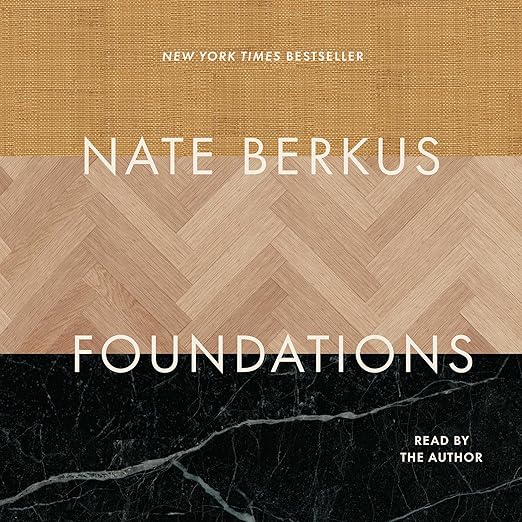
The Short Version
- Read by: Nate Berkus self-narrates with the same easy, television-honed authority that built his design career.
- At its heart: Personal history in design, timeless character over trend, decorating on any budget.
- Vibe: Warm, conversational, and brisk.
- Short version: A short, genuinely useful design philosophy best treated as a companion to Berkus's visual portfolio, not a substitute for it.
The four tenets Nate Berkus keeps returning to, Make It Personal, Embrace History, Build Character, Develop a Vision, sound like they belong on a poster until you hear him apply them to an actual decision, like whether a flea-market lamp with a chipped shade is worth keeping. This audiobook runs a lean two hours and thirty-seven minutes, short even by design-book standards, and Berkus uses that time efficiently: rather than a room-by-room renovation manual, Foundations is closer to a framework you can carry into any decision, from paint color to furniture placement, regardless of budget. He narrates it himself, and that choice matters more here than in most design books, since so much of the appeal is hearing him think through his own reasoning out loud.
Nate's Voice Is Reflected Throughout, Literally
Berkus has built a career on being the design world's most approachable authority, and Foundations plays directly to that reputation rather than trying to be something flashier. The four-tenet framework underneath the marketing language is genuinely more useful as a decision-making tool than most celebrity design books manage. Reviewer Alec describes spending a year 'slowly decorating' a first house and getting stuck in an endless buy-and-return cycle before the book clicked something loose, writing that they picked it up 'after seeing Nate Berkus talk about it.'
KeeKee calls it 'a great table book' with 'a lot of great details and perspective,' noting that 'Nate's voice is reflected throughout,' which for an audiobook version carries a literal double meaning worth appreciating. A third reviewer, elaine greco, keeps it simple: this is a 'renowned designer' whose taste she trusts, someone she credits with 'teaching VALUES, among other things.'
It's worth placing Foundations within Berkus's broader career arc too. He built his name on approachable, relatable design television long before this book existed, and the four-tenet framework reads like a distillation of two decades of on-camera problem-solving into something portable. That history is part of why the audiobook works as well as it does: he isn't reading a manuscript cold; he's explaining ideas he's spent years articulating out loud to homeowners in real time.
The bestseller status also says something about market appetite right now: instant New York Times bestseller performance for a design book doesn't happen automatically, and it suggests Berkus tapped into real hunger among readers for permission-based design advice rather than another rulebook dictating exactly what to buy and where to put it.
You Get His Actual Inflection, Not Just Words
The appeal of hearing this rather than reading it comes down to tone. Berkus has spent two decades on television explaining design choices in real time, and that skill translates directly to audio narration in a way it doesn't always for first-time author-narrators. When he walks through the difference between decorating with objects that have stood the test of time versus objects chosen purely for trend, you get his actual inflection and emphasis, not just words on a page.
A Palate Cleanser Between Denser Audiobooks
The book's structure, four tenets meant to apply to any home and any budget, works well in short audio sessions too; at two hours and thirty-seven minutes total, you could reasonably finish it in a single afternoon of chores, then return to individual sections before your next furniture purchase. For a design book, that's an unusually replayable structure, and its status as an instant New York Times bestseller suggests an audience well beyond design-industry insiders already found real use in the print edition.
A case also exists for this as a palate cleanser between denser audiobooks. At under three hours, Foundations doesn't demand the sustained multi-day commitment most nonfiction requires, which makes it an easy recommendation for anyone who wants something genuinely useful without adding another twelve-hour title to an already long queue. The four tenets are also memorable enough, short and easy to recall, that they stick after a single listen in a way denser design theory often doesn't, a stickiness worth something in a genre where most advice gets forgotten within a week of finishing the book, long before anyone actually gets around to applying it.
A Table Book You Can't See
The obvious tension with any design book is how much of its value lives in images you can't hear. KeeKee's review calls the print edition 'a great table book' full of imagery, and that visual dimension, photographs of the rooms Berkus references while explaining his reasoning, simply isn't part of the audio experience. You're getting his voice and his logic, not the finished spaces he's describing, which means the audiobook works best as a companion to browsing his actual portfolio online rather than a total substitute for the visual book.
The short runtime is also worth being upfront about: at under three hours, this is closer to an extended conversation than a comprehensive design course, and anyone expecting room-by-room, line-item guidance on renovation budgets or contractor selection will find the four-tenet framework more philosophical than procedural. That's by design, not exactly a flaw, but the practical payoff depends on how much translating you're willing to do yourself.
If His Persona Grates, So Will This
Because Berkus narrates his own material, the performance is inseparable from the content in a way worth naming directly: if his television persona grates on you, that reaction will likely carry over into the audiobook, since a professional narrator's neutral delivery isn't standing between you and his personality here. For the many listeners who already enjoy his on-screen presence, that's precisely the appeal, but it's a real factor either way.
It's also worth noting the four tenets overlap conceptually more than a tidy four-part structure might suggest; Embrace History and Build Character in particular cover similar ground from slightly different angles, so listeners expecting four cleanly distinct chapters may find the framework blurs together somewhat by the end.
Permission to Trust Your Own Instincts
Anyone who has stood in a room they've already decorated and still felt like something was off will find Berkus's framework genuinely clarifying, particularly the emphasis on personal history over trend-chasing. First-time homeowners in the thick of decision fatigue, exactly the situation Alec describes, are probably the best-fit audience, since the book's real strength is giving you permission to trust your own instincts rather than a rulebook to follow exactly.
At two hours and thirty-seven minutes, this won't work for anyone hoping for a comprehensive room-by-room renovation guide or detailed contractor advice; it's a philosophy, not a manual. Design professionals already fluent in concepts like layering history and personal narrative into a space may find the four tenets more like validation of what they already practice than new information. For everyone else looking for a short, warmly narrated nudge to stop second-guessing their own taste, the brevity is a feature rather than a limitation.
Common Questions
At under three hours, is this audiobook long enough to actually teach interior design principles?
It's long enough to explain Berkus's four-tenet framework clearly, but it works better as a philosophy you apply yourself than as a comprehensive, room-by-room design course.
Does Nate Berkus's audiobook work without the printed photographs the book is known for?
Mostly, since the four tenets are conceptual rather than purely visual, but reviewers do praise the print edition's imagery specifically, so the audiobook works best alongside browsing his actual design portfolio.
Are the Four Tenets of Good Design explained in enough depth to actually apply them?
Yes for the underlying reasoning, though Berkus frames them as starting ideas rather than a rigid recipe, so applying them to your own space still requires some translation on your part.