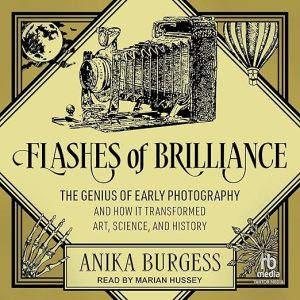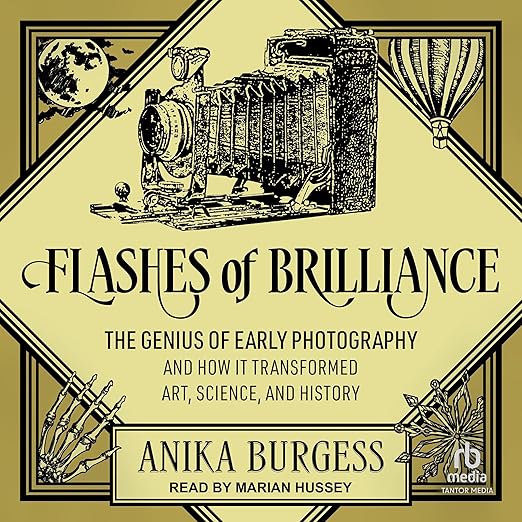
Somewhere in the second hour I paused this audiobook and went looking for photographs of suffragists, because Anika Burgess had just explained that the police adapted the telephoto lens to keep them under surveillance. That is the effect Flashes of Brilliance keeps producing. It hands you a fact about a piece of glass or a chemical bath, shows you the social arrangement that grew up around it, and leaves you wanting to see the evidence for yourself. Seven hours and eight minutes carry photography from its birth in the 1830s to the early twentieth century, and Burgess spends that time on the people who forced the leaps rather than on a tidy chronology of apparatus.
Sojourner Truth Used Self-Portraits to Claim Autonomy
What makes the book work is its framing. Burgess is a writer and photo editor, and she comes at the history the way a picture editor would: interested above all in what a photograph made possible that had not been possible before, and in the stubborn people who insisted on it. The description calls the innovators and entrepreneurs behind those advances "memorable eccentrics", and the book treats that as a thesis rather than as decoration. The register is experimental and occasionally hazardous, and the hazard is not metaphorical when the work involves hauling glass plates into catacombs.
The itinerary is genuinely wide. Burgess covers the catacombs, cities photographed at night, the depths of the ocean and the surface of the moon, and she keeps circling back to the early tangle between photography and power. Image manipulation, she points out, was a problem from the very start rather than a modern arrival. The police repurposed a lens built for distance into an instrument of political surveillance. And Sojourner Truth used self-portraits to assert identity and autonomy at a moment when nearly every other image of her would have been made by somebody else. That last strand is the one I have kept thinking about since.
Seven Hours Long, and No Review Mentions Hussey
The people who have posted about it are unusually well placed to judge. One says outright, "I teach history of photography and there were stories and fun facts here I had never heard." On a popular history, that is the review I weigh most heavily, because a specialist finding new material is the hardest test the form can pass. Another was "hooked from the beginning" by the account of what an early portrait session involved, and rates the pace of the writing and the language used as "top notch." A third calls the book "a fascinating history of early photography that is exceptionally well written."
Marian Hussey reads it, and I want to be careful here, because not one of the three reviews on this page mentions the narration at all. What follows describes the job rather than the performance. Popular history of this sort needs a voice that can carry technical vocabulary without turning brittle, handle nineteenth-century names and places cleanly, and move between anecdote and argument without signalling the gear change too hard. Seven hours is a forgiving length for that work. It is short enough that a slightly flat delivery would not sink the book, and long enough that a good one would compound across the chapters.
The History Stops Before Color Film Arrives
The obvious problem is the one nobody can design around: this is a book about pictures, and you cannot see any of them. Burgess describes specific photographs, specific compositions and specific technical results, and in audio you receive the description and the significance without the evidence. That is not fatal, and the prose carries far more of the load than you would expect it to, but it should change how you listen. Keep a browser within reach. Half the pleasure of the passages on cities at night or on the depths of the ocean lies in going to look afterwards, and this format quietly converts that into homework instead of a bonus.
Two smaller cautions. The review pool is thin: thirty-eight ratings behind a 4.3 average is a narrow base, and two of the three written accounts break off mid-sentence on the page, so you are reading partial arguments and cannot see where either was heading. One of them stops mid-word while its author is reaching toward a comparison with our own digital present, which is a shame, because that was clearly the most interesting thought in it. And be clear about scope before you buy, since the book closes in the early twentieth century. Color film, digital sensors and the camera in your pocket belong to a different history.
Even a Specialist Found Fresh Material Here
Three groups will get the most from it. Anyone who takes photographs without having thought much about where the conventions came from will find that the origin stories of manipulation, surveillance and self-presentation land straight into arguments we are still having about images. Anyone who enjoys social history told through objects will recognize the method, which sits closer to a cultural history of a technology than to a gallery of inventors. And specialists apparently find fresh material in it, which is the single most persuasive endorsement anywhere on the page.
My recommendation splits along one line, and it has nothing to do with taste. If you are content to hear about photographs, seven hours here is time well spent, and the writing does more descriptive labor than most nonfiction of this kind bothers to attempt. If you need to see what is being described, look into an illustrated print edition and treat the audio as a companion rather than the main event. Burgess has written something genuinely absorbing about a visual medium, and the format simply asks you to meet it halfway.
- Voice: Marian Hussey reads it, and since no reviewer here comments on the performance, the assessment below rests on what the material asks rather than on confirmed delivery.
- Big ideas: Early photographic innovation, surveillance and image manipulation, self-portraiture and autonomy, technology as social history
- Atmosphere: Curious and companionable, with a persistent itch to go and look
- Worth it?: Absorbing popular history that loses something real without the pictures, and still earns its seven hours.
Frequently Asked Questions
Does an audiobook really work for a book about photographs?
Mostly, with one adjustment. Burgess writes descriptively enough that the arguments land without images, but she is discussing specific pictures you cannot see. Treat it as a listening experience with a search engine nearby, and the gap closes. Listen while driving and you will lose a genuine part of the value.
Is this audiobook technical, or is it written for general listeners?
It is written for general listeners. Processes and equipment appear, but always in service of what a given advance let people see for the first time. A reviewer who teaches the history of photography still found unfamiliar material in it, so the accessible framing has not come at the cost of substance.
What does Anika Burgess bring to the subject?
She is described as a writer and photo editor, and the editorial background shows in how the chapters are chosen. The book keeps asking what a photograph made possible and who was changed by it, rather than cataloguing inventors, which is a picture editor's instinct applied to a century of history.