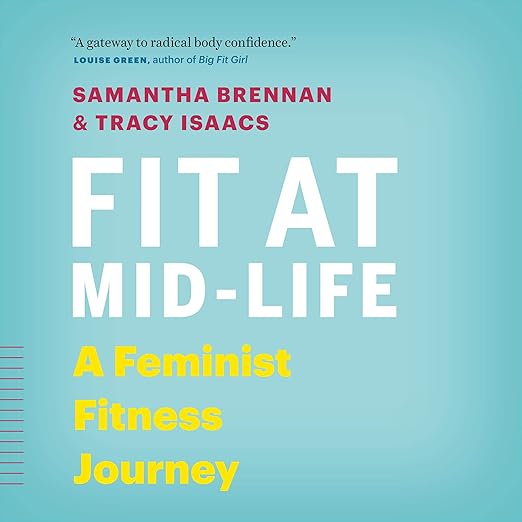
The fitness section of any bookstore has always operated on an implicit assumption: the reader is already convinced that getting fit is a neutral goal, and the 'how' is all that needs explaining. Samantha Brennan and Tracy Isaacs challenge that assumption throughout this audiobook, and the challenge is more interesting than the typical midlife fitness guide. Narrated by Adrienne Cornette over ten and a half hours, Fit at Mid-Life delivers practical advice on bone density, return-on-effort exercise choices, and activity selection for women in their forties, fifties, and beyond. But it also asks why women have been told what fitness means, by whom, and in whose interest those definitions have operated. That dual project, the practical and the critical, is what separates this audiobook from the substantial competition in its genre.
I came to this one through a recommendation from a listener who described it as 'the fitness book that made me angry in a useful way,' which is as good a description of its best qualities as I could offer. The anger is productive because it is aimed at structures rather than at individuals, and because it is paired with enough practical guidance to channel it somewhere.
Highlights
Brennan and Isaacs are philosophy professors, and that background shapes the book in ways that are mostly productive. The chapter interrogating why women avoid free weights at the gym is a good example: rather than simply telling women to use them, the authors examine the social messaging, the gym culture dynamics, and the way personal trainers are trained to speak differently to female clients than to male ones. This kind of structural analysis, embedded in what could otherwise be a straightforward activity guide, gives the audiobook an intellectual texture that fitness writing rarely achieves.
The personal experience sections work well. Both authors document their own mid-life athletic transformations: one became a competitive powerlifter in her mid-forties, the other a cyclist and martial artist after years of inactivity. These are not celebrity transformations. They are the kind of shifts that happen in ordinary lives, which makes them more useful as evidence than the spectacular before-and-after narratives that dominate wellness marketing. The message that it is never too late to become an athlete is made credible by the specificity of their experience rather than the authority of their credentials alone.
Adrienne Cornette narrates with clarity and appropriate warmth. The register she maintains, conversational but not breezy, suits both the practical advice sections and the more analytical feminist critique sequences. For a ten-hour audiobook that moves between these two registers, a narrator who can shift without creating tonal whiplash is important, and Cornette delivers that consistency. One reviewer described the book as 'practical, personal and inspirational,' noting that the authors are 'two smart, down to earth, fully embodied philosophy professors,' which captures what the Cornette narration also achieves: authority without condescension.
Weak Spots in Fit at Mid-Life
The book's feminist framing is central, not decorative. Listeners who want a purely practical fitness guide without ideological analysis will find the structural critique sections more than they bargained for. Equally, listeners who want rigorous academic feminism may find the practical advice sections too prescriptive for a genuinely complex subject. The book sits between those poles, which is exactly where it intends to sit, but knowing that going in sets appropriate expectations for what each half of the listening experience will deliver.
Some of the research citations feel dated relative to rapidly evolving sports science, particularly around the bone density and hormonal sections where recommendations have been revised in recent years. For the most current clinical guidance on those specific areas, supplement with up-to-date sources. The framework and analysis remain useful; it is the specific clinical prescriptions that may have been updated since publication.
One reviewer in their mid-forties described the book as having addressed a sense of hopelessness about their body that had seemed permanent. That response is not universal, but it reflects the book's genuine reach: not just to those already engaged with fitness, but to those who had stopped believing engagement was possible for them. That is a harder audience to write for, and Brennan and Isaacs reach them.
The chapter on why dress size has historically functioned as a fitness benchmark, even among women who profess not to care about it, is particularly sharp. Brennan and Isaacs do not simply assert that this is a problem; they trace the mechanism by which size became conflated with health in wellness culture, and they do so with enough specificity that the argument holds even for readers who approach it skeptically. The philosophy training shows here: the authors know how to construct a claim and provide evidence for it, and that discipline elevates what could otherwise be a familiar feminist observation into something that actually changes how you think about the question.
Cornette's performance in these analytical sections is particularly well-calibrated. She reads the argument-driven prose with a clarity that keeps the structure visible: premise, evidence, conclusion. In a book that moves between this kind of analytical writing and personal narrative, the ability to signal the register shift without making it feel abrupt is a narration skill that not all audiobooks in this genre achieve. Fit at Mid-Life benefits from a narrator who can hold both modes comfortably, and Cornette does.
Is This One for You?
Women in their forties and beyond who want more than a prescription for gentle yoga and walking will find this audiobook both validating and practically useful. The free weights advocacy, the bone density research, the frank discussion of how fitness culture has systematically underserved women in midlife: these are points the audiobook makes clearly and with evidence. Cornette's narration makes the ten-hour runtime comfortable. Listeners who want uncritical cheerleading or a purely technical approach should adjust expectations; those who want both the what and the why of getting fit later in life will find the combination here rewarding and, for many, overdue.
Good to Know
Is this audiobook primarily a fitness guide or a feminist critique of fitness culture?
Both, and the combination is intentional. Brennan and Isaacs deliver practical advice on exercise selection, bone density, and activity returns for midlife women alongside a sustained critique of how fitness culture has been shaped against women's interests. The two strands are woven together rather than separated, which means listeners expecting purely one or the other will need to engage with both.
How science-heavy is this audiobook, and is the research up to date?
The book draws on exercise science and sports research throughout, cited in accessible rather than technical prose. Some sections, particularly those on bone density and hormonal changes, may not reflect the most current clinical guidelines, which have evolved since publication. The framework and analysis remain useful; supplement with current clinical sources for specific medical guidance.
Does this audiobook address fitness for women of all ability levels, including those who are currently sedentary?
Yes, explicitly. Both authors document their own starts from relatively inactive positions in midlife, and the book consistently frames fitness as accessible regardless of current shape, size, age, or ability. One reviewer described going from feeling hopeless about her fitness to genuinely motivated after listening, which reflects the authors' deliberate effort to reach and include rather than to exclude.
Is Adrienne Cornette's narration a reason to choose the audiobook format over reading the print edition?
Cornette is competent and consistent, but this is not a case where narration transforms the experience in the way a gifted self-narrator might. The audiobook is a comfortable format for the material; Cornette serves it rather than elevates it. Print readers would not miss a definitive audio experience, though the narration is pleasant enough that audio is a reasonable first choice for a ten-hour listen.