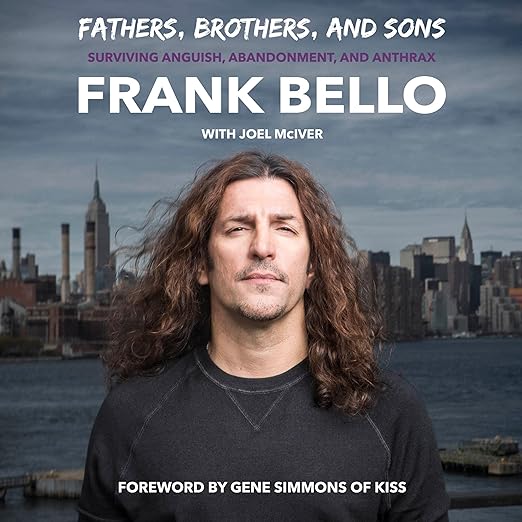
Frank Bello's bass lines powered Anthrax through four decades of thrash metal, but this audiobook memoir digs into quieter, harder territory: an absent father, a brother's unsolved murder, and the slow work of learning fatherhood without ever having seen it modeled. Bello narrates his own story here, from a roadie's start in his early teens through international stardom by his early twenties, and Fathers, Brothers, and Sons treats the band career mostly as scaffolding for a more personal reckoning with family, loss, and what it actually takes to become a decent parent when nobody showed you how.
The Murder's Quiet, Unresolved Weight Throughout
The book's emotional center is not the Anthrax years themselves but 1996, when Bello's brother Anthony was murdered in New York and the suspected killer walked free after a witness, intimidated by violent elements, withdrew testimony. Bello does not turn that injustice into the book's climax so much as its quiet, unresolved weight, something he carries into every later chapter about fatherhood rather than a wound the narrative neatly closes. That restraint is a real strength: reviewer Derrick, a fellow bass player, calls the book heartfelt, passionate, and inspiring precisely because Bello bares real vulnerability without turning the story into a plea for sympathy.
Reviewer William Irwin's description of Bello as the most down-to-earth guy in Anthrax tracks closely with how the book reads: name-checking Gene Simmons and Steve Harris as early heroes who treated him like he mattered as a kid, then explicitly modeling that same generosity forward once Anthrax made it big themselves. The through-line from absent father to chosen mentors to Bello's own parenting gives the memoir a clear emotional architecture, even though it never states that structure outright.
From Simmons and Harris to a Roadie Start
Bello name-checks Gene Simmons and Steve Harris specifically as the players who shaped his sense of what a career musician could look like, and both details are worth sitting with: Simmons built KISS into as much a business as a band, while Harris has led Iron Maiden's songwriting and business decisions for decades. Bello absorbing lessons from both suggests his own approach to longevity in Anthrax, staying with one band across a full career rather than chasing side projects, was shaped early and deliberately.
Bello's path into Anthrax started as a roadie in his early teens, not as a prodigy recruited for obvious talent, and that ground-up trajectory shapes the book's overall tone. This is a memoir about earning a place through proximity and persistence rather than a story of innate destiny, which tracks with Bello's own description of finding inspiration in bass players rather than claiming natural gift, and gives the eventual international stardom section more weight for having shown the unglamorous climb first.
Bello's Own Cadence Instead of a Hired Script
Self-narration by a professional musician telling his own story carries real weight, and Bello's delivery has the unpolished, direct quality of someone recounting his actual life rather than performing a script written at a remove. For a memoir this personal, hearing the specific cadence of Bello's own voice describing his brother's murder or his early bass-playing apprenticeship adds a layer of authenticity a hired narrator, however skilled, simply could not replicate.
The book explicitly avoids preaching or fishing for sympathy, according to its own framing, and that restraint carries through in Bello's narration too: he does not oversell the tragedy or milk the redemption arc for easy catharsis. Listeners get a working musician's plainspoken account of turbulence and recovery, delivered with the same directness that presumably made him a reliable bandmate for forty years running.
What the Book's Three-Part Title Really Means
The book's title itself does real structural work: fathers, brothers, and sons names three generations of male relationships Bello is working through at once, his own absent father, his murdered brother Anthony, and his role as a father to his own son now. Framing the memoir around that triangle rather than a chronological band history signals from the outset that the emotional throughline matters more here than tour dates or album credits.
Musician memoirs are frequently shaped heavily by a co-writer or ghostwriter, smoothing a rock star's voice into something more conventionally literary, and while this book may have had editorial help getting to the page, Bello narrating it himself keeps whatever polish exists from ever fully sanding down his actual speaking voice. That matters for a memoir this personal; the goal is not literary polish so much as a bandmate's honest account, and self-narration keeps that promise intact from the first page to the last.
A Runtime Short Enough to Leave Fans Wishing
Runtime is genuinely short for a rock memoir at five hours and forty-six minutes, and reviewer J. Weber says so directly, wishing the book ran longer even while calling it essential listening for any Anthrax fan. That brevity means detailed discography deep dives or extended tour-life anecdotes mostly stay out of scope; this is a focused personal memoir rather than a comprehensive band history, and listeners wanting the latter should adjust expectations accordingly.
Because the book centers so tightly on family rather than the band's full arc, casual listeners without any prior Anthrax context may find some music-industry references pass by quickly without much explanation. The memoir assumes at least passing familiarity with the thrash metal scene Bello came up in, even though its emotional core, fatherhood and loss, needs no specialized musical knowledge to land.
Anthony's murder and the witness intimidation that let the suspect walk free sit at the book's emotional center without ever becoming procedural true crime; Bello does not investigate the case himself on the page so much as carry its unresolved weight into later chapters. Listeners expecting a detailed account of the legal proceedings themselves should recalibrate, since the book stays focused on how that loss shaped Bello rather than on case reconstruction.
Anthrax's Place Among Metal's Big Four
Anthrax fans and heavy metal listeners generally are the most obvious audience, especially bass players who will recognize Bello's specific references to the players who inspired him, but the fatherhood-after-absence throughline gives this real reach beyond metal fandom into memoir readers interested in breaking generational patterns.
Anthrax's place in heavy metal history is worth naming for listeners less versed in the genre: alongside Metallica, Slayer, and Megadeth, the band is widely counted among thrash metal's so-called Big Four, a genuinely significant commercial and critical stature that context helps explain why a bassist's personal memoir carries enough built-in audience to matter beyond hardcore fans alone.
The book frames itself explicitly as offering wisdom to listeners, not just recounting events, which positions it closer to a guidance-driven memoir than a straightforward chronicle of Bello's career. That distinction is worth knowing going in, since it shapes how directly the book addresses the listener rather than simply narrating the past.
Skip it if you specifically want a comprehensive Anthrax band history with extensive tour and recording detail, since this stays personal and relatively brief by design rather than aiming for documentary-style completeness.
Does Frank Bello narrate this audiobook himself?
Yes, and his own direct, unpolished delivery adds real authenticity to the personal material, particularly the passages about his brother's murder.
Is this audiobook heavy, given that a murder is discussed?
Yes, that thread carries real emotional weight throughout, though Bello's narration handles it with restraint rather than dwelling on graphic detail.