The Short Version
- Voice: Arthur Morey handles Bill Cunningham's voice with warmth and a quality of affection that serves a posthumously published memoir, the performance respects the source without over-dramatizing it.
- Big ideas: creative identity and family disapproval, New York City as a space of transformation, fashion as democratic art
- Atmosphere: Effervescent and melancholic in equal measure, like a party thrown by someone who knew the best years were ending
- Worth it?: Fashion Climbing is a genuine literary find, a posthumous memoir written with infectious joy by one of New York's most original figures, and Arthur Morey's narration honors the voice behind it.
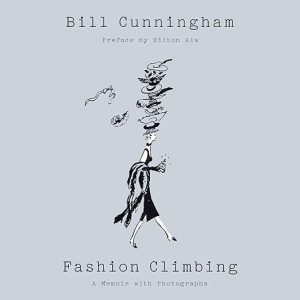
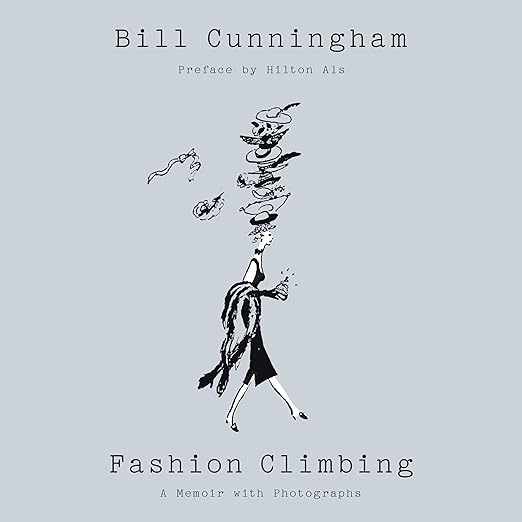
Bill Cunningham's Fashion Climbing is the kind of audiobook that makes you aware of what was nearly lost. Cunningham, the New York Times street photographer who spent decades on a bicycle recording how ordinary New Yorkers dressed, wrote this memoir, polished it, typewritten it neatly, and then put it away. He held it until his death in 2016. Arthur Morey narrates it with the care the text deserves: measured, warm, with a quality of attention that suits a voice being heard, in some ways, for the first time. At six hours and twenty-eight minutes, this is a portrait of a young man finding his vocation in the most unlikely and specific circumstances.
Under the Alias William J., a Secret Career
Cunningham grew up in lace-curtain Irish Boston, secretly trying on his sister's dresses, spending his evenings after school in the city's chicest boutiques. His desires were shameful to his family, and his path, dropping out of Harvard, moving to New York, working his way into the orbit of style mavens who recognized his gifts, required repeated acts of courage that the book describes without self-pity. Under the alias William J., his family name would have been a disgrace, he became one of the era's most celebrated hat designers, catering to movie stars, heiresses, and artists. This period of his life is almost entirely unknown to the people who know him from his photography, and that gap is precisely why the memoir matters.
Reviewer LKP noted that most readers know Cunningham with the camera, the bike, and the denim jacket, the documentary portrait that defined his public image in his final decades. This book is the story he never told while alive: the education in style, the gate-crashing of balls and opera openings to study how gowns moved and jewels hung, the conviction that fashion was democratic and that his job was to make women an inspiration to themselves and to everyone who saw them. The sentence the review record returns to most often is one of the memoir's finest: when he was broke and hungry, he would stroll past Fifth Avenue store windows and feed himself on beautiful things. That line captures the book's sensibility exactly, desire and poverty held together without bitterness.
Reviewer Michael A. Helbig came to the book expecting coverage of Cunningham's later career and was glad to find none of it. The memoir stops well before the photography era, and its focus on the hat-design years and the bohemian world of mid-century New York is richer for that focus. The specific texture of that world, the balls, the heiresses, the particular social geography of Manhattan fashion in the postwar decades, is documented with the authority of someone who was there and paying attention in a way most observers were not.
Morey Transmits the Joy Instead of Performing It
Morey's narration carries Cunningham's infectious joy without forcing it. The memoir is written in a voice that is unguarded and specific in a way that posthumous publication sometimes enables, freed from the anxiety of reception, Cunningham wrote exactly what he wanted to say. Morey reads it with appropriate restraint: he does not perform the joy so much as transmit it, which is the right choice for material where the author's personality is already present on every page and any additional performance layer would compete rather than serve.
The audiobook format activates the memoir's conversational quality in ways silent reading softens. Cunningham's prose has the rhythm of spoken memory, it circles, returns, builds associations across seemingly unconnected events, and hearing it aloud makes that associative logic feel natural rather than structurally loose. Reviewer Roberta Binder noted genuine surprise at discovering Cunningham's fashion background, having known him only as a photographer. For that reader, the book was an unlocking, and that experience of discovery is more immediate in audio, where the intimacy of the voice creates the sense of being told something private.
The Book Reads Like a Memory Being Assembled
The memoir does not proceed chronologically in a straightforward sense, it has the quality of a memory being assembled rather than a narrative being constructed. Cunningham moves between anecdotes with the associative logic of someone more interested in texture and feeling than in biographical order. Listeners who expect a conventional coming-of-age arc with clear turning points and resolved conflicts may find the structure impressionistic. The book resists resolution; Cunningham was a fundamentally private person, and the memoir honors that privacy even as it reveals far more than he shared in any interview during his lifetime.
The title, Fashion Climbing, carries more weight by the final chapter than it does at the opening, and that accrual of meaning is one of the book's genuine literary pleasures. The climbing is not straightforwardly triumphant; it is the process of a person finding out who they are in conditions that do not make such discovery easy. The class anxiety, the family shame, the financial precarity of the early years in New York all give the memoir a texture that the photographs he became famous for never revealed. What the book offers is access to the interior life of a man whose public presence was almost entirely oriented outward, toward other people and their clothes.
Readers Who Loved Just Kids Will Feel at Home
This audiobook is for anyone drawn to mid-century New York, fashion history as a record of social change, and the specific experience of people who built creative lives against family resistance and social convention. Cunningham fans who know him only from the photography and the documentary will find this essential. Listeners who connected with Just Kids by Patti Smith, another account of a young creative finding a vocation in New York's bohemian ecosystem, will feel at home here. Skip it if you need a memoir with linear narrative architecture or if fashion history is entirely outside your range of interest. Morey's narration makes the six-hour runtime easy to sustain.
Before You Listen
Does the Fashion Climbing audiobook cover Bill Cunningham's famous street photography career?
No, and deliberately so. The memoir was written to cover his earlier years as a hat designer and his education in New York style, stopping before the photography era that made him publicly famous. Listeners who know the documentary will find this an entirely different chapter of his life.
Is Fashion Climbing suitable as a standalone audiobook for listeners unfamiliar with Bill Cunningham?
Yes, though brief familiarity with who he became helps orient the stakes. The memoir is self-contained and Cunningham's voice is immediately engaging, so no prior knowledge is required to appreciate the narrative and what it reveals.
How does Arthur Morey's narration handle the memoir's personal and emotional content?
Morey's approach is warm but restrained, he reads with affection for the material without over-performing the emotional passages. This suits a memoir written by a genuinely private person who was candid in print in ways he was never candid in interviews.
Since Fashion Climbing was held back during Cunningham's lifetime, is the audiobook a polished production or rough around the edges?
The memoir was carefully written, typewritten and polished, per the publisher's account. This is not an unfinished draft; Cunningham worked on it with care. The posthumous nature of the publication is about his choice to withhold it, not about its editorial state.