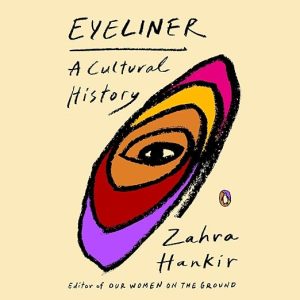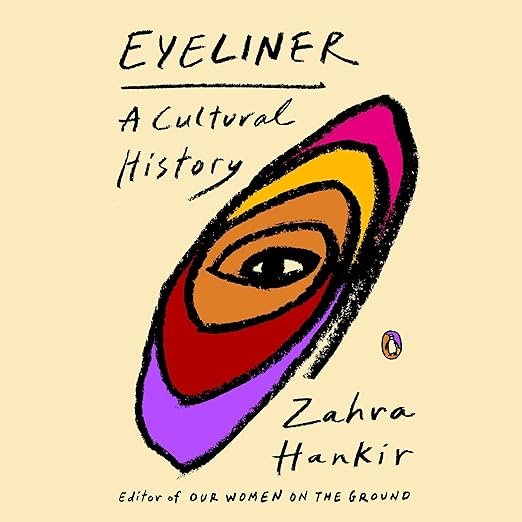
A single cosmetic tool carries an improbable amount of history once Zahra Hankir starts tracing it, and this audiobook spends nearly eleven hours proving the point without ever feeling like a stretch. Nefertiti and Amy Winehouse anchor opposite ends of a timeline that runs through Chad, Japan, India, and New York, and Hankir, previously known as the editor behind Our Women on the Ground, approaches eyeliner less as a beauty product than as a lens for reading power, rebellion, and belonging across cultures that rarely get discussed in the same book, let alone the same chapter.
Hankir Writes as a Practitioner of the Ritual
The structure leans on intimate reporting rather than a straight chronological survey: conversations with nomads in Chad, geishas in Japan, dancers in India, and drag queens in New York give each chapter a specific human anchor instead of a generalized cultural summary. That reporting instinct, evident in her earlier anthology work, keeps the book moving between anthropology, travel writing, memoir, and history without any one mode dominating for too long, which is a genuinely difficult balance for a single-subject cultural history to sustain across ten-plus hours.
The New York Times Book Review named it an Editors' Choice pick, and the praise quoted in the synopsis, from calling the makeup's story 'eye-opening' to describing the book as a 'rigorously researched, winding path through centuries and over continents', tracks with how the content actually unfolds. This is scholarship wearing a very approachable coat, more interested in specific women's stories than in abstract theory about beauty standards.
The synopsis's own framing, describing Hankir's eyes as the lens through which the whole book gets seen, is a nice bit of self-aware positioning: the author isn't writing from clinical distance about a product she's never used, she's writing as a practitioner of the very ritual she's investigating. That reflexive quality shows up throughout, in the difference between a scholar explaining eyeliner's history and a woman who wears it explaining what it has meant to the people she interviews.
A Portal Metaphor for Rebellion and Status
'Eyeliner' also sits in a specific, well-established nonfiction lineage: the single-object cultural history, the kind of book that takes something as ordinary as salt, cod, or color itself and uses it to unlock a much larger story about power and human behavior. Hankir's version distinguishes itself by staying close to lived testimony rather than pure archival research, which keeps the book feeling more like reported journalism than a museum catalog essay stretched to book length.
The book resists a strict chronological march in favor of following Hankir's own curiosity from culture to culture, letting a single artifact carry the reader from ancient burial customs to a modern drag performer's backstage ritual without ever feeling like a forced transition. That structural looseness is a deliberate choice rather than a lack of organization, mirroring how memory and cultural inheritance actually work rather than imposing a textbook's tidy timeline.
The synopsis's own framing captures the book's real ambition precisely: a 'seldom-examined product becomes a portal to history,' and that portal metaphor is exactly right. Hankir isn't writing a comprehensive encyclopedia of cosmetics; she's using one narrow, specific object as a way into much larger questions about who gets to define beauty, and who has used it, throughout history, to claim power that was otherwise denied them.
The synopsis opens with a three-part description that doubles as the book's own thesis, calling the object a 'cosmetic, tool of rebellion, status signifier' all at once. Each term gets real chapters devoted to it, drag performers and rebellious teenagers claiming the rebellion half, ancient royals and modern influencers claiming status, and Hankir moves fluidly enough between the three that the book never feels like it's checking boxes off its own opening line.
Nankani as Connective Tissue Across Continents
Narrator Soneela Nankani has to shift register constantly here, from historical reportage to first-person interview transcription to the occasional memoir aside, and the book's own reviewers suggest that range lands cleanly. One listener with no prior interest in makeup put it plainly: the narration explained everything so well that someone who 'knows nothing about eyeliner' came away with 'a deeper understanding of it', which is a meaningful compliment for a book whose subject could easily have stayed niche.
The audio format suits this kind of globe-hopping reportage particularly well, since Hankir's prose moves the way spoken storytelling does, circling back to recurring images and letting a scene breathe before the next cultural stop. Chapters built around specific interview subjects read almost like individual profiles, which makes the book easy to absorb in sittings shorter than its full runtime without losing the connective thread between sections.
CJK's review captures the chronological sweep in a single sentence, calling it a story spanning 'millennia' from 'ancient Egypt to modern day America', and that range is exactly what makes the audio format work so well here. Listening in longer stretches lets the throughline connect distant eras and continents the way a reader flipping back through chapters might miss, since Nankani's consistent voice becomes the connective tissue between Nefertiti's Egypt and Amy Winehouse's London.
Good for Girl Scout Troops and Ninth Graders
At just under eleven hours, this is a real time commitment for a book organized around a single object, and listeners expecting a tight, breezy read should recalibrate expectations. The depth is the point, not a flaw, but it means the pacing rewards patience over a quick cultural-trivia fix.
One reviewer specifically framed the book as strong material for a younger audience, calling it a good book with 'diverse cultural flare for a young audience of girls' and a fit for Girl Scout troops or ninth-grade classrooms. That framing is accurate but worth noting for adult listeners expecting a purely academic or clinical tone throughout, since the book's warmth and accessibility are deliberate choices, not simplifications.
Nearly eleven hours puts this on par with a full-length literary biography rather than a typical pop-culture nonfiction title, and that runtime signals real depth investment rather than padding. The synopsis closes by promising the book is 'delightful, surprising, and utterly absorbing', and for a title this genuinely researched, the description reads as earned rather than as standard jacket-copy inflation.
Not a Tutorial or a Step-by-Step Guide
Readers of cultural microhistories in the vein of Kassia St. Clair's The Secret Lives of Color, whose author blurbed this book directly, will find exactly the kind of texture they came for: specific people, specific places, and a genuine argument about what a small daily ritual says about power and identity.
A practical makeup tutorial or step-by-step application guide this is not, and anyone hoping for one should look elsewhere entirely, since nothing here concerns technique. This is cultural and historical reporting front to back, and treating it as a beauty how-to will only produce disappointment within the first chapter.
- Read by: Soneela Nankani handles the shift between reportage, interview transcription, and memoir with real range across nearly eleven hours.
- At its heart: Beauty as cultural power, global reportage, identity and rebellion
- Vibe: Warm, curious, and quietly scholarly
- Short version: A rich cultural history that rewards patience and earns its NYT Editors' Choice pick.
A Few Questions About Eyeliner
Is the Eyeliner audiobook appropriate for teen or student listeners?
Yes. One reviewer specifically recommended it for Girl Scout troops or ninth-grade classrooms given its accessible, culturally rich approach, though its scholarly depth holds up equally well for adult listeners.
How does the Eyeliner audiobook compare to other cultural object histories?
Kassia St. Clair, author of The Secret Lives of Color, blurbed the book directly, and listeners who enjoyed that title's approach to a single everyday object will recognize the same method here.