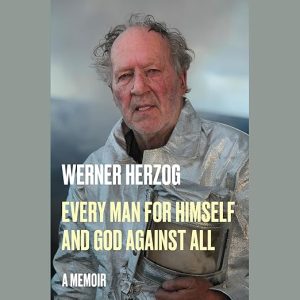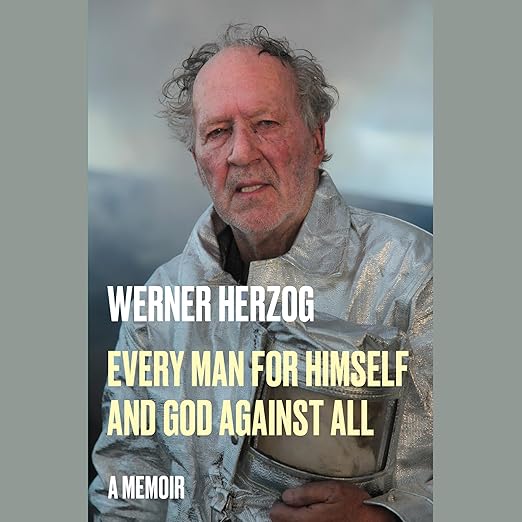
Werner Herzog made his first phone call at seventeen and directed his first film at nineteen, two facts he recites in this audiobook with the same flat wonder he might use to describe the weather over Bavaria. I put this memoir on during a quiet stretch of evenings when I wanted company that would not demand anything emotionally, and instead spent several unhurried nights inside one of cinema's strangest and most disciplined minds. Herzog narrates his own audiobook, and that single production choice reorganizes everything else worth saying about it. Every Man for Himself and God Against All moves from bombed-out postwar Munich to a remote Bavarian farmhouse without running water to eventually seven continents of documentary and dramatic filmmaking, and Herzog tells all of it in the same measured, faintly amused register, as if his own extraordinary life were simply a set of facts to be reported rather than marveled at.
Welding Nights to Pay for His First Films
Herzog was born in Munich in September 1942, at the exact hinge point of the Second World War, and his mother fled the Allied bombing raids with him and his older brother to a remote corner of Bavaria, where the family lived hungry and without running water for years. He did not know cinema existed until he was eleven. His interest in film arrived at fifteen, with no one willing to finance it, so he took a night shift welding in a steel factory to pay for his earliest work himself. That sequence, poverty to welding to filmmaking, is the spine of the book's first stretch, and Herzog narrates it without a trace of self-pity, which is almost more unsettling than if he complained.
Doing What People Say You Cannot Do
The book is loosely organized by theme and chronology rather than strict timeline, a structural choice one reviewer connected to a line from the economist Walter Bagehot: that the greatest pleasure in life is doing what people say you cannot do. Herzog's career, seven decades spanning documentary and fiction across every continent, reads as an extended illustration of that idea, and the memoir lets him revisit his most important experiences and inspirations in whatever order feels true to how he actually remembers them, rather than the order a ghostwriter might impose for narrative tidiness.
What holds the book together is less plot than temperament. Herzog treats an oxygen-starved climb, a hostile film shoot, or a childhood without food as data points in the same even voice, and the effect over thirteen hours is less a chronicle of a filmmaker's career than a portrait of a specific, replicable stubbornness. Listeners who know his documentaries, the obsessive expeditions, the refusal to fake a shot that could be filmed for real, will recognize the same instinct running underneath the memoir itself.
Herzog's Evenness of Delivery Is the Content
Self-narration is the audiobook's defining quality; no version read by a professional actor could replace it. Herzog's German-accented English and his absolute evenness of delivery are not stylistic flourishes, they are the content. His refusal to sound surprised by even the most improbable events he describes communicates something closer to integration of experience than performance of it: this is a man who has made peace with the shape of his own life, and the audiobook lets you hear that peace directly rather than have it summarized by a narrator standing at a professional distance from the material.
A Complete Maniac and a Great Artist
Herzog's own reputation, the mountain-hauling production behind Fitzcarraldo, the notorious on-camera interview where he shrugged off being shot with an air rifle, is exactly why one listener's description of him as 'a complete maniac, and truly a great artist' lands as affection rather than exaggeration. Hearing him describe his own history in that same unbothered tone, rather than have a third-party narrator interpret it for you, does most of the book's persuasive work.
A second reviewer, writing under the name Erwin C. W. S. Schmeegleschmitt Cloud Soup, said the book was 'whimsical yet no-nonsense' and finished it in about four days, already a fan through Herzog's films before starting. That combination, whimsical and no-nonsense at once, is a fair description of the audiobook's tone: Herzog can describe near-death experiences and career-defining obsessions with real lightness, then pivot to blunt, almost clinical self-assessment without any tonal seam showing. Few memoirists manage both registers this comfortably, and fewer still could read their own contradictions aloud this convincingly.
Following Memory, Not a Calendar
The loose, thematic organization that gives the book its distinctive voice also means listeners expecting a strict birth-to-present chronology should recalibrate. Herzog circles back to childhood, jumps forward to a specific production decades later, then returns again, following the logic of memory and inspiration rather than a calendar. Reviewer Francis O Walker, who rated the book four stars, praised the lucid writing but noted the loose structure explicitly; if a tidy, chronological arc is what a listener wants from a filmmaker's memoir, this is not quite that book, even though every individual passage is clear on its own terms.
Not a Tell-All in the Gossip Sense
Thirteen hours and forty-two minutes is a substantial commitment for a single-narrator memoir, though the density of material, childhood deprivation, a welding job, a first phone call, a first film, seven decades of work across every continent, means the runtime tracks an unusually eventful life rather than padding a thin one. Listeners more interested in Herzog's specific films than in his internal philosophy of art and obsession may find some stretches more essayistic than they expect from a standard celebrity memoir.
This is also not a tell-all in the gossip sense. Herzog is interested in the formation of a sensibility, poverty, isolation, a specific kind of fearlessness, more than in score-settling or industry anecdotes for their own sake. Listeners hoping for extensive detail on any single film's production will get some of that, but filtered through Herzog's larger argument about what shaped him, not delivered as a chronological making-of.
For Sensibility Seekers, Not Gossip Hunters
This audiobook rewards listeners who already have some curiosity about Herzog as a figure, whether through his documentaries, his fiction features, or his reputation as one of cinema's most singular obsessives. Fans of artist memoirs that prioritize sensibility over industry gossip, in the tradition of self-narrated books where the author's own voice is inseparable from the material, will find this a genuine highlight.
It also suits listeners drawn to postwar European history from an unusual angle: a specific, hungry, rural Bavarian childhood rather than a capital-city account, filtered through the eyes of someone who became one of the era's defining artists. The combination of personal history and philosophy of craft gives it staying power beyond a typical celebrity audio memoir.
Listeners who prefer a strictly chronological memoir, or who want extensive blow-by-blow detail on specific film shoots rather than Herzog's broader reflections on obsession and self-invention, should adjust expectations before starting, or consider a more conventional making-of documentary instead.
Key Details
- Voice: Herzog narrates himself, and his German-accented, unhurried delivery makes six decades of obsession sound like plain fact.
- Big ideas: Postwar poverty, self-invention, artistic obsession across seven continents.
- Atmosphere: Wry, unhurried, oddly hypnotic.
- Worth it?: A rare case where the author's own voice is the single best reason to choose audio over print.