Quick Take
- Narration: K.C. Hook delivers the regulatory and technical content with a clear, methodical pace that works well for the procedural EPA 608 material across all four section types.
- Themes: Refrigerant management and ozone protection, EPA 608 certification across Core and Type I/II/III sections, DOT compliance and safety protocols
- Mood: Precise and procedural, with an environmentally conscious framing that gives the regulatory content genuine weight
- Verdict: A well-structured EPA 608 audio prep guide that covers all four exam sections and integrates practice questions throughout, suited for HVAC technicians who need certification prep that fits into a working schedule.
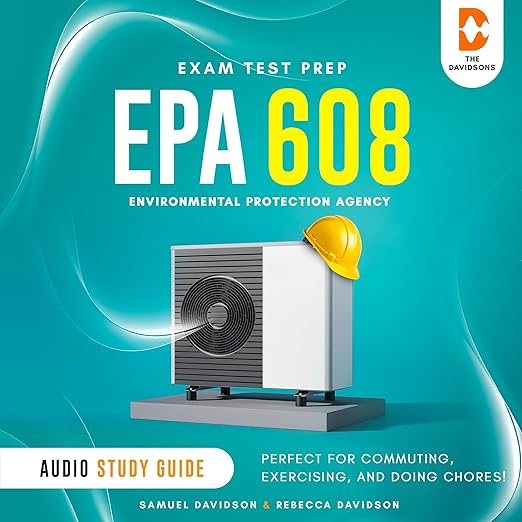
The EPA Section 608 certification is not the kind of credential that gets a lot of attention in education discussions, but it is required by federal law for any technician who works with refrigerants covered by the Clean Air Act. HVAC professionals, refrigeration technicians, and anyone who services equipment using CFCs, HCFCs, or HFCs needs this certification, and the exam is more technically detailed than many candidates expect. Samuel Davidson’s audio guide for the EPA 608, narrated by K.C. Hook, addresses this gap with a format that is genuinely practical for the people who need this certification.
The 5.0 rating across 51 reviews, with no written reviews to parse, reflects a specialized audience that found the resource useful. For a technical certification guide with this narrow a target audience, that is a meaningful signal.
How the Four-Section Structure Maps to the Exam
The EPA 608 exam has four sections: Core, Type I covering small appliances, Type II covering high-pressure systems, and Type III covering low-pressure systems. Each section tests different aspects of refrigerant handling, recovery procedures, and equipment-specific knowledge. Davidson’s guide mirrors this four-section structure, which means a listener preparing for a specific certification type, such as Universal certification requiring all four, can understand exactly where they are in the coverage at any point.
K.C. Hook’s narration handles the technical distinctions between appliance types with consistent clarity. The difference between high-pressure and low-pressure system recovery procedures, and why those differences matter for both environmental compliance and safe operation, is the kind of content that benefits from a steady, explanatory voice rather than a compressed technical recitation.
The Chemistry Behind Ozone Regulation
One of the areas where this guide earns attention is the treatment of ozone chemistry. Understanding why CFCs deplete stratospheric ozone, how HCFCs were introduced as transitional alternatives, and where HFCs fit in the regulatory timeline is background that gives the procedural rules their meaning. A technician who understands why certain refrigerants are being phased out follows the compliance requirements more reliably than one who memorizes rules without context. Davidson’s approach here, covering the Three Rs of Recover, Recycle, and Reclaim in their regulatory and environmental context, reflects this understanding-first philosophy.
The DOT compliance sections, covering refrigerant cylinder labeling and transport protocol, are dry but essential. Hook handles these sections with appropriate seriousness, and the integration of exam-style questions following each segment means the listener is testing retention of the procedural details immediately rather than trying to hold them in memory until the end of a chapter.
Safety Content in Audio Form
PPE requirements, oxygen deprivation risks, and cylinder handling procedures are safety-critical areas where audio has a genuine advantage over silent reading because the emphasis in narration can signal which details are most consequential. Hook’s delivery of the safety protocol sections communicates the importance of these procedures without overstating it, which is the right calibration for technical content where both under-caution and over-reaction have real-world consequences.
At ten hours and two minutes, this is an appropriately scoped listen for a four-section technical certification. HVAC professionals who drive to job sites have a natural study window that this guide is designed to fill, and the exam-style question integration means those ten hours are active preparation rather than passive absorption.
Who Should Listen / Who Should Skip
Listen if: You are an HVAC or refrigeration technician preparing for EPA 608 certification, or you manage technicians and want to understand the regulatory framework. The four-section structure, environmental context, and integrated practice questions make this a practical audio prep resource for a demanding technical exam.
Skip if: You need detailed refrigeration system diagrams, pressure-enthalpy charts, or visual schematics to understand the technical content. The guide covers the regulatory and procedural knowledge well, but listeners who need equipment diagrams to understand system behavior will require a printed supplement.
Frequently Asked Questions
Does this guide prepare you for all four EPA 608 certification types, or just the Core section?
The guide covers all four sections: Core, Type I (small appliances), Type II (high-pressure systems), and Type III (low-pressure systems). Technicians pursuing Universal certification, which requires passing all four sections, can use this as a complete prep resource across all tested areas.
How does K.C. Hook handle the specific refrigerant chemistry terminology and regulatory nomenclature?
Hook’s narration has been described as clear and methodical. The refrigerant terminology including CFC, HCFC, HFC designations and the ozone depletion potential nomenclature is handled with appropriate technical precision, which matters for an exam where specific refrigerant classifications are directly tested.
Are the practice questions integrated throughout the audio or presented as a separate section at the end?
The practice questions with detailed audio explanations are integrated throughout the guide, appearing after concept-heavy segments rather than collected at the end. This spaced approach helps reinforce specific regulatory details while they are still in immediate context.
Is this guide appropriate for someone who has no prior HVAC background, or does it assume trade knowledge?
The guide is designed to be accessible to technicians at various stages of their career, from entry-level candidates to experienced professionals seeking certification for the first time. That said, candidates with no hands-on refrigeration experience may benefit from some practical exposure to the equipment types described in the Type I, II, and III sections.