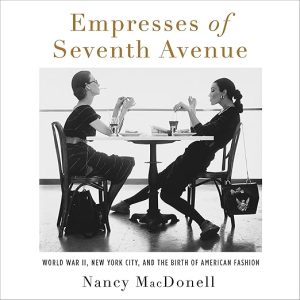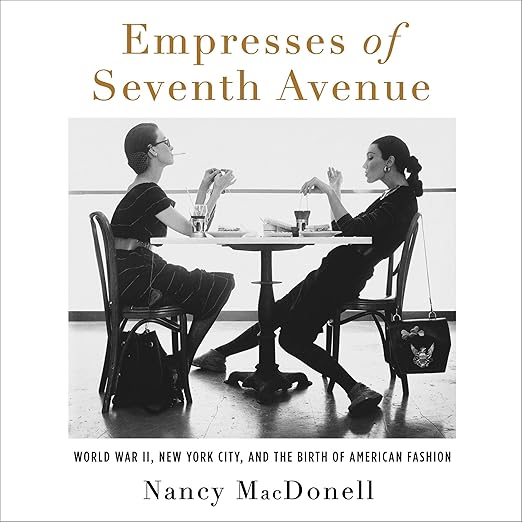
Nancy MacDonell's Empresses of Seventh Avenue is one of those audiobooks that makes you feel slightly embarrassed by the gap in your knowledge. The Nazi invasion of France in 1940, which severed the American fashion industry from its Parisian supply chain of ideas and designs, is a well-documented historical event. What has been far less documented is how that rupture directly created the conditions for American fashion to develop its own identity, and how a small group of women, largely erased from the official record, made that development happen. MacDonell, a fashion historian and journalist, sets out to correct that erasure across ten hours and eight minutes of narration by Gail Shalan, and the result is genuinely compelling history.
Shalan's narration has a clean, measured quality that suits the material well. Fashion history can tip easily toward either the breathless enthusiasm of a runway correspondent or the dry rigor of academic prose. Shalan finds a middle register: engaged but precise, warm without being effusive. She keeps the narrative moving through decades and across a large cast of characters without losing the listener in the thicket of names. For a book covering as much institutional ground as this one does, that navigational clarity is not a small achievement.
Nearly Five Hundred Billion Dollars, Built by Erased Women
The argument at the center of Empresses of Seventh Avenue is worth stating clearly: the nearly five-hundred-billion-dollar American fashion industry that produced Calvin Klein, Ralph Lauren, Donna Karan, Halston, Marc Jacobs, and the rest could not have emerged as it did without the foresight and labor of women who have been almost entirely written out of the narrative. MacDonell is not making a rhetorical point for effect. She is making a historical claim, and she backs it with research that spans recruitment decisions, editorial choices, the mechanics of wartime trade restrictions, and the specific aesthetic arguments that New York-based designers, retailers, editors, and photographers made to a public that had always assumed real fashion originated in Paris.
One reviewer noted that the title is somewhat misleading, that the book covers the geopolitical shift more than Seventh Avenue as a physical location. That observation has merit, but it undersells how thoroughly MacDonell embeds her subjects in the specific texture of that world. The business decisions, the magazine pages, the individual careers: all of it is grounded in the material reality of mid-century New York's garment industry, even when the argument extends to consider what American fashion's global position became in the subsequent decades.
Shalan Delivers It With Authority and Engagement
The audiobook format suits this book particularly well because MacDonell's prose is built on a strong narrative spine. She is a journalist as well as a historian, which means she knows how to set a scene, how to use an individual story to carry a large structural argument, and how to move between intimate profile and wide-angle history without the transitions feeling jarring. The chapters on specific women, their backgrounds, their tactical decisions in the face of an industry that had not previously credited them with strategic agency, are the strongest material in the audiobook. They read like profiles in the best tradition of long-form magazine writing, and Shalan delivers them with the right combination of authority and engagement.
The Booklist endorsement quoted in the synopsis, describing this as perfect not only for people in love with fashion but for anyone interested in fashion as art, obsession, and societal phenomenon, is accurate and then some. This is not an insider's book. It does not require prior knowledge of fashion history to follow. What it requires is an appetite for the kind of history where the official record has systematically omitted the most interesting actors, and a willingness to reconsider which decisions actually created the industry landscape that contemporary culture inherits.
A Notepad Helps Through the Early Chapters
The cast of characters is large. MacDonell is recovering an entire network of women rather than building a single-subject biography, which means the audiobook asks listeners to hold a fair number of names in mind across ten hours. The narrative is well-organized enough that confusion is rarely serious, but listeners new to the period may want to keep a notepad accessible during the early chapters while the principal figures are being introduced and their relationships to each other established.
The geopolitical context of the German occupation of France is handled with appropriate weight. MacDonell does not dwell on it beyond what is necessary to explain the rupture in the supply chain of ideas and materials, but she does not minimize the human cost either. Listeners expecting a purely celebratory history of American fashion's rise will encounter a more complicated story, one that begins in catastrophe and follows the people who turned that catastrophe into an opportunity that changed the cultural landscape permanently.
Fans of The Barbizon Will Feel at Home
Ideal for listeners interested in women's history, fashion, and the intersection of culture and geopolitics. Strong appeal for anyone who has enjoyed books like The Barbizon or The Girls of Atomic City that recover the contributions of women in institutional and commercial contexts where those contributions went systematically uncredited. Also a strong pick for business history listeners who want a case study in how entire industries are remade under crisis conditions. Those hoping for a narrowly focused Seventh Avenue neighborhood history will find the scope considerably broader, but the ten hours are well-spent on a story that genuinely needed to be told and that MacDonell has researched and assembled with evident care.