The Short Version
- Read by: Virtual Voice handles the structural framework reasonably well but struggles to carry the book's mentorship-focused, interpersonal content.
- At its heart: leadership as mentorship, team-building over solo execution, performance-driven culture
- Vibe: Practical and direct, built around one clear three-part framework
- Short version: A focused, credibly endorsed leadership primer for senior superintendents specifically, best paired with a preview given its AI narration.
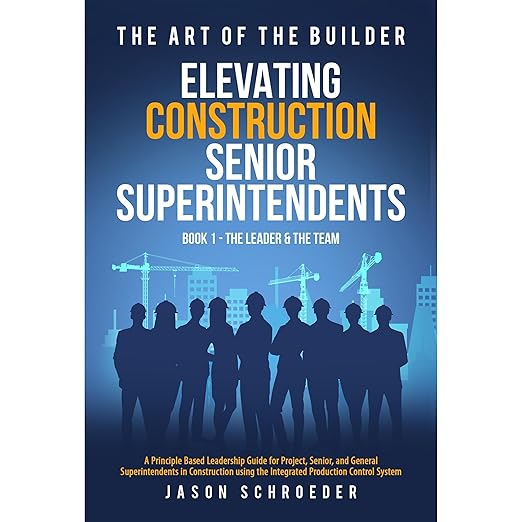
Chief people officer is an unusual job description for a construction superintendent, but that is exactly the reframe Jason Schroeder pitches at the start of this six-hour, twenty-four-minute audiobook. His argument is that senior-level superintendents should think of themselves less as the person executing the physical work and more as the person mentoring, organizing, and building the team that does it, a shift in identity as much as in daily task list. The book centers on three things Schroeder says any winning team needs: a multiplier leader, a strong team, and a clearly defined, strenuous performance target, and the whole audiobook builds outward from that three-part framework.
Book 1 of a Thread, Fourth Release Overall
The title carries a small numbering wrinkle worth flagging upfront: this is Book 1 of the Senior Superintendents thread specifically, but it is actually the fourth overall release in Schroeder's wider Art of the Builder series. That likely means it opens a new, topic-focused arc within an already-established body of work rather than launching Schroeder's project from scratch, so listeners new to his material should know there may be earlier Art of the Builder titles covering related ground, even though this particular book reads as a self-contained starting point for the senior-superintendent material specifically.
Virtual Voice narrates, and the mechanical regularity of synthetic delivery is a real, specific limitation for a book whose entire argument is about mentorship, team culture, and interpersonal leadership rather than pure technical procedure. Content built around the human dynamics of managing people, earning trust, building a multiplier leader's influence over a crew, tends to lean on vocal warmth that AI narration cannot fully replicate, even when the underlying content is sound. The more structural, framework-driven sections, the three-part model itself, translate more cleanly to synthetic narration than the softer mentorship material does, which is worth knowing before starting.
Individuals Don't Win, Teams Do, Schroeder Says
One reviewer brings genuine, hard-earned credibility to their praise: a builder for over forty years and a superintendent for twenty-five of those years, who describes the book as an eye-opener significant enough to change how they approach the job even after decades of experience. That is a meaningful endorsement precisely because it comes from someone with nothing left to prove and no obvious reason to be impressed easily; a career superintendent finding real value this late in a career suggests the three-part framework holds up against a lot of accumulated real-world experience rather than only appealing to newer supervisors still building their approach.
A second reviewer calls it 'a hidden gem' worth returning to more than once, directly thanking Jason by name for compiling the material, a small but telling detail that suggests a closely engaged, communicative relationship between the author and his specific professional readership. A third simply describes the guidance as 'good and practical information, well rounded,' adding that they appreciated how directly it could be applied both personally and on the job, which speaks to the book's stated goal of building better team environments rather than staying purely theoretical.
Schroeder's own line, that individuals do not win the war against waste and variation but teams do, is worth sitting with, since it reframes what a senior superintendent's actual job is measured against. Waste and variation are specific, familiar construction-management terms, inconsistent output, inefficient use of materials and time, and naming them directly rather than speaking only in generic leadership language gives the book real specificity within its own trade rather than reading like a repackaged general-business guide with a construction cover slapped onto it. That trade-specific grounding is part of why the forty-year builder's endorsement above carries real weight rather than reading as generic praise.
A Real Gap in How the Trade Trains Leaders
At just over six hours, the runtime fits a focused professional-development audiobook rather than an exhaustive management textbook, and Schroeder's three-part framework is compact enough that a listener can reasonably absorb the core structure in one sitting and then return to specific sections later as real workplace situations come up. That kind of returnable, reference-adjacent structure suits audio reasonably well for a leadership book, even with the caveat about AI narration and the softer mentorship content noted above.
Construction as an industry has a well-documented mentorship gap, with a large share of experienced site leaders approaching retirement and fewer newer superintendents getting the kind of structured, deliberate leadership training that other trades and industries have built out over the past few decades. That broader context is worth keeping in mind when weighing this book's value: a short, focused audiobook explicitly aimed at senior superintendents is filling a real, specific gap in how the trade develops its own leaders, rather than competing against a crowded field of existing construction-leadership resources.
Built for Truck-Cab and Job-Site Listening
This is written first for senior-level construction superintendents and site leaders specifically, rather than entry-level supervisors still focused mainly on execution, particularly anyone already sensing that their role has shifted from doing the physical work themselves to building and mentoring the people who do it now. Readers within Schroeder's existing Art of the Builder audience will also find plenty of value in this entry, since it appears to build on an established voice and framework rather than introducing his approach completely from scratch.
Listeners who need vocal warmth and personality to stay engaged with leadership content, or who are put off by AI narration on principle, should sample a preview first, particularly given how much of this book's value depends on the softer, mentorship-driven material. Entry-level workers looking for hands-on execution guidance rather than team-leadership philosophy should also know this is pitched specifically at senior superintendents, not at supervisors just starting out on the tools.
Audio specifically suits the schedule this audience actually keeps better than most professional-development formats do: a superintendent moving between job sites, sitting in a truck between meetings, or driving to an early morning walkthrough has real listening windows that rarely line up with time to sit down with a physical book or an online course. A runtime this compact fits naturally into that kind of fragmented schedule, playable in short site-to-site stretches rather than requiring one dedicated study session, which is a practical format advantage worth weighing alongside the content itself for this specific profession. Owners and project executives who want to understand how their senior field leadership is being trained could also get real value here, even without ever picking up a tool themselves, since the three-part framework doubles as a clear, shareable vocabulary for talking about leadership expectations across an entire organization, from the field all the way up to the executive team, which is a genuinely useful byproduct of a book this narrowly scoped.