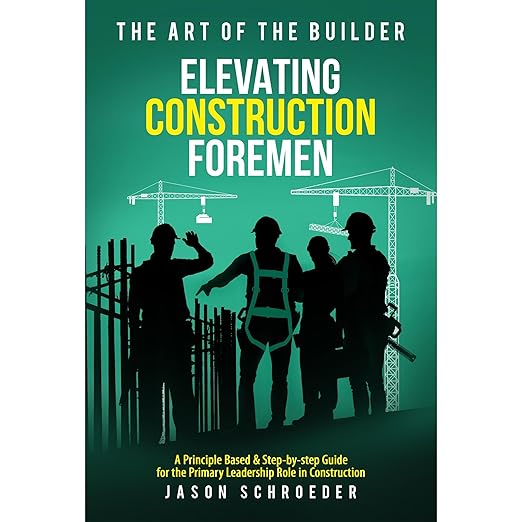
Elevating Construction Foremen occupies a narrow but genuinely underserved space in the professional development audiobook market. Jason Schroeder, writing the sixth entry in his Art of the Builder series, opens with an argument worth taking seriously: everything in a construction project flows through the foreman, and nearly every training resource in the industry treats that position as an operational afterthought rather than as the role on which everything else depends. This audiobook exists to correct that omission directly and without hedging. At seven hours and one minute, it covers enough practical ground to function as a working framework without tipping into the kind of padded comprehensiveness that plagues many business audio titles in adjacent leadership categories.
Only Crew Leaders Generate Actual Revenue
Schroeder's central claim deserves clear statement because it drives everything else in the book. Workers and crew leaders are the only positions that directly generate revenue in a construction project. Everyone else, estimators, project managers, superintendents, executives, exists in a support function for the people who actually build things. From that foundational premise, he constructs a compelling case for treating the foreman role with the same institutional seriousness the industry typically reserves for project management, and possibly more. The framework he provides covers how crew leaders can manage their teams effectively, how information, materials, equipment, and clear working areas should consistently flow to the front line, and how broader organizations can restructure their processes to reduce the constant interruptions that slow production and erode profitability over the course of a project.
A Game-Changer Despite the AI Narration
The reviews for this audiobook are notably enthusiastic given its niche subject matter. One listener described it as a game-changer that fundamentally shifted their understanding of what planning-ahead actually means at the crew level rather than at the management level. Another described it as easy to absorb and relatable, a meaningful compliment for a professional development title aimed at practitioners who may not identify primarily as habitual readers. Schroeder writes clearly and without unnecessary jargon, which is a deliberate and disciplined choice in a field that sometimes uses technical language as a substitute for actual clarity.
The Virtual Voice narration is a genuine consideration for prospective listeners. Schroeder does not narrate the audiobook himself, and the AI-generated delivery will not suit everyone across seven hours. The content is substantive enough that most reviewers on record do not mention the narration as a problem, but listeners who are particularly sensitive to synthetic speech should sample before purchasing rather than discovering the issue halfway through the production.
Joel Hamilton, Credited as Nearly a Co-Author
The specificity of this audiobook is its primary virtue as a professional resource. Most leadership content in the self-help and professional development space is written for white-collar managers and then applied loosely, often very loosely, to other industries and operational contexts. Schroeder writes from and for the construction industry specifically. The language, the scenarios, the examples, and the challenges are all calibrated to the field rather than translated from somewhere else, and that specificity is worth more than it might seem to practitioners who have spent years filtering generic leadership advice through their own construction industry context.
The acknowledgments section is also an instructive signal about the book's origins. Schroeder names multiple contributors by name and explicitly credits Joel Hamilton as someone who contributed enough to be considered nearly a co-author. That collaborative authorship is visible in the content itself: the framework feels tested against real conditions on real job sites rather than theorized from outside the industry. Listeners familiar with the earlier Art of the Builder volumes will recognize the approach and find this entry consistent with the series' established standards.
Nineteen Reviews, All Positive, Still a Small Sample
This is the sixth book in a series, and Schroeder writes with assumptions about a reader who has been engaging with his broader project rather than discovering his ideas for the first time. Listeners coming to this audiobook without any background in the Art of the Builder series may find some frameworks feel slightly underexplained, particularly where Schroeder references concepts he has developed more fully in earlier volumes. That said, the core argument about foreman centrality stands independently, and most listeners should be able to engage with the content productively even without the series history behind them.
The rating comes from only nineteen reviews, all highly positive, which is a small enough sample to limit conclusions about the audiobook's limits. Listeners in roles significantly above the foreman level, senior project managers or executive leadership, for instance, may find the material more directional than immediately actionable, since much of what Schroeder recommends requires organizational buy-in from above the foreman level to actually implement. The book is written for the person in the role as much as for the organization that needs to support them.
What Organizations Owe Their Foremen Directly
Foremen and crew leaders in construction who want a framework built specifically for their role will find this audiobook valuable in ways that general leadership titles rarely achieve for their particular context. Superintendents and project managers trying to understand how to better support frontline leadership will also get actionable perspective here. The book explicitly addresses what organizations owe their foremen in terms of information flow, material delivery, and advance planning, which gives higher-level listeners a concrete picture of what adequate support actually requires in practice. Listeners outside the construction industry will find many of the principles transferable but will need to do more contextual interpretation than the audiobook asks of its primary audience.
At a Glance
- Narrator: Virtual Voice narration; listeners sensitive to AI delivery should preview a sample before committing to seven hours.
- Subjects: Frontline leadership in construction, crew management and resource flow, planning discipline on the job site
- Tone: Practical, direct, and field-tested
- Bottom line: Jason Schroeder delivers a rare leadership framework built specifically for construction foremen rather than adapted from generic management theory, and the reviews reflect genuine industry recognition.
Frequently Asked Questions
How does the Virtual Voice narration hold up over the seven-hour audiobook runtime?
Reviewers on record do not cite the narration as a problem, but sensitivity to synthetic voice quality varies by listener. Sampling a preview before committing to the full runtime is advisable if you have uncertainty about AI-generated delivery across an extended professional development listen.
Is this audiobook relevant for construction professionals above the foreman level, such as project managers or superintendents?
Yes. The book argues that the entire organization should orient itself around clearing obstacles for frontline crew leaders, which has direct implications for how project managers and superintendents structure their own daily work. Higher-level listeners will find it useful for understanding what genuine support for foremen actually requires.
Does the audiobook address construction safety management specifically, or is the focus primarily on productivity and team leadership?
Schroeder treats quality, safety, schedule, and profit as interconnected areas of foreman responsibility throughout the framework rather than addressing safety in a dedicated standalone chapter. Listeners looking for a specialized safety management resource should supplement with a more focused title.