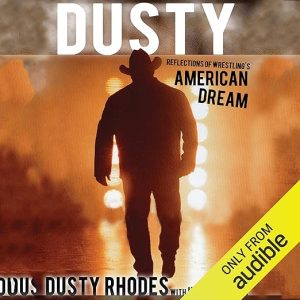
Somebody attached the wrong byline to this record, and sorting that out has to come before anything else. The title reads Dusty, the author field says Dusty Rhodes, and the category is sports with a combat sports tag hanging off it. The description underneath describes something else entirely: Judith Earle, a solitary childhood in a riverside house, awkward and intense years at Cambridge, travels with an elegant socialite mother, and the family next door whose members each fall in love with her. Two listener responses name the novel as Dusty Answer, two name Rosamond Lehmann as its author, and one does both. The audiobook runs eleven hours and fifty-eight minutes with Jenny Agutter credited as the reader.
What Dusty Rhodes Delivers
Margaret Johnston's four-star entry does the provenance work the listing refuses to do. It records that Dusty Answer was Lehmann's first novel, published in 1927 when the author was twenty-six, that sales were slow and critical notice thin until Alfred Noyes praised it in the Sunday Times, and that the review turned the book into a bestseller almost overnight. That same account describes the heroine, Judith Earle, as an intelligent, earnest girl who becomes entangled in the lives of five cousins who occasionally visited the house next door, played with her as a child, and reappeared years later.
Set that beside the publisher summary and the picture holds steady: a girl alone by a river, a mother more decorative than present, a university that supplies passion and disillusionment in roughly equal measure, and one family that absorbs her entire young womanhood. The description calls them the Fyfe family. Whichever surname you take, the shape of the novel is the same, and it is a shape that almost no contemporary book attempts anymore, because it refuses to make the heroine's desire into a plot with a solution.
The Best Parts of Dusty
The most useful reading of the novel comes from a four-star response signed bibliophile, which calls it a period piece from England before and after the Great War and then does something more precise. It traces Judith as a young woman of privilege whose father is dead and whose mother largely ignores her, whose only real companions are the group of young people who turn up next door at their grandmother's, all of them siblings or cousins, and who struggles the whole way through to find acceptance among them. Falling in love with one of them more than the others is not the story. Being permanently outside their circle is.
Nearly twelve hours sounds long for a book in which so little happens externally, and that is exactly why the format suits it. Lehmann's events are small, social, and internal, the kind of material a reader skims on the page and a listener cannot. Sentences that scan as decoration when your eye is moving fast turn out to be doing the psychological work, and hearing them at speaking pace is the closest most of us will get to reading a 1927 novel the way its first audience did.
Before You Commit to Dusty
The metadata problem is not cosmetic. A shopper hunting for a wrestling autobiography under that byline will find an interwar English novel, and a reader hunting for Lehmann will never find this file at all, because the title has lost a word and the author credit belongs to someone else. Nothing about the recording itself is in question here, but the search path to it is broken in both directions, and the sample is the only reliable way to confirm what you are buying before you commit twelve hours.
The pool is also old. Laura Canon's four-star entry is dated July 5, 1999, thirteen years before this recording was published in March 2012, and it mourns that Lehmann's books were out of print, recommending her to anyone who likes English writers such as Elizabeth Taylor or Mary Webb. That is enthusiasm for a novel that spent decades hard to find, which explains the warmth of the pool but also means most of it was written about paper.
Two further cautions, one about pace and one about evidence. ThatTwin's five-star entry, headed with a warning that you will not exit this quickly, reaches for Proust as a comparison, and anyone who has tried Proust knows that is a promise and a threat at once. And not one of the five responses says a word about Jenny Agutter's reading. They are responses to a novel, several of them written before this audio edition existed, so the performance itself remains untested by anyone on the page.
Who Should Pick Up Dusty
Victoria Ortiz, five stars in February 2013, supplies the strongest recommendation on the listing and the most revealing one. That entry describes first reading Dusty Answer more than fifty years earlier and wanting to reread it ever since, then finding it still powerful even with twenty-first-century eyes, the characters real and their struggles painful, recommended without reservation. Books that hold up across five decades of one reader's life are rare, and that is the specific claim being made here.
So: come to this if you read interwar English fiction, if you want a long slow account of first love that declines to resolve into anything tidy, or if you have been looking for Lehmann and gave up. Avoid it if you arrived from the sports shelf expecting a memoir from the ring, if you need forward plot momentum, or if a heroine's inner weather across twelve hours sounds like a chore rather than a pleasure. The novel is worth the hours. The listing is the only thing here that lies.
In Brief
- Voice: Jenny Agutter is the only voice credited across the full eleven hours and fifty-eight minutes, with no cast, abridgment, or dramatization noted on the record.
- Big ideas: first love and disillusionment, interwar English class, a girl's education by the family next door
- Atmosphere: slow, interior, quietly sad
- Worth it?: A 1927 novel that earns its twelve hours, sold under a byline and a category belonging to a completely different book.
Frequently Asked Questions
Which book does the Dusty audiobook actually contain?
The description and every substantive listener response point to Rosamond Lehmann's 1927 novel Dusty Answer, not to a sports memoir. The title field has dropped a word and the author credit belongs to someone else. Play the sample before buying, because the opening minutes will settle it faster than any field on the record.
How long is the Dusty audiobook and who is credited as narrator?
Eleven hours and fifty-eight minutes, published by Audible Studios in March 2012, with Jenny Agutter listed as the sole reader. No abridgment is noted anywhere on the record, and the running time is consistent with a complete text rather than a condensed one.
Is any background in 1920s English fiction needed first?
No. The novel explains its own world through Judith: a house by a river, a mother who travels, a university that changes her, and a family next door she cannot stop measuring herself against. Knowing the period helps you place the manners, but nothing in the book depends on that knowledge.
Is this a romance with a happy ending?
The publisher summary promises passion and disillusionment in the same sentence, which is a fair warning. Judith's attachment to the family next door drives everything, yet the book is far more interested in what wanting costs her than in pairing anyone off. Expect ache rather than resolution.