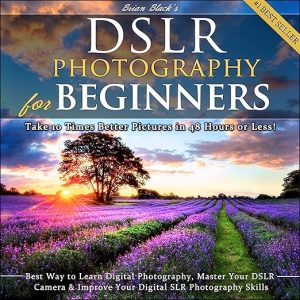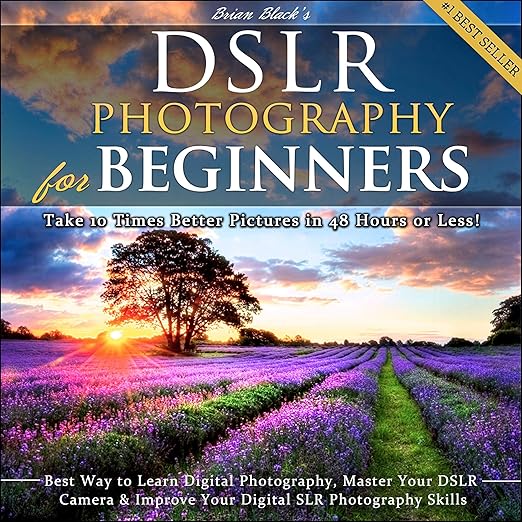
Can 111 minutes of audio actually teach you to see like a photographer? That's the real promise underneath this audiobook's admittedly hooky pitch, and DSLR Photography for Beginners is more interesting than its own marketing copy suggests. Brian Black's guide opens with the kind of direct-response energy you'd expect from a late-night infomercial, promising mind-blowing pictures and results within 48 hours, and comparing itself favorably to courses that can run upwards of a thousand dollars, and if that style isn't your taste, know upfront that it doesn't let up much across the runtime.
Underneath the salesmanship, though, is a genuinely specific curriculum: composition and the rule of thirds, how angles and framing turn a picture into a story, the practical differences between wide angle, telephoto, and fisheye lenses, and how polarizing, neutral density, and ultraviolet filters actually change an image. This audiobook was clearly written by someone who remembers exactly what it felt like not to know any of that, and who built the guide specifically around what he wished he'd had access to when he was starting out.
893 Ratings and a Reviewer Who Knew Nothing
Black frames his own origin story as the reason the guide exists: he couldn't find an option that wasn't either buried in jargon or priced like a four-figure course, so he built the thing he wished had existed. That's a common self-published nonfiction structure, but it lands here because the content list that follows actually matches the promise, concrete techniques rather than vague encouragement to find your eye, everything from focal points to how to mix up your shots with specialized lens alternatives.
A 4.3 rating across 893 ratings for a sub-two-hour beginner's guide is a solid outcome, and the reviews back up the synopsis's own claims specifically. One reviewer, new enough to the hobby that the letters SLR were still a mystery, credits the audiobook with providing an actual foundation rather than just confidence-boosting pep talk, which is the right bar for a book pitched this directly at total beginners who feel behind before they've even started.
The synopsis's repeated promise that developing an eye for photography is possible, even for someone who has never picked up a camera, is worth taking seriously as the book's actual thesis rather than just cover copy. Black isn't just listing settings and specs; he's arguing that seeing a good photograph before you take it is a learnable skill, not a talent some people simply have and others don't, and the whole guide is structured around proving that specific point.
Andrew Helbig's First Appearance Here, and the Right Tone
Andrew Helbig narrates, and this is a first appearance in these notes with no prior track record to draw on. What the material clearly needs is an approachable, unintimidating register that keeps the promised jargon-avoidance sincere rather than condescending, since the entire pitch of the book amounts to a promise not to make anyone feel stupid for not knowing this yet. A narrator who tips that tone into talking-down-to-the-listener territory would undercut the whole premise Black spends the opening minutes establishing.
One review stood out for its specificity: a social media manager for a small college describes needing usable photos in wildly inconsistent conditions, indoors, outdoors, full sun, dark rooms, and finding this guide's explanations organized and easy to apply on the job rather than just easy to follow in the abstract. That's a meaningfully different endorsement than generic praise, someone actually used the content under real deadline pressure across a genuinely varied set of shooting conditions, not just as pleasant background listening.
A Primer at 111 Minutes, With a Real Format Limit
Be honest about the runtime going in. One hour and fifty-one minutes is a primer, not a comprehensive manual, and it won't replace a full technical course on manual-mode settings or advanced post-processing. Treat it as a fast on-ramp for the specific concepts it covers, rule of thirds, lens choice, filter basics, rather than an exhaustive reference to return to for years of shooting.
An inherent format tension is also worth naming directly: photography is a visual skill, and an audiobook can describe the rule of thirds or a filter's effect but can't show the resulting image. Listeners will get real conceptual grounding here, but pairing this with even a quick look at example photos afterward will do more for retention than audio alone, especially for the more visually dependent concepts like framing and focal points that Black spends real time describing in words alone.
Beneath the Pitch, Genuine Filter and Lens Specifics
Short instructional audio like this lives or dies on how well it respects a beginner's actual attention span, and under two hours is a deliberate choice rather than a limitation born of thin material. Compared to multi-hour technical courses that front-load theory before ever getting to practical application, this format gets a listener to usable technique fast, at the real cost of depth on any single topic.
Beginner guides that lean hard into direct-response marketing language are a familiar self-published subgenre by now, and listeners who've encountered a few will recognize Black's specific rhythm of rhetorical questions and urgent promises. What separates a good one from a forgettable one is whether the actual instructional content holds up once the pitch fades away, and the specificity of the technique list here, real filter types, real lens categories, suggests this one does.
True Beginners Who Just Bought Their First DSLR
True beginners who just bought or are about to buy a DSLR and feel intimidated by denser technical guides are the exact target audience, and the reviews confirm the book delivers for that specific reader. Anyone wanting a fast primer before a trip, event, or new hobby purchase will get real value from under two hours, and the direct, confident tone works in the book's favor for listeners who specifically want to feel encouraged rather than lectured.
Skip it if composition basics and filter types are already familiar territory, since there isn't enough runtime here for genuinely intermediate material. Listeners who learn best from seeing example images side by side with the explanation should also budget time to look some up separately rather than expecting the audio alone to fully close that gap, particularly around lens comparisons where seeing the actual difference matters more than hearing it described.
Good to Know
How long is the DSLR Photography for Beginners audiobook?
One hour and fifty-one minutes.
Can an audiobook really teach photography without showing example images?
It gets you real conceptual grounding, but pairing it with a quick look at example photos afterward will do more for retention than audio alone, given how visual the skill is.