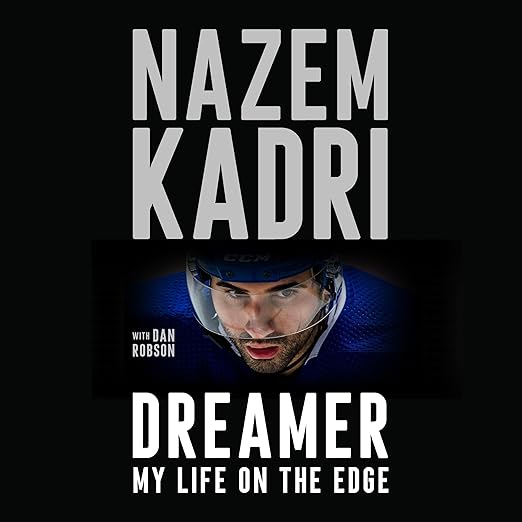
- Read by: Kadri reading his own account of abuse aimed at him is a different object from a hired performance of it, and the unevenness is part of the value.
- At its heart: representation and its price, a career reshaped by a trade, faith carried into a locker room
- Vibe: Warm and unbitter, generous about people who were not generous back
- Short version: A short, candid sports memoir strongest on what happened away from the ice, weakest on the hockey itself.
The Stanley Cup spent one of its days at a mosque in London, Ontario, and that image is the destination this audiobook is walking toward for six and a half hours. Nazem Kadri won it with Colorado in 2022, the first Muslim player to do so, and took his day with the trophy home. Everything before that moment in the book is the cost of arriving at it.
The Verdict, Briefly
Toronto drafted Kadri in the top ten, and the description is unusually candid about why: elite skills, yes, and also a player who would reflect the city's immense diversity and large Muslim population. Being selected partly as a symbol is a strange professional inheritance, and it shapes everything that follows. Fans took to him for old-school toughness as much as for the highlight reels, which meant he was simultaneously the representative of one community and the enforcer traditionalists wanted. Carrying both is the recurring strain of the first half.
A five-star from 6 November 2024 reads the Toronto years the way the book invites: as a period when management worked against a young player's development rather than for it. That response also says outright that the reader deals with racism too and found the book resonated because of it, which is the audience Kadri is most obviously writing for. Whether you accept the management critique or not, the book's account of thriving in the face of it is the emotional spine.
Kadri reads it himself, and on this material that is not a cost-saving decision. The harassment during Colorado's Cup run was directed at him personally, and hearing him deliver it in his own voice is a categorically different artifact from a hired reader performing somebody else's abuse. Athletes make uneven narrators as a rule. Here the unevenness turns into an asset, because the moments where the delivery tightens are the moments that still cost him something.
Two crowds define the championship section, and Kadri holds both in view at once. Brutal anti-Muslim harassment came from one opposing fan base during the Colorado run; extraordinary support came from Denver. Neither cancels the other, and the book resists the easy move of letting the good crowd redeem the bad one. What it produces instead is a fairly unsentimental account of how quickly a professional athlete learns to sort a building by which section is shouting what, and how little control anybody has over which version of a city they get.
Why Listen to Dreamer
Access is the sell. A five-star from 4 January 2025 calls this one of the best hockey books it has come across, praising the first-hand accounts of specific well-known moments and the willingness to be vulnerable about them, and it closes by recommending the audio edition specifically. That is the only written response on the listing to say anything about the format at all, and its point is a fair one: a first-person sports memoir gains something real when the first person is doing the talking.
Humor turns out to be the book's most interesting weapon. After the controversy over an uncalled penalty on the Cup-winning goal, Kadri answered it by making joke t-shirts and turning the result into more than a quarter of a million dollars for his foundation. A grievance memoir would have litigated the call for a chapter. This one monetizes it for charity and moves on, and that instinct, deflecting hostility by converting it into something useful, runs through the whole account.
Purpose sits underneath all of it. Kadri helped found the league's diversity alliance, has been asked to speak for a community since the day he first put on skates, and closes on the idea that the highest success is a destiny anyone can choose. Read cynically, that is a motivational-poster line. Read against the preceding six hours, in which a top-ten pick spends a decade being told what kind of player he is allowed to be, it lands harder. The book earns its final sentiment by having refused sentiment for most of its length.
Points to Consider
Written responses on this page are fan mail, and should be read as such. A five-star from 14 November 2024 signs off by telling Kadri he is missed in Colorado, which is affection rather than assessment. All five visible entries are five stars, while the underlying average across 143 ratings sits at 4.5, so somewhere behind the column are readers who were less delighted and did not write. Nothing on the page tells you what they objected to.
Publisher information on the record is a print imprint rather than an audio one, which is a small thing that occasionally matters. It tells you nothing about who produced or engineered the recording, and it means the page carries no audio-specific production credit at all. For a self-narrated memoir that is rarely a problem, but a buyer comparing editions has less to go on here than usual.
Scope is the honest caveat. Six hours and thirty-eight minutes covers a draft, a decade in Toronto, a trade, a championship, an international harassment story and an ongoing career in Calgary, which means compression everywhere. Anyone wanting tactical hockey analysis, systems, or a detailed account of the Cup run game by game will find the book moving faster than that. The book is a life told through hockey rather than hockey explained through a life.
Should You Listen to Dreamer?
Hockey listeners who follow the league closely will get the most, since half the pleasure is hearing a participant describe moments they watched from outside. Beyond that, it works for anyone interested in what representation costs the person doing it, and for young athletes from communities with no obvious path into a sport. Kadri is explicit that the book exists partly to be handed to them.
Set it aside if you want an analytical hockey book, or a settling of scores with names and receipts, because the register stays generous even when the material is not. Set it aside too if you need a comprehensive career account rather than a selective one. The hockey is not decorative either, for anyone hoping to skate past it: the frame is a career, and the story gets told inside it.
Before You Listen
Do I need to follow hockey to enjoy this audiobook?
Following the sport helps but is not required. The career markers, a top-ten draft, a trade to Colorado, a championship in 2022, get explained as they arrive, and the central material is about harassment, faith and representation. Listeners with no interest in the game at all will find the frame stays hockey throughout.
How much of the audiobook covers the 2022 Stanley Cup run?
Less than a hockey fan might hope. The run matters most as the setting for the anti-Muslim harassment Kadri received, the disputed penalty on the winning goal and the day he took the trophy to his hometown mosque. Six hours and thirty-eight minutes across a whole career leaves little room for game-by-game detail.