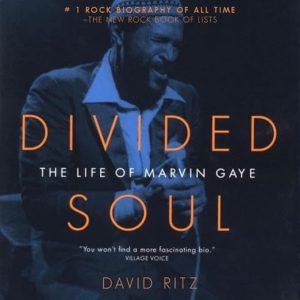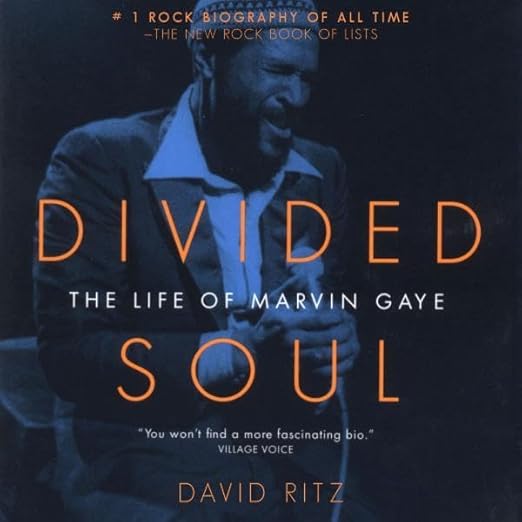
Divided Soul is one of the finest music biographies in the audiobook catalog - not because David Ritz was an objective observer, but precisely because he wasn't. Ritz spent years as Marvin Gaye's collaborator and confidant, conducting interviews that Gaye himself understood might become a posthumous record. That proximity produced material that no journalist arriving after the fact could have obtained: Gaye discussing the nature of his divided self, his relationship with God and sin, his complex terror of his own father, and the specific way fame interacted with a psychology that was always simultaneously reaching toward transcendence and pulling toward collapse. Dion Graham narrates this audiobook, and the casting is exactly right.
Graham's voice has a quality that suits the material in a way that is difficult to articulate without sounding mystical. He reads with the musicality of someone who understands that Gaye's biography is inseparable from his sound - that to tell this story without a feel for rhythm, pause, and tonal modulation is to miss the subject entirely. The six-hour-and-thirty-seven-minute runtime covers Gaye's trajectory from the Washington, D.C. slums through his early gospel work, his Motown rise alongside Diana Ross, Berry Gordie, Smokey Robinson, and Stevie Wonder, his fall, his European exile, his comeback, and finally his death at his father's hands the day before his forty-fifth birthday.
What makes this biography exceptional rather than merely good is Ritz's willingness to hold two contradictory truths simultaneously. Gaye was a charming, generous, genuinely brilliant artist and a deeply troubled man whose demons were not incidental to his music but constitutive of it. The songs that made him iconic - What's Going On, Let's Get It On, Sexual Healing - did not emerge despite his psychological complexity but from within it. Ritz understands this and structures the biography accordingly: the music is not a separate thread from the personal narrative but its fullest expression.
The reviewer who wrote that this was the most honest music biography they had encountered was identifying something real. Ritz does not protect Gaye's reputation by softening the addiction, the paranoia, the treatment of the women in his life, or the strange theological framework through which Gaye understood his own excess. Nor does he reduce Gaye to those failures. The portrait that emerges is of a man who genuinely believed in love as a spiritual force while being constitutionally unable to sustain it in his own life, and that tension is the book's true subject. Graham delivers that complexity without editorializing, which is the correct choice.
The Best Parts of Divided Soul
The audiobook format does something particular for this biography that reading in print cannot fully replicate. Graham understands pacing in a way that honors Gaye's own musicality - he knows when to move quickly through difficult material and when to hold with a sentence that deserves weight. The Motown sections, which cover some of the most important American popular music history of the twentieth century, are rendered with the specificity that Ritz's access enabled: these are not impressionistic scenes but specific conversations, specific moments in the recording studio, specific fights with Berry Gordie about creative control over what became seminal work.
At six hours and thirty-seven minutes, the biography covers an enormous amount of ground without feeling rushed. Ritz is a writer with a journalist's sense of selection, and he knows which stories carry the biography's argument about the divided nature of his subject's soul. The pace is brisk but not compressed; nothing essential feels dropped. Graham's rhythm through the material mirrors that sense of purposeful forward movement, making the six-plus hours pass with the momentum of a much shorter recording.
Before You Commit to Divided Soul
The biography is candid about the circumstances of Gaye's death at his father's hands, and the chapters leading up to that event are among the most quietly devastating in the audiobook. Ritz had the context that makes those final years legible: the return to his parents' home in Los Angeles, the cocaine and the paranoia, the way a lifelong relationship with a father who never celebrated his success culminated in a moment of violence that the family and Gaye's estate spent decades trying to contextualize. Graham reads those chapters with a stillness that makes them land harder than a more dramatic approach would.
One reviewer raised the question of why no Marvin Gaye biopic has been made, suggesting the complete story would be difficult to contain in a film and that much of it would be hard for audiences to reconcile with the music they love. That observation holds. The audiobook is the form that can honor the full complexity without the distortions of dramatic compression or the need to protect a posthumous legacy. What is here is the uncompressed version, and Graham's narration serves that completeness faithfully.
Should You Listen to Divided Soul?
Listeners who love Gaye's music and want the full context behind it will find this biography essential listening. Anyone interested in Motown history, Black American music from the 1960s through the 1980s, or the specific economics and politics of the Motown creative system will find the biographical details Ritz assembled here are not available in the same form anywhere else.
Skip this if you want a celebratory portrait that keeps the darkness at a distance. Ritz did not write that book and Graham does not narrate it that way. The divided soul of the title is taken seriously throughout, and the biography is proportionally harder to listen to for it - which is also what makes it the most enduring account of Gaye's life that exists in audio form.
For listeners who have encountered Gaye only through his music, the biography functions as a profound expansion of context. Songs like What's Going On and Inner City Blues carry political weight that is well-documented; what this biography adds is the personal architecture that surrounded and enabled that work - the specific period of Gaye's life in which artistic ambition and personal chaos were most productively intertwined. Graham's narration makes that architecture audible, giving the biographical narrative a rhythm that feels appropriate to its subject in a way that even a careful reader might not fully register from the page alone.
Common Questions
Does the Divided Soul audiobook cover Marvin Gaye's death and the circumstances surrounding it?
Yes, in detail. Ritz had the biographical context and personal relationship with Gaye to address the circumstances of his death - shot by his father the day before his forty-fifth birthday - with specificity and without sensationalism. Those final chapters are among the most sobering in the book.
Is Dion Graham's narration in the Divided Soul audiobook appropriate for a music biography?
Graham is an excellent match for the material. His narration has a musicality that suits a biography about soul music, and he handles both the celebratory passages about Gaye's recordings and the darker biographical material with consistent skill.
Does this audiobook cover the broader Motown history or focus only on Marvin Gaye?
The biography is centered on Gaye but the Motown context is substantial. Diana Ross, Berry Gordie, Smokey Robinson, and Stevie Wonder all appear as significant figures in Gaye's story, and the specific dynamics of the Motown system are explored in enough depth to function as social history alongside the biography.
How does David Ritz's personal access to Marvin Gaye affect the Divided Soul audiobook's credibility?
Ritz collaborated with Gaye for years before the singer's death and conducted interviews that Gaye understood might become a posthumous record. That access produced material unavailable elsewhere - Gaye's own words on his psychology, his theology, his father, and his music - which makes the biography both more intimate and more credible than accounts assembled from secondary sources.