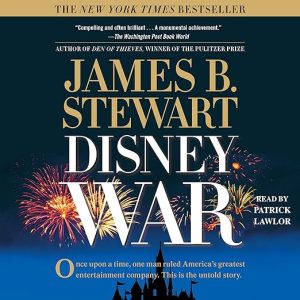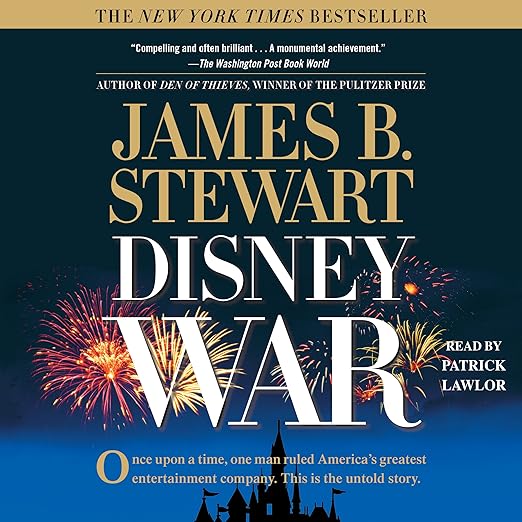
James B. Stewart built his reputation on works like Den of Thieves and Blood Sport - meticulous, sourced, narratively gripping accounts of powerful institutions behaving badly - and DisneyWar may be the fullest expression of that approach. This audiobook, narrated by Patrick Lawlor, runs twenty-five hours and forty minutes and covers the corporate collapse of Michael Eisner's tenure at the Walt Disney Company with unprecedented access to both Eisner himself and Roy Disney, the founder's nephew who eventually declared open war on the chairman. Stewart had access to thousands of pages of internal documents, memos, and transcripts that most corporate journalists never see, and it shows in the texture of the narrative at every level.
First, the Big Picture
The Disney most people know - the theme parks, the animated features, the brand synonymous with family entertainment - is precisely what makes the internal story of the Eisner era so dissonant. Stewart opens with Roy Disney's November 2003 resignation and the declaration of war that followed, then moves methodically through the history of a corporate culture that had corroded in ways invisible from the outside. The central mysteries he investigates are not small ones: what actually caused the catastrophic break with Jeffrey Katzenberg, the studio chief who built much of Disney's second golden age and then became Eisner's most dedicated enemy? How did Michael Ovitz, widely considered the most powerful man in Hollywood and Eisner's close friend, end up as Disney president for fourteen months before being fired with a payout that triggered years of litigation? What happened between Eisner and Pixar's Steve Jobs that made the destruction of that partnership seem preferable to any accommodation?
Stewart answers each of these questions with specificity that gossip cannot provide. The memos, the transcripts of board meetings, the recollections of people who were present in rooms where decisions were made - these give DisneyWar an evidentiary weight that distinguishes it from retrospective entertainment industry mythology. One reviewer compared it favorably to Barbarians at the Gate and noted accurately that it covers a business defined by "effervescent magic" while demonstrating that the internal reality contained all the ego, paranoia, and political maneuvering of any other major corporation. That juxtaposition - the gap between Disney's public identity and its internal reality - is the book's central tension and its primary source of dramatic energy across the full runtime.
What Makes DisneyWar Worth Hearing
Patrick Lawlor is well-suited to this material. The book requires a narrator who can handle both the procedural density of corporate chronology and the human drama of individual personalities in sustained conflict. Lawlor manages the large cast - Eisner, Roy Disney, Katzenberg, Ovitz, Jobs, Frank Wells, Sandy Litvack, and dozens of board members and executives whose names and positions need to remain distinct - with a consistency that makes the twenty-five-hour runtime navigable. The differentiation is functional rather than theatrical, which is what this kind of corporate narrative requires. The listener needs to know immediately who is speaking and what their position in the hierarchy is, and Lawlor's delivery provides those anchors without interrupting the momentum of Stewart's prose.
One reviewer noted that the book's thoroughness works against it in places - Stewart covers every episode in granular detail, and some sections on film development process and board governance will test some listeners' patience. At twenty-five hours, that is worth acknowledging honestly. Those who stayed with it consistently described the overall experience as among the better nonfiction audiobooks they had encountered, and the final sequences - the September 2004 board meeting, Eisner's last maneuvers - reward the patience the earlier chapters require. The payoff for investing in the detail is a narrative whose conclusions are not available to the reader who skips to the interesting parts.
A Few Reservations
The Eisner-Katzenberg rupture is the book's emotional core, and Stewart builds to its full context gradually. Katzenberg's departure in 1994, after Frank Wells's death removed the most important internal mediator in the executive structure, set in motion a decade of legal and personal conflict that cost Disney hundreds of millions of dollars. Understanding why that relationship broke so completely - and how Eisner's particular need for control operated across his major relationships with Ovitz, Jobs, and Roy Disney - is what makes DisneyWar more than a corporate scandal chronicle. It is an extended study in how a single leader's psychological architecture can reshape an institution around its own limitations.
The September 2004 board meeting, in which Eisner played what Stewart describes as his last cards, is the book's formal climax. Stewart's account of that meeting - drawn from transcripts and participant recollections - has the pacing of a political thriller, which is appropriate given what had accumulated over a decade. Listeners who have been patient with the book's earlier density will find that patience rewarded in the final sections.
Should You Listen to DisneyWar?
Listeners with an appetite for serious corporate journalism - the kind that treats business as human drama rather than management case study - will find DisneyWar essential. Anyone with a personal or professional interest in Disney's history, Hollywood's power structures, or the psychology of executive leadership at the top will find the material unusually rich. The comparison to Barbarians at the Gate is apt: both books require investment in corporate specifics and reward it with genuine narrative tension. Casual listeners looking for a quick entertainment industry overview should know this is a demanding audiobook. Those who find corporate governance detail genuinely tedious should adjust their expectations before committing to twenty-five hours; those who find it fascinating will be well-served by every page of Stewart's reporting.
Questions Listeners Ask
Does this audiobook cover the full Eisner era at Disney, or just the final years?
DisneyWar covers the full arc of the Eisner tenure, tracing the decisions and relationships from his early years at Disney through the golden age of The Little Mermaid and The Lion King and forward into the deterioration of the late 1990s and early 2000s. The book provides context for why the final conflict with Roy Disney was the culmination of accumulated damage.
Is this audiobook accessible without prior business or entertainment industry knowledge?
Stewart writes for a general audience and explains corporate structures and Hollywood dynamics as he goes. Prior knowledge is helpful but not required. The personal drama between Eisner, Katzenberg, Ovitz, and Jobs is engaging enough to carry listeners through sections that require more patience with corporate procedure.
How does Patrick Lawlor's narration handle the large cast of executives and board members in this audiobook?
Lawlor differentiates the cast functionally rather than theatrically - the vocal differentiation is consistent and clear without being exaggerated. Across twenty-five hours and a very large cast of named individuals, that consistency is essential for keeping the corporate politics intelligible from chapter to chapter.
Is this audiobook sympathetic to either Eisner or Roy Disney, or does it present both perspectives?
Stewart had unprecedented access to both sides and his journalism is notably balanced. Eisner comes across as a complex figure - genuinely talented and also paranoid and destructive - rather than a villain. Roy Disney's position is treated with equal scrutiny. The book's reputation for fairness is part of what makes its unflattering conclusions so credible.