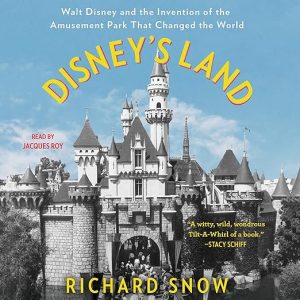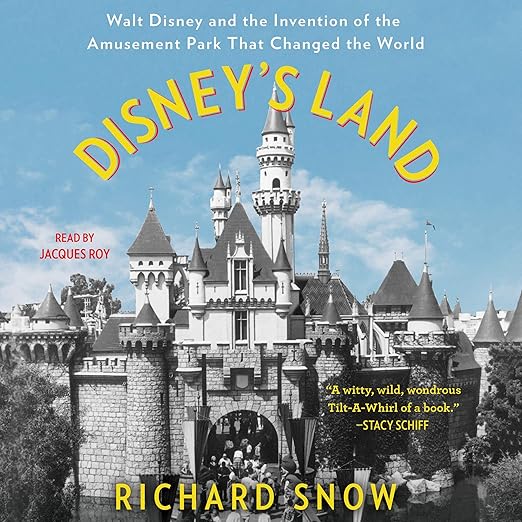
Walt Disney stood over 240 acres of Anaheim farmland in the early 1950s and pictured a place where people could live among Mickey Mouse and Snow White for a day, a week, or forever, so why did literally no one around him, not his brother Roy, not the bankers, not even his wife Lillian, want him to build it? This audiobook, Richard Snow's Disney's Land, spends its opening chapters inside that near-universal skepticism before tracking exactly how Disney overcame it.
Written by Snow and narrated by Jacques Roy, this twelve-hour-and-one-minute audiobook holds 4.6 out of 5 from 653 ratings on Audible. The Wall Street Journal called it 'entertaining,' and Ken Burns is quoted praising Snow's 'historian's eye and a child's delight,' blurbs that track closely with what listeners themselves report.
Financed Partly by Davy Crockett Coonskin Caps
Snow builds his account around the gap between Disney's vision and everyone else's skepticism, and that gap does real narrative work. Amusement parks in the early 1950s carried the reputation of Coney Island: sagging, disreputable, a business nobody respectable wanted to be associated with. Disney financed the park partly against his own life insurance policy and later brought in ABC as a sponsor, funding the rest through an unlikely windfall, the sale of enormous quantities of Davy Crockett coonskin caps. That detail alone tells you the kind of resourceful, slightly improvised production this book documents, not a smooth corporate rollout but a genuine gamble assembled from whatever leverage Disney could find.
The opening-day disaster on July 17, 1955, gets treated with real weight rather than as a quick footnote before the triumphant ending. Snow describes Disney as 'nearly suicidal with grief' at what looked like a public failure on a grand scale, before the book pivots to the 800 million visitors who have come since. That willingness to sit inside the failure before the recovery is what separates Disney's Land from a simple corporate-history victory lap.
Nearly Suicidal With Grief on Opening Day
The retired admiral brought onto the design team is a small but telling detail about how seriously Disney treated the construction as a logistics problem, not just a creative one. Coordinating engineers, animators, and landscapers on a year-and-a-day deadline required something closer to a military-scale operations plan than a typical construction schedule, and Snow's inclusion of that hire signals how much the book cares about the unglamorous coordination work behind a famously imaginative result.
Eight hundred million visitors since 1955 is a figure worth sitting with for a moment: that is more than double the entire current population of the United States, accumulated one park visit at a time across seven decades. Snow uses that number less as a triumphant final statistic than as the payoff to the specific, granular difficulty the rest of the book spends hundreds of pages establishing, which is why it lands with real weight rather than reading as a marketing footnote.
Roy Keeps Walt, Roy, and Lillian Straight
Jacques Roy's narration favors composed authority over showmanship, a register that has served dense narrative nonfiction well elsewhere in his catalog, and it suits a book with this many names to track: Walt, Roy, Lillian, ABC executives, a retired admiral, engineers, animators, and landscapers all cycling through the story of a single frantic year-and-a-day build. Keeping listeners oriented through that many contributors without the story bogging down is a real narration challenge, and Roy's steady, unhurried pacing handles the proper-noun density cleanly.
Fun Even for the Screwdriver-Averse, One Reviewer Says
Reviewer Doc Watson, who has visited Disneyland for over 60 years as a longtime Southern California resident, calls the book 'expansive' and 'informative,' a review worth weighing given how much personal history he is measuring it against. Carol Peckham makes a sharper point about Snow's actual skill: he specializes in narrating how transformative technologies and inventions happened in a way that stays 'fun to read even for those of us who recoil at screwdrivers and exposed wiring,' meaning the engineering and construction chapters land as genuinely entertaining rather than as dry technical detail.
Snow's own reputation as a popular historian, evident in the blurbs from both the Wall Street Journal and Ken Burns, rests on making dense institutional and financial history readable without dumbing it down, and Disney's Land continues that pattern. The book treats financing structures, life-insurance policies leveraged, ABC sponsorship deals negotiated, with the same narrative energy it brings to the more obviously cinematic material, which is a harder trick to pull off than it sounds.
A Pleasant Read, Not New Scholarship
Listeners who have already read deeply on Disneyland's history should adjust expectations. Reviewer D. Gottwald, who says he has 'read just about everything available' on the park's development, calls this one 'a pleasant read' rather than a source of new scholarship, and specifically points to Todd James Pierce's Three Years in Wonderland as the more recent original-research title in the space. For newcomers to the subject, Gottwald's own four-star review still frames Disney's Land as the right starting point, just not the deepest dive available.
The Origin Year, Not the Decades After
At 12 hours, the book also stays tightly focused on the park's conception and construction rather than surveying the decades of expansion that followed. Listeners hoping for a comprehensive history of Disneyland through the present day, rather than the specific origin story of its first troubled year, should know the scope stops well short of that.
The Davy Crockett coonskin cap financing detail is a genuinely remarkable piece of pop-culture history in its own right, not just a colorful footnote. The Davy Crockett craze exploded across America in 1954 and 1955, driven substantially by Disney's own television series, and the fact that merchandise from one Disney project helped bankroll an entirely separate one says something real about how integrated Disney's businesses already were before the park itself proved anything.
Skip It if You Want Fresh Scholarship
Disney history buffs, theme park enthusiasts, and anyone interested in how ambitious, financially precarious projects actually get built will find plenty here. Doc Watson's six-decade relationship with the park itself suggests this book rewards both newcomers and lifelong fans, and listeners who enjoy narrative nonfiction about invention and engineering, the kind Carol Peckham praises Snow for elsewhere in his catalog, will find the construction chapters especially satisfying.
Skip this if you are already deeply read on Disneyland history and specifically want new original scholarship, since Gottwald's review suggests Three Years in Wonderland covers that ground more freshly. Listeners wanting a full history of the park's evolution past its opening years, rather than a tightly focused origin story, should also look for a different, broader title.
Before You Listen
Does this audiobook cover the full history of Disneyland or just its founding?
Mostly the founding. Disney's Land focuses tightly on the park's conception, financing, and construction through its rocky opening day, not the decades of expansion that followed.
Is Jacques Roy's narration in this audiobook easy to follow given how many people are named?
Yes. Roy keeps proper nouns and the large supporting cast, from Roy Disney to the engineers and animators involved, clearly distinguishable through steady, unhurried pacing rather than rushing through the detail.
Is this Disney's Land audiobook worth it if I already know Disneyland's history well?
Possibly less so. One well-read reviewer calls it a pleasant listen rather than new scholarship, and points to Todd James Pierce's Three Years in Wonderland for more original research.
Does the audiobook cover Disneyland's disastrous opening day?
Yes, in detail. Snow treats the chaotic July 17, 1955 opening day as a real low point, describing Disney's despair before the park's eventual, enormous success.