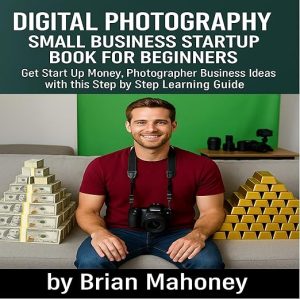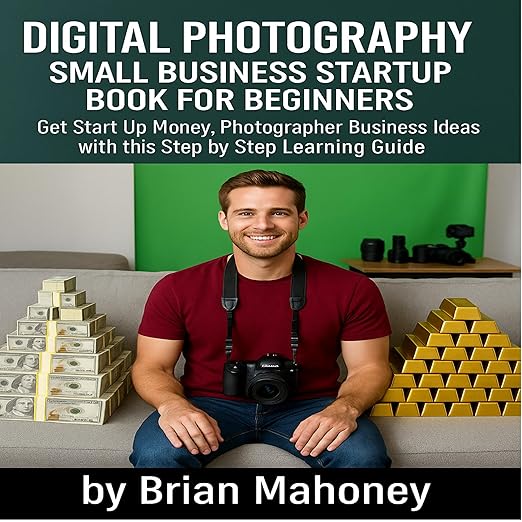
Can a smartphone camera really become the foundation of a paying business? That is the promise at the center of this audiobook, narrated by author Brian Mahoney across a brisk three hours and seven minutes, which walks beginner photographers through picking a profitable niche, securing startup capital, and structuring a business built to protect their profits rather than just their gear.
Mahoney pitches the material at three overlapping audiences: hobbyists wondering if their passion could ever pay real bills, side-hustlers looking for additional income, and photographers tired of shooting for “exposure” instead of money. The book stays entirely on the business side of the equation, client acquisition, pricing structures, incorporation, and does not cover camera operation or technical photography skill.
Scroll Up and Click Buy Now, Verbatim
Reviewer Scoso frames this precisely: “If you are looking for a book that tells you how to operate all the photography gear itself, this is not that.” The book instead stays on the business side throughout, incorporation, client acquisition, offer stacking, so what it does cover gets real depth within a short runtime rather than trying to also teach technique and spreading itself thin.
The tone throughout is unapologetically sales-forward, right down to a closing line urging listeners to “Scroll up and click Buy Now,” a holdover from the book's written sales copy that survives intact into the audio synopsis. That style will read as motivating to some listeners and as a little much to others, and it is worth knowing going in that the persuasive, hustle-culture register of the marketing extends into the substance of the book itself, not just its cover copy.
The specific business topics Mahoney covers, incorporation structure, protecting personal assets, stacking multiple revenue streams from a single photo shoot, print sales alongside session fees alongside licensing, give the book a genuinely practical skeleton beneath the motivational language. A beginner walking away from three hours with even a rough mental model of how to structure pricing and protect their new business legally has gotten real, usable value, even if the delivery leans harder into hype than a more buttoned-up business guide would.
Reviewer Eddie Williams keeps his praise brief, calling it simply “Awesome,” which is not the most informative endorsement on its own but does add a third independent five-star voice to a title that already carries a strong 4.6 average, suggesting the positive reception here is not limited to the two more detailed reviews doing most of the descriptive work.
It is worth situating this within the wider self-published business-guide category on audio platforms generally, a crowded space where quality varies enormously and where a short runtime can sometimes signal thin content rather than efficient editing. Reviewer feedback here suggests Mahoney lands closer to the efficient-editing end of that spectrum, delivering a focused argument rather than padding three hours with repetition, even if the persuasive tone will not suit every listener's taste in business writing.
Mahoney's Coach-Style Voice Backs His Own Advice
Mahoney narrating his own material gives the advice a direct, first-person confidence that a hired narrator reading someone else's business plan secondhand could not really replicate. The synopsis describes him as having taught thousands of entrepreneurs how to build businesses on low startup costs, and whatever the exact scale of that experience, hearing the strategies delivered in his own voice, rather than performed by an actor, reinforces the practical, coach-style register the book is going for.
Reviewer James Deen 29 took the book on his nephew's behalf, someone brand new to photography asking how to book his first paying gigs, which is a useful real-world test case for exactly who this is built for: not an experienced photographer looking to scale, but someone who does not yet know where to start monetizing a camera at all. The straightforward, step-by-step structure reviewers describe suits that beginner audience specifically.
Cash-Machine Claims With No Cited Evidence
That same reviewer, James Deen 29, is more mixed overall, admitting “I have to admit that I've read (and seen!) better” elsewhere, even while finding the book useful enough to recommend onward to a true beginner. That kind of qualified praise is worth taking seriously: this reads like a solid, honest starting point rather than a definitive or exhaustive treatment of building a photography business, and more experienced side-hustlers may find the strategies more introductory than they are hoping for.
At just over three hours, this is a fast, compact listen rather than an exhaustive business course, and the marketing language throughout, cash machine framing, secret strategies, promises of clients ready to pay now, leans more toward motivational pitch than toward citation-backed business strategy. Listeners who want their business advice delivered with more restraint and less hype should adjust expectations for the tone specifically, separate from the practical value of the content itself.
It is also worth being direct about what evidence backs the specific income claims scattered through the marketing language, finding clients, stacked offers, cash machine framing. The synopsis does not cite verifiable case studies or figures, so listeners should treat the more dramatic promises as motivational framing rather than guaranteed outcomes, while still taking the underlying business structure advice, incorporation, pricing, client acquisition, on its own practical merits.
A brief final note on format: the persuasive, energetic delivery lands more naturally spoken aloud with genuine enthusiasm than the same words might read silently, where repeated exclamation points and bolded promises common to this style of sales writing can feel more grating on the page than in Mahoney's own voice.
Between Casual Gigs and a Real Studio
Total beginners wondering whether their photography hobby could realistically become income are the clear target audience, especially anyone who already owns a camera, DSLR or just a smartphone, and needs the business side explained from the ground up. The 4.6 rating across 109 ratings suggests the straightforward, no-nonsense delivery reviewers describe is landing well with exactly that audience.
Anyone specifically weighing whether to formalize a photography side hustle into a real, incorporated business will find the most direct value here, since that transition, from casual paid gigs to a structured business protecting its owner legally and financially, is exactly the gap this book is built to close.
Anyone who already has some paying photography work trickling in but has not yet formalized pricing or business structure will find the material lands at exactly the right stage of that journey, past the pure hobbyist point but before the complexity of an established studio operation.
The relentless hustle-culture pitch of the marketing copy carries into the book itself, so listeners allergic to phrases like “cash machine” and “stack your offers” should brace for that register throughout, not just in the opening pitch. Experienced photographers already running a business, or beginners hoping for hands-on technical camera instruction alongside the business content, will find this narrower and more introductory than what they are looking for.
In Brief
- Performance: Brian Mahoney narrates his own material with direct, coach-style confidence, a natural fit for a self-help business guide built on personal instructional authority.
- What it covers: Turning a photography hobby into income, client acquisition and pricing, small business setup and startup capital
- Feel: Fast-paced, motivational, hustle-forward
- Our call: A solid, no-frills starting point for total beginners wanting the business side of photography explained plainly, not a technical camera course.
Frequently Asked Questions
Does this audiobook teach how to use a camera?
No. Reviewer Scoso makes this explicit: the book covers the business of photography, incorporation, clients, pricing, not how to operate camera gear.
How long is the Digital Photography Small Business Startup Book for Beginners audiobook?
About three hours and seven minutes, a brisk, compact listen rather than an exhaustive business course.
Is Brian Mahoney the narrator of this audiobook as well as the author?
Yes, Mahoney narrates his own book, giving the practical, step-by-step advice a direct first-person delivery.
Is this audiobook better suited to complete beginners or experienced photographers?
Complete beginners specifically. One reviewer took the book on behalf of a nephew brand new to photography, and the straightforward structure reviewers describe suits someone who does not yet know how to book a first paying gig.