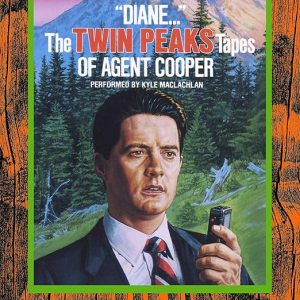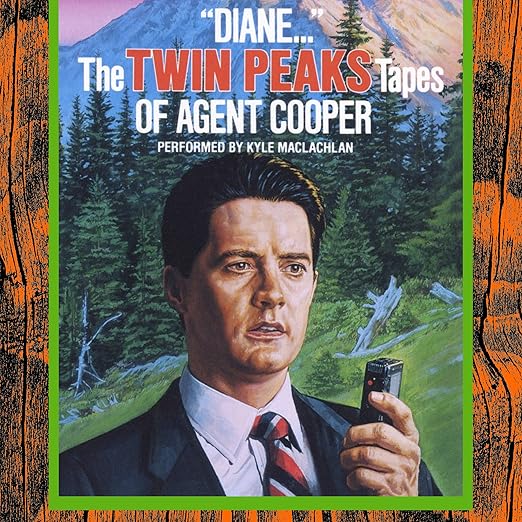
- Narration: Kyle MacLachlan is not playing a character; he is reprising one he inhabited completely, and the difference between that and a hired narrator reading the same text would be enormous.
- Themes: small-town mystery, the interior life of a dedicated investigator, the mythology of Twin Peaks
- Mood: Deadpan, eerie, and deeply nostalgic
- Verdict: An essential forty-five minutes for Twin Peaks devotees; for everyone else it is a curious artifact of early 1990s media tie-in culture.
I pulled this one up on a quiet Tuesday evening, mostly out of curiosity about what a forty-five-minute Grammy-nominated spoken word album from 1990 would feel like in 2026. The answer is that it feels like a very specific kind of time travel, one that only works if you have spent enough time in the world of Twin Peaks to know why hearing Kyle MacLachlan say Diane into a recorder, followed by a remark about never drinking coffee that has been anywhere near a fish, is not just nostalgia but something closer to homecoming.
Diane: The Twin Peaks Tapes of Agent Cooper is exactly what the title says. It is a collection of recordings made by FBI Special Agent Dale Cooper for his unseen associate Diane, the format he uses throughout the television series to process his observations about the mystery of Laura Palmer's murder and the strangely beautiful town that surrounds it. Some of this material comes directly from the first season of the show. Some was recorded exclusively for this release in 1990, and that bonus content, the new material created specifically for listeners, is what gives the album its value for serious fans beyond simple nostalgia.
The Verdict, Briefly
The format is radical in retrospect. This was released in October 1990 as a cassette tape tie-in to a television phenomenon, and it represents an early example of what we would now call expanded universe content, material that deepens the primary work without duplicating it. Cooper's tape recordings are the show's most intimate narrative device. They are the moments when David Lynch and Mark Frost's creation steps back from the visual surrealism and lets Cooper speak in his own voice, direct and slightly formal and occasionally touched by something that is not quite mysticism but sits close to it.
Reviewer Lars Tr. R. makes the key observation: even though much of the material is drawn directly from the series, there is significant new content recorded exclusively for this release. That distinction matters. This is not simply a clip reel of Cooper's on-screen tape recordings. It is an extension of his interior life into territory the show did not explore, and MacLachlan, who understood the character as completely as any actor understands any role, delivers that extension with total credibility.
Kyle MacLachlan is the only reason this works, and he is a sufficient one. The recordings are Cooper's voice, which means they are MacLachlan's voice, and the intimacy of the cassette-diary format suits audio in a way it never quite suits any other medium. Reading the transcripts would be interesting. Hearing MacLachlan deliver them is something else entirely. Reviewer Nicole describes how the recording takes you easily into the mystical world of Twin Peaks, and that is the right word: mystical. Cooper's relationship with the town, with the case, with the coffee, with the cherry pie, with Diane herself who is never heard and never explained, is one of television's great character studies, and these tapes let you spend forty-five minutes inside it.
The Grammy nomination for Best Spoken Word Album acknowledges something real about the quality of the work. Spoken word as a category covers everything from audio novels to political speeches, and the nomination places this recording among the more distinguished examples of the form in its year of release.
What to Watch For in "Diane...": The Twin Peaks Tapes of Agent Cooper
The short runtime is simply what it is. At forty-five minutes, this is not an audiobook in the usual sense. It is a companion piece, a document, an artifact. Reviewer Andrew Comeau notes with slight disappointment that it ends after the second season premiere, meaning it covers only the early period of the show rather than the full arc. Given its 1990 release date, that limitation is structural rather than a creative choice, but it is worth knowing if you are expecting coverage of later plot developments.
Reviewer Andrew Comeau also recommends The Autobiography of FBI Special Agent Dale Cooper: My Life, My Tapes as a companion text worth prioritizing if you want more extended written access to Cooper's interior world. That recommendation is sound context for anyone building out their Twin Peaks listening and reading.
Who Will Get the Most From It
This recording is for Twin Peaks fans who want to spend forty-five minutes inside Dale Cooper's head in Kyle MacLachlan's voice. That is the entirety of its audience, and within that audience it is close to essential. People who have not watched Twin Peaks will find it pleasant enough as a piece of deadpan early 1990s spoken word but will miss the context that gives it meaning. The recording pairs naturally with a rewatch of the first season, particularly for those returning to the show after the 2017 revival.
A Few Questions About "Diane...": The Twin Peaks Tapes of Agent Cooper
Is this a full audiobook or something shorter?
It is forty-five minutes long, originally released as a cassette tape in October 1990 as a tie-in to the first season of Twin Peaks. It functions as a companion piece or expanded universe document rather than a standalone audiobook. The short runtime is essential to its nature as a collection of recorded diary entries rather than a narrative.
Does this contain material not seen in the TV show?
Yes. While some recordings draw directly from scenes in the first season and the second season premiere, reviewer Lars Tr. R. confirms that significant material was recorded exclusively for this release in 1990. That bonus content is one of the main reasons fans seek it out rather than simply rewatching the show's scenes.