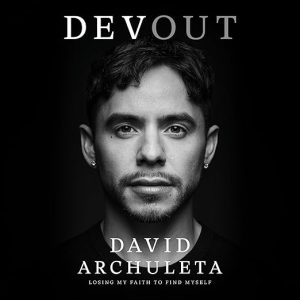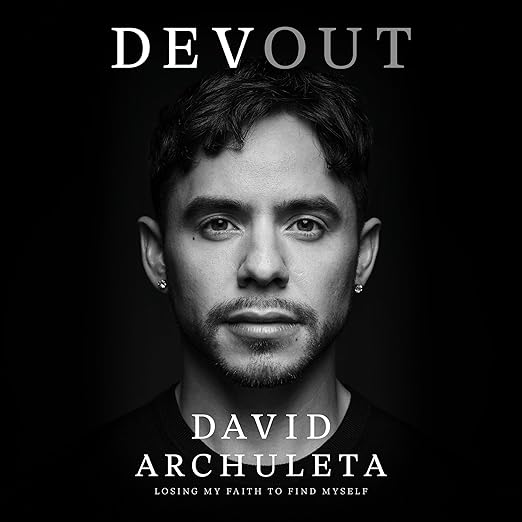
David Archuleta's memoir arrives in audio as something more than the print version translated to voice. Devout includes three original songs, "On Purpose," "Old and Young," and "Stay," performed by Archuleta and making their exclusive debut in this audiobook. That detail matters more than it might initially seem. Archuleta's story is inseparable from music: the voice that made him a national figure at seventeen on American Idol season seven is the same instrument he spent years unable to fully inhabit because so much of his inner life was being suppressed. Having those songs present in the audio, heard as they emerge from the narrative rather than as a marketing supplement, gives the memoir a structural coherence that a text-only edition cannot achieve.
The audiobook covers the full arc of Archuleta's life, from his childhood as a devout member of The Church of Jesus Christ of Latter-day Saints through his rise to fame, his two-year missionary sabbatical in South America, three broken engagements, a period involving thoughts of suicide, and his eventual decision to leave the Mormon Church and live publicly as a queer man. That is a substantial amount of emotional territory for one narrative, and Archuleta does not rush it. The account of being seventeen on a hit television show with a domineering father who was banned from the set is specific in its details and carries the particular texture of someone recounting events they have spent years processing rather than describing them fresh.
The Specific Grief of Leaving Your Own Faith
The tension between faith and sexuality is the memoir's central knot, and Archuleta refuses to resolve it cheaply. He does not present his departure from the LDS Church as a straightforward liberation narrative, because that would be dishonest to the genuine loss involved. He loved his faith. The community, the practice, the sense of cosmic order it provided, these were real sources of meaning, not simply a cage he was always trying to escape. What the memoir captures with unusual precision is the specific grief of leaving a belief system that was genuinely your own, not just one imposed from outside, and the ways that grief coexists with the relief of finally living without concealment.
The account of his father's control is handled with care. Archuleta describes the emotional abuse and the domineering management of his career without settling into a simple victim narrative. He is trying to understand his father as a product of specific pressures and beliefs, not simply to condemn him. That nuance makes the childhood sections more complicated and more credible. The detail that his father was banned from the American Idol set is offered as fact rather than as the emotional centerpiece it could easily have become in a less careful memoir.
Archuleta Knows When to Let Silence Work
Archuleta is a skilled self-narrator in ways that go beyond the obvious asset of speaking in one's own voice. He has the musician's ear for pacing and emphasis, and those instincts shape how the memoir sounds as an audio experience. He knows when to slow down, when to allow a sentence to land without immediately following it with interpretation, and when to let silence do work. One reviewer described the memoir as authentic, vulnerable, and honest, and that assessment holds up as a description of the audio specifically: Archuleta's voice is not performing honesty, it is simply honest, which is a different thing entirely.
The three songs deserve individual mention. "On Purpose" emerges in the context of Archuleta's extended period of uncertainty about identity and direction. "Old and Young" addresses the strange temporal experience of having been publicly famous since adolescence while still being in the process of becoming a person. "Stay" is the memoir's most emotionally direct musical moment. Cowritten during the process of working through the memoir's themes, they are not polished singles designed for radio. They are working songs, evidence of composition in process, and they are exactly the right kind of song for what this book is doing.
Two Years in South America, Still Unresolved
The sections dealing with thoughts of suicide are present and direct. Archuleta does not frame them as a distant historical artifact. He writes about this period with the specificity of someone who still has close access to what it felt like, and listeners who are managing their own mental health around similar themes should approach those sections with that awareness. One reviewer explicitly noted finding in these passages a reflection of their own experience leaving the LDS Church and facing rejection from trusted people. That level of specific resonance is both a testament to Archuleta's honesty and a signal of the emotional stakes the memoir carries.
Archuleta's account of his time as a missionary in South America is one of the memoir's more interesting sections, because it represents a genuine attempt to resolve the tension between his faith and his sexuality through total immersion in one side of the equation. The two-year absence from the music industry, the relationships formed during the mission, and the ways those years ultimately clarified rather than resolved his internal conflict are described with a thoughtfulness that avoids both romanticization of the missionary experience and easy dismissal of it.
Essential for Fans, Given the Exclusive Songs
This audiobook is strongly suited to anyone who grew up inside a rigorous religious tradition and has navigated the complicated terrain of deconstructing that tradition while still holding genuine affection for parts of it. Listeners with LGBTQ+ family members who remain in faith communities will find this memoir a specific and honest account of what that negotiation actually costs. Fans of Archuleta's music will find the audio edition genuinely essential given the exclusive songs. Pop culture readers interested in American Idol era celebrity narratives will find the behind-the-scenes accounts substantive. The memoir is not suitable for young listeners given the frank discussion of suicide, sexual identity, and emotional abuse. For adults, it is one of the more honest coming-out memoirs to emerge from the intersection of celebrity and religious life.
Are the three exclusive songs in the Devout audiobook woven into the narration or added at the end?
They appear at points within the memoir that correspond to the themes each song addresses, so they function as part of the narrative structure rather than as an appendix. This integration is what makes the audio edition a meaningfully different experience from the print version.
Does the Devout audiobook require any prior knowledge of David Archuleta's music or American Idol?
No. Archuleta explains the American Idol context fully within the memoir, including what the show was, what his experience on it was like, and why it matters to his story. Listeners without that pop culture context will not feel lost. That said, fans who followed his career will find additional layers of meaning in his account.
Is the Devout audiobook specifically for LDS or Mormon listeners, or is it accessible to a broader audience?
The LDS context is central to the memoir's conflict and is explained fully within the narrative, so no prior knowledge of the Church of Jesus Christ of Latter-day Saints is required. Archuleta's account of faith, sexual identity, and leaving a religious community speaks to experiences that resonate well beyond one specific denomination, and multiple reviewers from different backgrounds have identified personally with the themes.