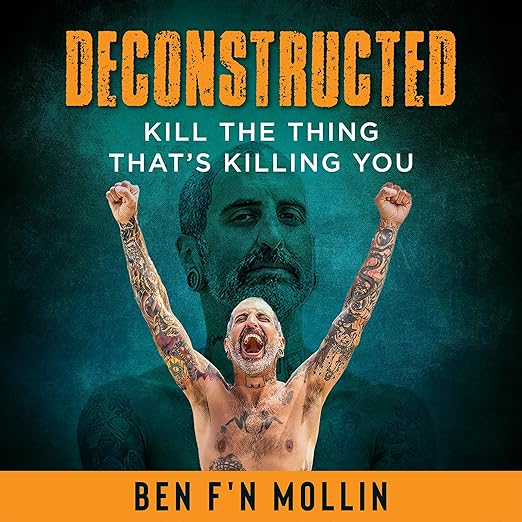
Full title on the cover copy runs Deconstructed: Kill the Thing That's Killing You, and this audiobook record keeps only the first word of it. The subtitle is the half that tells a buyer what they are getting, so losing it costs the listing something real. Two other fields repay reading side by side: the author is entered as Ben F'n Mollin and the reader as Ben Mollin, which is one person doing both jobs with a stage name in one slot. Four hours and forty-seven minutes, out through Transcendent Publishing in December 2025, and shorter than almost anything else on the recovery shelf.
Celebrity hairdressing is not a trade most people associate with rock bottom, which is exactly why this memoir works. Mollin had the clients, the reputation and the schedule, and the schedule is what nearly finished him: overweight, drinking functionally, working himself into a corner and thinking seriously about the escape hatch. The most exact account of the register comes from a November 2025 response, which calls the style bombastic, says the book pulls no punches, and admits it is not always an easy read while insisting it stays compelling throughout. That is a fair summary of a book that would much rather be honest than likeable, and it sets expectations better than the copy does.
Recovery memoirs usually arrive with the arc pre-installed: fall, bottom, rise, wisdom. This one refuses to smooth the middle. The copy names fame, creativity, depression, addiction, suicide, death and reinvention as its subjects in that order, and the order matters, because reinvention lands as one item on a list rather than as the destination the whole book bends toward. Mollin's own line is that if you want to walk away from everything you should run, since you will get there faster. That is a joke with a serious mechanism inside it, and the book keeps operating exactly that way.
Mollin Narrates His Own Worst Nights
One entry filed five stars in December 2025 and then spent its body explaining that the writing style was not to its taste and that the humor did not land. Both things are true at once, and the combination is the most useful signal on the whole page. What that response is grading is not the prose but the life underneath it, which the same entry describes as the unexpected story of a celebrity hairdresser fighting substance abuse, weight and depression behind a glitzy surface. If the voice puts you off in the first ten minutes, the material may well hold you anyway.
Self-narration is the whole proposition, and it deserves more scrutiny than this page gives it. Ben Mollin reads his own account of drinking, burning out and weighing the exit, which is the version a listener will always prefer and the version most likely to go wrong, because a writer performing his own worst nights can flatten into a single register across nearly five hours. Thirty-one ratings sit above the reviews and not one written response says a word about the reading. On a memoir sold on rawness, delivery is the product, and this listing never evaluates it. Sample a stretch about the worst of it and one of the funny passages back to back before you commit.
Humor is the surprise, and it is what keeps the book from becoming an ordeal. The copy calls the treatment raw, gritty and surprisingly funny, and those modes sit inches apart rather than in separate chapters. A man who spent his working life making other people look good is unusually well placed to write about performance, and the sharpest passages are the ones where the professional charm is still running smoothly while everything behind it has already stopped. Four hours and forty-seven minutes is short enough that the intensity never outstays itself, which is a real design decision in this genre and not an accident of page count.
Five-Star Reviews From Inside the Author's Circle
Provenance is the thing to weigh here. A March 2026 response opens with the day its writer first met Mollin, at an outdoor conference with a 5K run, jujitsu demonstrations and Rich Roll on the speaker list, and describes trying to chase him down a straightaway. It is warm, specific and well written, and it is also a verdict from somebody inside the circle. Independent authors draw responses from their own communities as a matter of course and nothing is being hidden. It does mean the five-star column measures reception among people who know the work and its author more than reception among strangers.
Dates are the second thing. The record puts publication at December 10, 2025, and three of the five written responses were filed before that date. Advance copies explain that completely and the practice is entirely standard. Read alongside the acquaintance entry, though, it describes a launch column rather than an accumulated one: five entries, five stars apiece, most of them arriving before or within weeks of release. The badge reading 4.9 across thirty-one ratings is arithmetically sound and socially very young.
Built for Anyone Grinding Through an Enviable Job
Anyone grinding themselves down inside a job that looks enviable from the outside is the reader this was built for. So is anybody in early recovery who has run out of patience with tidy arcs, and anybody working in an image trade, hair or fashion or entertainment, where being on is the actual product being sold. At under five hours it is one long afternoon, and the brevity is part of the medicine: this book says its piece and stops rather than inflating a life into a system with worksheets attached.
Fit matters more than usual on this one. The copy itself names suicide, addiction, depression and death among its subjects, and the treatment is direct rather than clinical, so anybody currently in a fragile stretch should choose the moment carefully or leave it alone. Listeners who want evidence, protocols or a program will find opinion and hard experience instead. Bombast is the last consideration: the volume never really comes down, because the swagger is not a flaw in the writing so much as the thing the book is about surviving.
In Brief
- Performance: Ben Mollin is the only voice on a file that swings between burnout and punchline, so the thing to listen for in a sample is whether the jokes get a different delivery from the confessions.
- What it covers: burnout behind a glamorous career, functioning alcoholism, depression and suicidal thinking, reinvention without a tidy arc
- Feel: Loud, raw and unexpectedly funny
- Our call: A short, unpolished memoir that trades craft for honesty and mostly wins the trade.
Common Questions
What is the full title of this audiobook?
Deconstructed: Kill the Thing That's Killing You. The record shows only the first word, which is a genuine loss, because the subtitle is what signals the subject: dismantling the career, the drinking and the self-image that were doing the damage long before any of them finished the job.
Does the author narrate the audiobook himself?
He does. One person fills both credit slots, with a stage name in the author field and the plain version in the reader field. That gives the memoir its authority and also its main risk, since a self-read confession can settle into a single pitch across a whole file and never move off it.