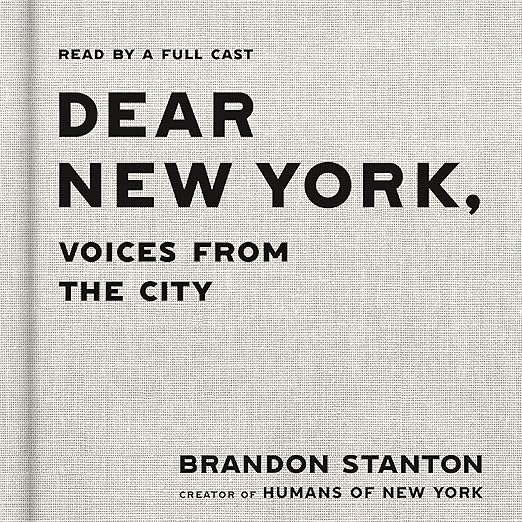
Field recordings of subway platforms and playground chatter open this audiobook before a single scripted line arrives, and that choice tells you everything about what Brandon Stanton and Macmillan Audio built here. This is not a narrated reading of Stanton's photography book Dear New York, it is a full audio reimagining, thirty-nine different actors and non-actors voicing the same firsthand stories that originally appeared paired with portraits in the print edition, layered over real street sound collected across all five boroughs in the summer of 2025.
Stanton Frames Every Account as a Letter Home
Stanton built his reputation on Humans of New York, the photography project turned global sensation, and Dear New York extends that same premise into pure audio: strangers' unfiltered accounts of grief, ambition, love, and daily survival, read aloud not by the original subjects but by a rotating cast standing in for them. The synopsis calls the finished product a companion piece inspired by Stanton's Grand Central Station installation, and the choice to cast different voices for each story, rather than one narrator performing dozens of characters, keeps every account feeling like a distinct person rather than a single actor's interpretation of forty different lives.
Two trade reviews embedded in the synopsis get at what makes this format work. Kirkus called the finished piece 'a fine stage set for this audiobook of living theater', and Library Journal, in a starred review, praised how the sounds of streets and subways carry 'a myriad of voices' straight to listeners. Both assessments land accurately. The production genuinely earns the theatrical comparison, since the sound design does real narrative work rather than sitting underneath the voices as decoration.
Named performers like Andre Bellido, Johnny Heller, and Jamilah Lewis-Horton sit in the credits alongside dozens of working actors and genuine New Yorkers with no professional performing background at all, and the synopsis frames the whole project as a direct extension of Stanton's real Grand Central Station installation, where his photography and subjects' stories were displayed at genuinely massive public scale. Translating that scale into an intimate, headphones-based listening format is its own kind of achievement, compressing a train station's worth of stories into something a single listener can absorb start to finish.
The title itself does real work here. Framing each account as a letter, 'Dear New York,' rather than simply a profile or an interview, positions every speaker as writing directly to the city itself, an intimate, almost confessional address rather than a detached third-person portrait. That epistolary framing is part of why the audio format lands so effectively: hearing a letter read aloud carries a different, more personal register than hearing a subject interviewed or profiled.
All Five Boroughs Get Equal Narrative Weight
The sheer scale of the voice cast is the audiobook's clearest asset. Names like Rebecca Soler, George Newbern, Eunice Wong, and Neil Hellegers sit alongside dozens of less famous actors and genuine nonactors, and the mix matters: professional polish from some readings, rawer authenticity from others, mirrors the actual texture of a city where celebrity and anonymity share a subway car. No single performer dominates, which keeps the listening experience feeling closer to eavesdropping on a real city than to a traditional single or dual narrated memoir.
The field recordings deserve their own mention. Collecting ambient audio from all five boroughs specifically, rather than defaulting to generic Manhattan street noise, signals a level of care that a simple narrated reading would never have needed to demonstrate. It is the kind of production choice that only makes sense once you accept the audiobook is functioning as documentary theater rather than a straightforward book-to-audio conversion.
Committing to all five boroughs specifically, not just the Manhattan skyline most outside media defaults to when it pictures New York, is itself a meaningful curatorial choice. Staten Island, the Bronx, and Queens rarely get equal narrative weight in most New York City storytelling, and this production's insistence on genuinely citywide coverage gives Dear New York a broader, more accurate portrait of the city than its more Manhattan-centric competitors typically offer.
Stanton's career arc is worth knowing for context. Humans of New York began in 2010 as a straightforward street photography project and grew, gradually and almost accidentally, into one of the largest storytelling platforms to come out of social media, reaching an audience of tens of millions through nothing more elaborate than a photograph and a few paragraphs of someone's own words. Dear New York is the logical extension of that same instinct into full audio production, applying the platform's founding idea, ordinary people's own words carry more power than any outside narrator's summary, to sound instead of just text and image.
Five-Star Reviews That Never Mention the Audio
The three reviews attached to this listing, all five stars, are worth reading with one caveat: they describe the print photography book specifically, praising 'heavy, beautiful paper' and pictures given as Christmas gifts, not this audio production. Reviewer Kati writes that fans of Stanton's other books 'will not be disappointed with this one', which is a reasonable proxy for his overall reputation, but none of the three actually speaks to how the multi-voice audio experience compares to reading the printed portraits and captions.
At four hours and thirty-seven minutes, this is a relatively compact listen for a book pulling from stories across an entire city, which means depth per individual voice is necessarily limited. Listeners expecting the extended, magazine-length profiles of some narrative nonfiction will find something closer to a mosaic of shorter, sharper fragments instead, more Humans of New York in structure than a single sustained narrative arc.
Unlike a printed collection a reader can flip through and sample out of order, this audiobook offers no easy way to jump back to one specific story once you have heard it, a real navigation limitation for a format built from dozens of discrete short pieces rather than one continuous narrative arc. Listeners who want to revisit a specific favorite account later should note the timestamp or chapter marker as they go, since finding it again afterward is not straightforward.
Audio-Drama Enthusiasts Will Study This Closely
Recommend this to existing Humans of New York fans curious what the format sounds like translated into full-cast audio, to New Yorkers who want their own city reflected back at them in genuinely varied voices, and to anyone interested in documentary-style audio production as a craft in its own right. It rewards a single attentive sitting more than background listening, given how much the sound design contributes.
Audio-drama enthusiasts and anyone fascinated by documentary sound design specifically will find a lot to study here beyond the New York subject matter itself, since the production choices around field recording and multi-voice casting are unusually ambitious for the format.
Skip it if you specifically want the visual component of Stanton's work, since photography is the entire premise of the print original and none of it survives in audio form. Listeners who prefer one consistent narrator's voice across a whole book, rather than dozens of different readers, may also find the constant voice-switching more disorienting than immersive.
Before You Press Play
- Read by: Thirty nine actors and nonactors voice distinct New Yorkers rather than one performer covering every role, giving each account its own texture.
- At its heart: Urban life and anonymity, oral history, the ordinary made theatrical
- Vibe: Intimate and cinematic
- Short version: A genuine audio reimagining rather than a simple reading, worth a focused single sitting for anyone curious about documentary-style sound production.