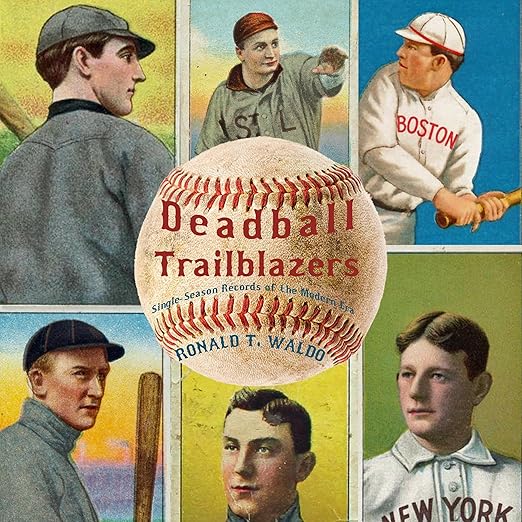
I tend to read baseball history in summer, which is when the sport feels most like what it actually is: a form of seasonal time-keeping. I spent a long July afternoon this past year with Deadball Trailblazers, and what struck me first was how few of the names in this book appear in contemporary baseball discourse. The Deadball Era, 1900 to 1919, is the pre-Babe Ruth world, the period before the home run became the sport's organizing principle. It produced some of the strangest and most durable records in baseball history, and most fans could not tell you who holds them.
Ronald Waldo's project is to fix that. Deadball Trailblazers covers twelve players from the era, each profiled through the lens of a specific single-season record they set. Some of those records are achievements: Jack Chesbro's 41 wins, Rube Marquard's 19 consecutive victories, Chief Wilson's 36 triples for the Pittsburgh Pirates. Some are records of futility: shortstop John Gochnaur's 98 errors in a single season, pitcher Jack Nabors losing 19 straight games in 1916. All of them, Waldo argues, tell you something essential about the period and the people who played through it.
John Guccion narrates with the steady, authoritative pace that historical material of this kind requires. Waldo's prose has the quality that reviewers consistently describe as transporting, something that functions less like journalism and more like guided memory. Guccion does not impose on that quality by performing it dramatically; he serves it, which is exactly the right approach. The result is an eleven-plus-hour listen that holds attention despite being structured around individual profiles rather than a continuous narrative arc.
What makes the book work beyond its research is Waldo's decision to include a secondary story for each player alongside their record-setting season. These secondary threads, covering personality, mindset, and behavior, are where the writing earns its reputation. Reviewers describe Waldo's style as inserting the reader back in time, and that quality comes from the secondary material rather than the statistics themselves.
What Makes Deadball Trailblazers Worth Hearing
The records Waldo profiles have a particular significance that goes beyond curiosity about the past. Jack Chesbro's 41 wins in 1904 have not been broken, nor have most of the others profiled here. These are records set over a century ago that the entire subsequent history of modern baseball has not surpassed. Understanding why they exist, what the game's conditions were that made them possible, and what kind of person set them, is genuinely illuminating for anyone who wants to understand the sport's development.
The inclusion of the futility records is equally important. Gochnaur's 98 errors and Nabors's 19 consecutive losses are not just curiosities; they represent the human cost of a period when the game had far fewer safety nets for struggling players and far less organizational infrastructure to address systemic failures. Waldo treats these figures with the same biographical seriousness as the record-setters, which gives the book real moral dimension alongside its historical interest.
Things to Know Before Starting Deadball Trailblazers
The book is structured as discrete profiles rather than a continuous narrative, which means the reading experience is episodic by design. Listeners who prefer a single sustained argument or through-line may find the chapter-to-chapter transitions slightly abrupt. That said, the profile structure also means you can return to individual chapters without losing context, which suits audio listening particularly well.
Familiarity with the era is not required. Waldo builds in sufficient background for each player before the record-setting season. But listeners who arrive with some working knowledge of Deadball Era baseball, Ty Cobb, Nap Lajoie, the basic mechanics of dead-ball strategy, will get more from the secondary stories than those coming to the period entirely fresh.
Who Ronald Waldo Is Writing For
Baseball history readers who want a serious, character-driven account of an era the sport has largely moved past. The book is also genuinely valuable for fans who want to understand why certain records exist and why they have lasted, which gives it relevance beyond pure historical curiosity.
Skip if you need contemporary baseball relevance, statistical modeling, or a narrative that unfolds as drama rather than history. This is old-school sports writing at its most deliberate, which is a strength for the right reader and a mismatch for others.
Frequently Asked Questions
Does narrator John Guccion's voice suit the historical material?
Guccion narrates the 11-plus hours with a steady, authoritative delivery that suits Waldo's old-school sports writing style. Reviewers describe the prose as inserting the reader back in time, and a narrator who understands the deliberate pacing of that kind of storytelling is essential to the experience.
Are the records of failure, like John Gochnaur's 98 errors, given the same depth as the achievements?
Yes. Waldo explicitly includes records of futility alongside records of greatness, and reviewers highlight this as part of the book's character. Understanding why a player lost 19 straight games or committed 98 errors in a season requires the same human context as understanding how Jack Chesbro won 41 games, and Waldo provides both.