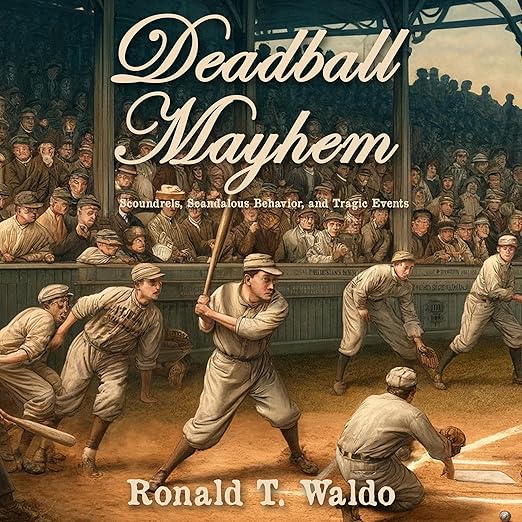
Deadball Mayhem doesn't ease listeners into baseball's most turbulent era. This audiobook opens on pitcher Win Mercer, a fan favorite who drew crowds of women to the ballpark on Ladies' Days, and sits with the fact of his suicide in San Francisco on January 12, 1903. From that first chapter forward, author Ronald T. Waldo keeps circling back to the gap between the game's public glamour and the private wreckage trailing so many of its early stars, a choice that sets the tone for everything that follows.
Waldo returns here as the historian behind Deadball Trailblazers, and this follow-up widens the lens considerably. Chick Stahl's suicide, National League president Harry Pulliam's suicide, Ed Delahanty's accidental death, and Pittsburgh pitcher Eddie Doheny's mental breakdown on the eve of the 1903 World Series all get room to breathe here, alongside the gambling intrigue swirling around Rube Waddell's mysterious late-season arm injury in 1905 and the tense 1908 National League pennant race.
The Review
What separates this from a highlight-reel history of the 1890s and early 1900s is how deliberately Waldo leans into tragedy as connective tissue rather than an occasional footnote. Reviewer Steven Gerweck, who called it fantastic storytelling, frames the book as a direct continuation of Deadball Trailblazers, and that continuity shows in how confidently Waldo moves between the star players who built the sport's popularity and the scoundrels, gamblers, and broken men working the margins around them.
The book also spends real time on scandal that never made it into a courtroom: Carl Mays's desertion, Mike Donlin's off-field indiscretions, and the bitter feud between Pirates owner Barney Dreyfuss and Giants manager John McGraw. None of these threads gets a tidy resolution, which feels honest to the period itself, a sport still inventing its own rules for how players, owners, and gamblers were supposed to behave around one another, on and off the field.
It helps to understand why the period even carries the Deadball name: the ball itself was softer and got reused for entire games instead of being swapped out scuffed or dirty, and teams built strategy around bunts, stolen bases, and pitching duels rather than home runs. That context matters here, because Waldo's darker stories, Mercer's suicide, Doheny's breakdown, Delahanty's death, all played out inside a sport that looked and felt fundamentally different from the power-hitting game most modern listeners associate with baseball history.
Why Listen to Deadball Mayhem
The appeal here is specificity. Rather than offering a broad survey of Deadball Era baseball, Waldo builds his book around named individuals and dated events: Waddell's questionable injury right before the 1905 World Series against the New York Giants, New York's gambling apparatus working the edges of that tight 1908 pennant race, and the specific circumstances surrounding Pulliam's death as sitting league president. Listeners who already know the broad strokes of this era will find the granular detail genuinely rewarding rather than repetitive.
It also works as a corrective to the sanitized version of early baseball history that tends to circulate in more general sports narratives. The synopsis doesn't shy away from calling this mayhem and tragedy, and the book earns that framing by refusing to separate the sport's growth from the human cost running alongside it. For listeners drawn to true crime or tragic historical figures as much as sports history, this crosses genre lines in a way a conventional team history rarely does.
Listeners specifically drawn to the 1908 pennant race thread have a natural companion in Cait Murphy's Crazy '08, a well-regarded single-season history of that exact chaotic year in the National League. Waldo's book covers similar ground from a different angle, less focused on one climactic season and more interested in tracing scandal and tragedy across the full decade, which makes the two a useful pairing for anyone who wants both the wide lens and the close-up.
The Caveats
David Cantor narrates, and no track record exists yet in listener feedback for how he handles a 15-hour nonfiction history this dense with names, dates, and overlapping storylines. Nonfiction narration succeeds or fails on pacing and clarity more than performance, and a book moving between this many named ballplayers, executives, and gamblers puts real pressure on a narrator to keep each thread legible without leaning on dramatic flourish to paper over any confusion.
Only one rating is attached to this listing, which is a genuinely thin sample size despite the perfect score and Gerweck's enthusiastic review. That doesn't mean the book is untested exactly, Waldo has an established track record with Deadball Trailblazers, but it does mean a new listener is relying more on authorial reputation than on a broad chorus of confirmed listener reactions before committing 15 hours.
Worth flagging too: the genre tag calls this energetic and motivating, athletic-achievement material, and that framing undersells how much of the runtime sits with suicide, addiction-adjacent scandal, and institutional corruption. This is closer to somber historical true crime wearing a baseball uniform than a rousing underdog story, and listeners expecting pure inspiration from a sports title should recalibrate their expectations before pressing play on this one.
Structurally, this plays more like a mosaic than a single connected story, which is worth knowing going in for audio specifically. In print, a reader can flip back to an index or an earlier chapter to reconnect a name with its context; in audio, that option disappears, so listeners will want to give this their full attention rather than treating it as background listening, especially during the sections juggling several overlapping scandals at once.
Should You Listen to Deadball Mayhem?
This is a strong match for dedicated baseball history readers, especially anyone who already owns Deadball Trailblazers or has read other single-era deep dives into the sport's early professional years. The density of names and incidents rewards listeners who already carry some scaffolding for the period, whether that's general Ty Cobb-era baseball knowledge or the specific 1890s-through-1908 window Waldo covers across this particular book.
Skip it if you want a single, continuous narrative arc rather than a mosaic of linked incidents, or if you're specifically after triumphant sports storytelling without the darker material woven through it. Casual listeners without existing interest in early baseball history may find the sheer volume of names harder to hold onto across 15 hours than a fan already fluent in the era's cast of characters would.
- Performance: David Cantor has no prior track record in these notes; nonfiction pacing across a name-dense 15-hour history is the real test here, and the data doesn't yet confirm how he handles it.
- What it covers: Deadball Era scandal and tragedy, gambling's influence on the game, the gap between public stardom and private ruin
- Feel: Somber and true-crime adjacent, historically dense rather than triumphant
- Our call: A rewarding listen for committed baseball history fans, but recalibrate if you came expecting an uplifting sports story.