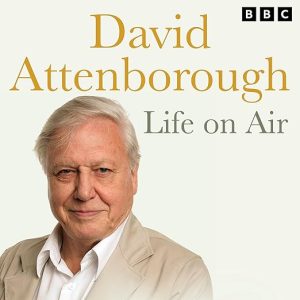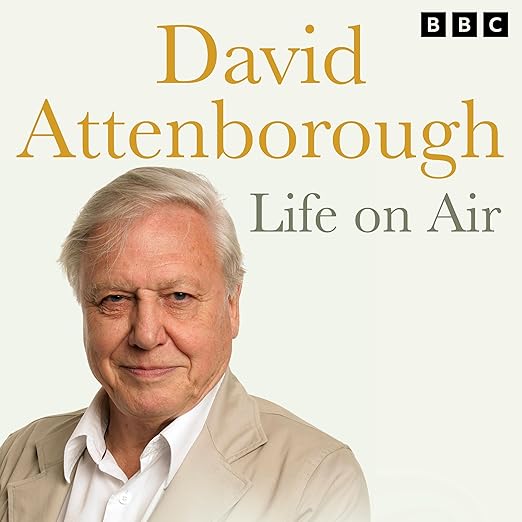
David Attenborough reading his own memoir is a particular kind of audiobook experience that does not belong to any normal category of self-narration. David Attenborough - Life on Air runs nineteen hours and twenty-three minutes, produced by BBC Studios, and the voice carrying it is the same voice that introduced generations of viewers to the planet's wildlife through Zoo Quest, Life on Earth, The Blue Planet, and a dozen landmark series between. Hearing Attenborough narrate his own story is not the same as hearing a celebrity narrator hired to read a book about a celebrity; it is something closer to watching someone build the final exhibition of their life's work and then stand in the middle of it, pointing at what matters and explaining what they saw. The Good Book Guide called it an enthralling autobiography from one of the linchpins of television, and in audio form that description lands with even more force.
The memoir covers Attenborough's career from its beginning at the BBC in the early 1950s through the making of Life in Cold Blood, the series that concluded his definitive survey of the natural world. That is more than fifty years of broadcasting history, institutional change, international travel, and encounters with wildlife that defined what the twentieth century knew about the planet. The audiobook does not attempt comprehensiveness; Attenborough selects stories and episodes rather than providing a year-by-year chronicle, and the result is a memoir shaped by what he found worth remembering rather than by what a biographer would require for completeness.
Commissioning Civilisation as Controller of BBC2
The audiobook's most revelatory passages are those dealing with Attenborough's tenure as Controller of BBC2 in the 1960s. He introduced colour television to Britain, commissioned groundbreaking cultural programming including Kenneth Clark's Civilisation and Jacob Bronowski's The Ascent of Man, and built the institutional infrastructure that would eventually support his own documentary work. These chapters reveal Attenborough as a television executive of considerable cultural taste and strategic intelligence, a dimension of his career that the public wildlife broadcaster persona has largely obscured. Hearing him describe those years in his own voice, with the same measured authority he brings to narrating a sequence about bird-of-paradise courtship, is genuinely surprising and shifts how you understand everything that came after.
His encounters with luminaries, Montgomery, Anthony Eden, Benjamin Britten, the Queen, are delivered with appropriate reverence and appropriate wit. Attenborough does not name-drop for effect; he contextualizes. These figures appear because they were genuinely part of the institutional world he was navigating, and his assessments of them are characteristically precise rather than anecdotal. One reviewer noted that listeners who remember watching Zoo Quest on British television as children will find the book particularly resonant, and that is accurate. But the audio experience is not limited to British listeners of a certain generation: the quality of Attenborough's recall and the precision of his observation make the memoir compelling regardless of whether you have the cultural reference points.
Zoo Quest to New Guinea, Borneo, Sierra Leone
The nineteen-hour runtime should not deter. Attenborough structures the audiobook with the pacing instinct of a documentary maker rather than a memoir writer, and the narrative moves between the institutional, the BBC's evolution from black-and-white regional broadcaster to global natural history powerhouse, and the personal, the specific animals he encountered, the specific logistical crises that nearly ended particular productions, with the fluency of someone who has spent a career understanding how to hold an audience across changing subjects. The passages dealing with early Zoo Quest expeditions to New Guinea, Borneo, and Sierra Leone are among the most vivid, and Attenborough's delivery of the wildlife encounters carries the same quality his documentary narration does: a genuine absorption in the subject that is never performative.
The BBC Studios production quality is evident throughout. The audio is clean, the pacing is unhurried, and Attenborough's diction is as meticulous in his reading of these pages as in any of his broadcast work. For listeners who have grown up with natural history documentaries as part of the audio furniture of their lives, the experience of hearing that voice recount the decades of work that produced those documentaries has a quality that no professionally narrated edition of the same memoir could replicate.
Filming the Komodo Dragon During the Cold War
The sections dealing with the making of specific landmark series reward the closest listening. Attenborough describes the technical challenges of filming the Komodo dragon, the political difficulties of accessing certain territories during the Cold War, and the ethical debates within the BBC about how much human intervention was acceptable in wildlife filming. These passages are more candid than the public documentary persona might suggest, and they give the audiobook its substance beyond the surface pleasures of a distinguished life recounted by its subject. The behind-the-scenes material for Zoo Quest and Life on Earth in particular has a quality of genuine historical record.
The memoir ends with Life in Cold Blood rather than with Attenborough's subsequent work, which means this audiobook does not cover the Planet Earth series or the later climate-focused documentaries. Listeners who want to understand the arc of his career through its most recent phase will need to look elsewhere. What this audiobook provides is the foundational fifty years that made those later works possible, and the institutional and personal history that shaped the man who made them.
The Entire Justification for This Audiobook
This audiobook is suited to longtime admirers of Attenborough's documentary work who want to understand the institutional and personal history behind it, to listeners interested in BBC history and the development of television as a cultural medium, and to anyone who has wondered how the natural history documentary became its own genre and who built it. Listeners primarily interested in Attenborough's environmental advocacy work and later career should supplement with more recent sources. The nineteen-hour runtime rewards patient, devoted listening rather than background absorption, and the audiobook is at its best when given the sustained attention it offers in return. The self-narration by Attenborough himself is not a gimmick or a marketing convenience: it is the entire justification for the audio format here.
Questions Listeners Ask
Does David Attenborough narrating his own memoir audiobook add something that a professional narrator could not provide?
Yes, substantially. Attenborough's voice carries the entire history of BBC natural history broadcasting, and hearing him assess his own career and describe his wildlife encounters creates a resonance that a professional narrator reading the same text could not replicate. The self-narration is one of the audiobook's primary arguments for choosing audio over print.
Does this audiobook cover Attenborough's most recent documentary work, including Planet Earth and the climate films?
No. The memoir was produced to cover the period ending with Life in Cold Blood, concluding his first Great Natural History survey. His later work including Planet Earth, Frozen Planet, and the recent environmental advocacy documentaries is not covered. The audiobook represents the first fifty-plus years of his broadcasting career.
Is this audiobook accessible to listeners who are not familiar with British broadcasting history?
The audiobook is most rewarding for listeners with some familiarity with BBC history and Attenborough's documentary legacy. International listeners who know him through Planet Earth or Blue Planet will gain significant context, but some of the institutional and political detail about BBC2 and early British television may require patience for those without that background.
At nearly twenty hours, is the David Attenborough - Life on Air audiobook paced well enough to hold attention throughout?
The pacing is consistently strong. Attenborough structures the memoir with the instinct of a documentary maker rather than a linear chronicler, balancing institutional history with specific wildlife encounters and personal reflections. Reviewers who have absorbed the full runtime consistently describe the experience as engaging rather than demanding.