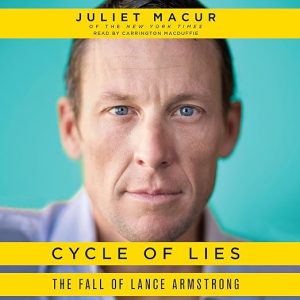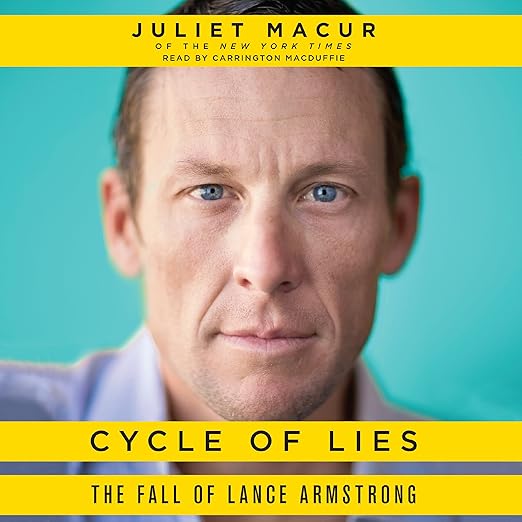
Cycle of Lies is the audiobook I kept returning to in the week after I had supposedly finished it, pulling up specific chapters to re-examine a detail or confirm my memory of a quote. Juliet Macur's investigation into Lance Armstrong's career operates on a scale that few sports journalism projects have attempted, and narrator Carrington MacDuffie rises to meet it. At eleven hours and thirty-one minutes, this is a substantial commitment, but one that pays off in ways that simpler Armstrong accounts do not. The book belongs on the short list of truly definitive sports biographies in audio form.
The distinction between this book and others covering the same territory starts with access. Macur was present in June 2013 when Armstrong fled his Texas home in the face of multimillion-dollar lawsuits. She sat with him for extended one-on-one interviews. She spoke with more than a hundred witnesses, including family members Armstrong had long since cut out of his life, among them the adoptive father who gave him the Armstrong name and a grandmother and aunt who had been rendered invisible by his rise. This is not a book assembled from press archives and secondhand accounts. It is reported from the inside, and that quality of access shapes everything about how the narrative accumulates.
What We Made of It
What separates Macur's work from the earlier wave of Armstrong exposés is not the revelations themselves, which were largely already on record by the time this book arrived, but the richness of texture she builds around those facts. The taped testimony of J.T. Neal, one of Armstrong's most important father figures, recorded in the final years of Neal's life as he was losing his battle with cancer at the very moment Armstrong was gaining global fame for surviving the same disease, is one of the most genuinely haunting sequences I have encountered in a sports biography. Macur weaves this material through the larger narrative without turning it into melodrama, which requires real editorial discipline that lesser journalists do not always manage.
Reviewer Cliveden, who knows the existing Armstrong literature well, noted that the book does not break significant new ground in terms of facts but praised it as the most comprehensive synthesis available. That assessment strikes me as fair and also somewhat undersells what Macur achieves. Comprehensive synthesis of a story this complicated and contested, across this many sources, is itself a significant accomplishment. The book does not just accumulate evidence; it builds an argument about why Armstrong's code of silence held as long as it did, and what it finally took to break it.
What Makes Cycle of Lies Worth Hearing
The audiobook format does something interesting with Macur's multi-voice approach. MacDuffie reads the firsthand accounts of Armstrong's former friends and family members with a quality of careful evenhandedness that preserves their individual credibility without editorializing. When the book moves between Armstrong's own rationalizations and the contradicting testimony of those who knew him best, the contrast registers cleanly in audio in a way that might require more active attention on the page.
One reviewer who described themselves as knowing nothing about cycling beyond the location of the Tour de France found the book entirely absorbing, which speaks to the quality of the narrative construction. Macur does not assume cycling expertise from her audience. The sport is contextualized as the setting for a story about ego, loyalty, and systemic corruption rather than as a story primarily about athletic performance. That choice makes the audiobook genuinely accessible regardless of your prior relationship with professional cycling, and it explains why the book has found readers far outside the cycling community.
What Might Not Land
Armstrong's own testimony accounts for a significant portion of the book's core, and Macur is honest about the problems that creates. Armstrong was, by his own admission and by extensive external documentation, someone who shaped and reshaped his version of the truth depending on audience and circumstance. MacDuffie reads these sections with a neutrality that puts the interpretive work on the listener, which is the right call, but anyone hoping for the narrator to signal skepticism will find the approach deliberately withheld.
The sheer volume of witnesses and the complexity of the legal and institutional history of the doping scandal can also slow the middle sections of the audiobook. Listeners who came primarily for the human drama of Armstrong's rise and fall may find the structural analysis of cycling's anti-doping apparatus demanding. That material is important context, but it requires patience from anyone who is not already drawn to the procedural dimension of investigative journalism. MacDuffie's steady delivery keeps the complex passages followable even when the material thickens.
The Right Listener for Cycle of Lies
This audiobook will be essential listening for anyone who followed the Armstrong story and wants the most complete available account in audio. It is also the right choice for listeners who appreciate long-form investigative journalism, particularly those drawn to stories about how institutions and individuals protect myths that eventually collapse under the weight of accumulated testimony. Reviewer Victor San Diego noted that the film rights were secured by J.J. Abrams and Paramount Pictures before the book was even published, which speaks to the cinematic quality of the story Macur constructs.
Listeners who are looking for a straightforward sports biography, or who want an account sympathetic to Armstrong, should look elsewhere. Macur is fair, but she is not gentle, and the cumulative weight of more than a hundred witnesses does not leave room for rehabilitation narratives. This is a book about what happens when a culture of silence finally breaks, and MacDuffie's narration gives that story the gravity it deserves.
In Brief
- Narrator: Carrington MacDuffie handles the dense, multi-voice reporting structure with clarity and quiet authority, keeping the sprawling cast of witnesses organized and readable.
- Subjects: Betrayal and loyalty, the mythology of sports heroism, the culture of silence in professional cycling
- Tone: Investigative and unsettling
- Bottom line: The most complete portrait of Lance Armstrong's rise and fall currently available in audio, and Juliet Macur's access makes it the definitive account.
Frequently Asked Questions
Is prior knowledge of professional cycling necessary to follow the audiobook?
No. Macur builds in enough context about the sport and its institutional structures that a listener with no cycling background can follow the narrative. Multiple reviewers confirmed this, including one who knew only the country where the Tour de France is held before listening.
How does narrator Carrington MacDuffie handle the audiobook's large cast of witnesses and voices?
MacDuffie reads with consistent clarity and careful neutrality, which serves the investigative structure well. The multi-voice nature of the reporting is organized and legible in audio, and MacDuffie does not attempt character differentiation that would feel out of place in a work of nonfiction journalism.