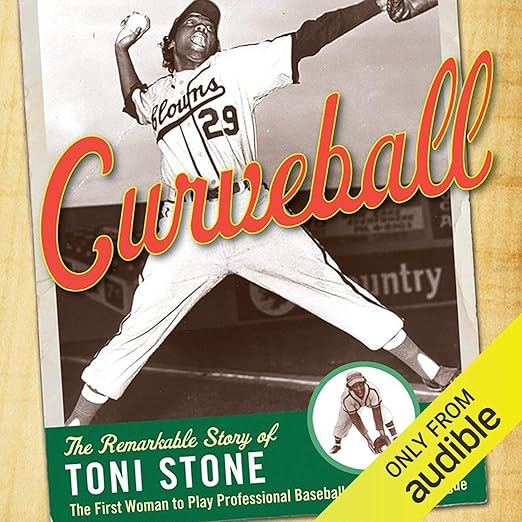
I finished Curveball on a Sunday afternoon when the light was doing that particular late-autumn thing where it makes everything feel both urgent and elegiac. That was the right atmosphere for Martha Ackmann's biography of Toni Stone, the first woman to play professional baseball on a men's team. I had known the broad outlines of Stone's story before I started listening, but Ackmann's excavation of the specific details, the years Stone spent in St. Paul persistently hanging around ballgames until boys' teams and white teams and older teams started inviting her in, the years in San Francisco, the moment she took Henry Aaron's roster spot on the Indianapolis Clowns, turned something I thought I knew into something that genuinely unsettled me.
April Matthis's narration is the right choice for this material. She reads with a kind of contained intensity that serves the biography's tone. Ackmann is not a sentimentalist, and Matthis does not sentimentalize either. There is a steadiness to how she handles both the painful passages, Stone being passed over, harassed, patronized by the same teammates she was outperforming, and the triumphant ones, Stone connecting with Satchel Paige, playing alongside the era's finest athletes, simply refusing to leave a field that kept trying to eject her.
What Martha Ackmann Delivers
Ackmann is a historian who writes with a journalist's instinct for scene and a scholar's care for evidence. She reconstructs Stone's childhood in Minnesota, her years performing in the pageant of the Negro Leagues, and her marriages with the same attention to specific anecdote that the best sports biographies bring to game recaps. One of the things that makes Curveball unusual is how honestly it engages with the Negro Leagues themselves as an institution in flux, bleeding talent to the majors as integration opened those doors, leaving women like Stone even more exposed to its instability.
Stone's famous line, there has got to be a first in everything, maybe it will be me, sounds like a motivational poster abstracted from context. Ackmann gives it the weight of a woman who had concrete, specific, institutional reasons to believe it would not be her, and who refused that logic every morning for decades. The encounters with Ernie Banks, Willie Mays, Buck O'Neil, and Paige are not name-drops; they are structural to understanding where Stone fit, and did not fit, in a world that was actively reshaping around her.
What Martha Ackmann Gets Right
The audio format does something particular for this biography. Matthis's delivery in the sections where Stone speaks in her own voice, through interviews Ackmann tracked down and through the remembered words of people who knew her, has a directness that print sometimes softens. Listening to Stone's stubbornness rendered aloud gives it a physical quality that sitting with the page does not always provide. At nine and a half hours, this is a full biographical immersion, not a survey.
Ackmann structures the book chronologically but not rigidly. She allows herself detours into the social history of segregation-era sports, the economics of the Negro Leagues, the gendered dimensions of athletic legitimacy in the 1950s. These digressions are all load-bearing. None of them feel like padding. The result is a biography that is not only about Toni Stone but about the entire structure of exclusion she was throwing herself against.
Where Martha Ackmann Loses Some Ground
Readers expecting a traditional sports narrative with triumphant arcs and clean turning points will find Curveball more complicated than that. Stone's career was contingent, contested, and never fully recognized by the institutions she gave it to. The book does not manufacture a resolution the historical record does not support, which means the ending is more bittersweet than celebratory. One reviewer described it as interesting, engaging, and sad all rolled into one, and that compression is accurate.
If you come in expecting a straightforward story of triumph over adversity, the social history portions may feel like detours. They are not. They are the architecture that makes Stone's specific choices legible.
Who Should Pick Up Curveball
Essential listening for anyone interested in the history of the Negro Leagues, the intersection of race and gender in American sports, or simply a well-built narrative biography. April Matthis makes this a full audio experience rather than a reading-experience adjacent one. Less suitable for listeners who want a linear rise-and-triumph structure; this is a richer and more resistant story than that.
Good to Know
How does April Matthis handle the historical narration versus the personal anecdotes?
Matthis navigates both registers well. She keeps the documentary sections grounded and informative while bringing slightly more presence to the scenes centered on Stone's own voice and experience. Several reviewers specifically praised the overall narration quality.
Is this biography based on direct interviews with Toni Stone?
Ackmann conducted extensive research including interviews with people who knew Stone and drew on archival material. Stone died in 1996, so direct interviews are limited, but the biography is described as thoroughly researched and not padded by reviewers familiar with the subject.