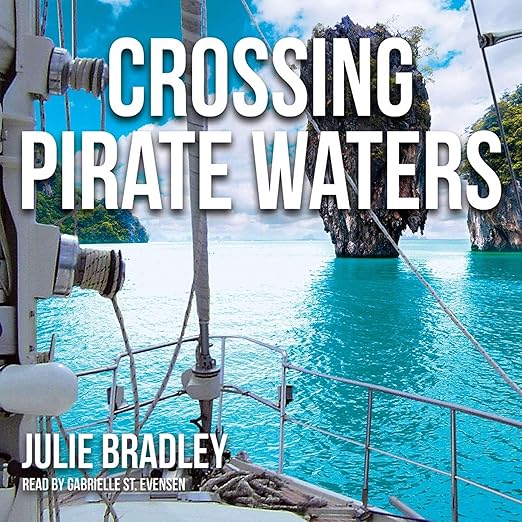
Pirates appear in the title of this audiobook and nowhere else on the record. The description routes Glen and Julie through the Indian Ocean, the Gulf of Aden and the Red Sea, calls the far side of the world dangerous and promises trouble, but the word pirate never once surfaces in it. None of the five reviewers uses the word either. Ten hours and sixteen minutes of a circumnavigation, sold on a threat the copy underneath declines to name.
First, the Big Picture
Mahontay supplies an objection the publisher invited in writing. The jacket advertises, as a selling point, natives in penis sheaths on tropical islands. Mahontay's four stars open by complaining that the beginning goes on too much about the phallic coverings of men on a specific island, then concede that once that is past, the book is much better. A publisher and a reader looking at the identical stretch of pages: one put it on the jacket, the other wanted it cut.
Eighteen place names close the summary, from Vanuatu and New Caledonia through Bali, Borneo and Singapore to Djibouti, Eritrea, Sudan and Malta, with an instruction to keep an atlas beside you. That list is the honest summary of the book. Mahontay confirms it from the other direction, noting that while the book speaks some of the voyage, a lot of it covers sightseeing on land and trips away from the yacht. Anyone who wants passages and weather should adjust the expectation: this is a travel book that happens to arrive by sea.
Patti LaGrelius and Mahontay disagree about how long the voyage lasted. Patti describes an eight year sailing adventure around the world. Mahontay puts it at seven and a half years and adds a biographical detail the description never supplies: a married couple, both retired from the US military, sailing as an escape from the life they had known. Neither figure can be checked against anything on this page, because the publisher supplies no dates whatsoever. Six months across eight years is a trivial gap; what it shows is how much of this record readers had to supply themselves.
Why Listen to Crossing Pirate Waters
Ten hours and sixteen minutes covers the harder half of a circumnavigation, and the summary is unusually specific about the geography of it. Turmoil in the Mideast keeps Glen and Julie lingering in the South Pacific among remote islands; finishing the voyage means leaving friendly shores for the Indian Ocean, the Gulf of Aden and the Red Sea before Europe. That is a genuine route with genuine risk built into it, and it explains the title even though nobody writing the jacket got around to it. The stakes are structural, not invented for a jacket.
Julie Bradley's prose is what the column actually praises, repeatedly and in those exact terms. Patti LaGrelius credits her with a beautiful style and describes feeling present in the situations she narrates, the good ones and the bad ones alike. Jake, who reports reading a great many cruising books, puts Bradley's at the top of the list and says the problem now is finding another that belongs on the same shelf. Spike calls both books very engaging. The jacket promises dry wit and compelling descriptions, and three reviewers independently back the claim up.
Glen is the other half of this voyage and gets remarkably little. The blurb names Glen twice, both times paired with Julie, and supplies no further detail of any kind. Mahontay's aside about a married couple retired from the US military is the only characterization of the partnership anywhere on the record, and it arrives from a reviewer rather than a publisher. For a book about two people sharing a small boat for the better part of a decade, that silence is a strange one.
A Few Reservations
The narrator is not the author, which matters more here than it would in a novel. L. Gabrielle Penabaz reads ten hours of a first-person account written by Julie Bradley, so every I in the text belongs to one woman while the voice delivering it belongs to another. That arrangement can work beautifully, and it can also open a small gap between listener and teller in precisely the passages reviewers single out for their intimacy. This listing says nothing about the choice, so a few minutes of audio will tell you more than the whole page does.
A single vote holds up the 4.7 badge, if the counter is to be believed, while five written responses sit directly underneath it. Those two numbers cannot both describe the same thing, and 4.7 is not a figure one whole-star vote can produce in any case. What you can usefully read is the spread: four fives and Mahontay's four, a column carrying exactly one reservation and stating it clearly. Take the written grades seriously and let the badge go.
Neither the series information nor the jacket agrees with Mahontay about what this even is. The field says Escape Series, number two. The description says book two of the Escape Series, sequel to Escape from the Ordinary. Mahontay calls it part 2 of a 2 book set, which shuts a door the other two leave standing open. Anyone wondering whether a third volume exists, or whether the voyage ends here, will not learn it on this page, and the gap between a pair and a series is the gap between finishing and starting.
Who Should Pick Up Crossing Pirate Waters
Armchair adventurers get a mention in the jacket text, and they are exactly the right audience. The text insists you need not tell a spinnaker from a mainsail, and the column backs it: Patti began with the first book and stayed for this one, Gail Murphy cannot imagine ever sailing around the world and read it regardless, Spike found both volumes engaging. What is on offer is geography, character and dry wit instead of seamanship, and ten hours of that goes down easily.
Listeners who want the sailing itself should temper the expectation, because by the account of the one reviewer who counted, a good deal of this book happens ashore. Anyone put off by frank descriptions of unfamiliar customs should read Mahontay's opening sentence carefully first, since the blurb treats that same material as a highlight. And anyone expecting the pirates the title names should know it never mentions them at all. Bring the atlas the description asks for.
Questions Listeners Ask
Do you need the first Escape book before this audiobook?
It helps. The jacket calls this book two of the Escape Series and a sequel to Escape from the Ordinary, and one reviewer started there before arriving here. The voyage is already well under way when this volume opens and no recap appears anywhere in it. Nothing stops you beginning here, but you will be joining midstream.
How much of this audiobook is actually sailing?
Less than the packaging implies. One reviewer notes that the book speaks some of the voyage but gives a lot of its length to sightseeing on land and trips away from the yacht, and the text signs off with eighteen place names and a recommendation to keep an atlas nearby. Treat it as travel writing that moves by boat.
Is the audiobook read by Julie Bradley herself?
No. L. Gabrielle Penabaz is credited for the full ten hours and sixteen minutes, so the first-person account belongs to one person and the voice delivering it to another. Reviewers praise Bradley's written style repeatedly without touching the performance, which makes the reading the one element here you cannot assess ahead of time.