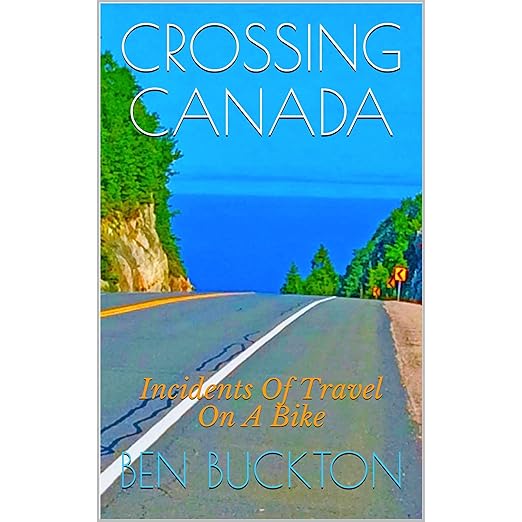
Tarmac runs out at the Atlantic, on Newfoundland, and that is where Ben Buckton finally stops pedaling. Between that point and the Pacific coast of Vancouver Island sit 4,500 miles, the Rocky Mountains, the endless Prairies, Ontario and the Great Lakes, the St Lawrence River and the Maritimes, all of it crossed during the long, hot summer of Canada's 150th birthday year. The audiobook runs thirteen hours and thirty-nine minutes, which is roughly the pace of the trip itself: slow, incremental, weather-dependent, and interrupted constantly by other people. What arrives at the end is not a triumph narrative. It is a daily log, kept honestly, by a man who stowed a ukulele on the bike before he left.
The Verdict, Briefly
Before the description gets anywhere near the bicycle, it spends six lines on praise. Those lines are not newspaper notices or jacket blurbs. Set them against the responses posted underneath the same listing and they line up almost word for word: the 'truly inspiring' and 'totally recommend this' fragments belong to a five-star response filed in the United Kingdom in April 2020, and the fragment about the bike trip feeling real belongs to a separate one filed the week before that. A seller quoting its own customer responses back at prospective buyers is not deception, but it does mean the endorsement stack at the top of the page and the star average underneath it are drawing on the same small pool of opinion rather than two independent ones. Weigh them as a single signal, not as corroboration.
Karl, Bill, Greg and Willem, Bob: the trip is generously stocked with people, and they are the real reason to consider it. Karl, seventy-three, crossing the continent on a cheap supermarket bike and sleeping in fields. Bill, living quietly in Saskatchewan after years of being shot, stabbed, divorced and arrested. Greg and Willem in Montreal, proud founders of the Men Of Beer Cycling Club. Bob from Australia, spending his retirement riding around the world on a little 116cc ex-postman's motorcycle. A vicious dog attack in Manitoba. The strange, recurring appearances of the Calgary Two. The largest alcohol-free 150th anniversary party in the country. And a disastrous night out on Black Sturgeon Lake involving Trevor, his Uncle Wayne, and the aforementioned ukulele. Buckton is not assembling an argument about Canada. He is collecting encounters, and the encounters are odd enough to carry a long stretch of listening on their own.
What Makes CROSSING CANADA Worth Hearing
Bedtime reading is how one response describes using it, a habit that listener keeps with travel books generally because they find the form relaxing, and that response singles out the daily log specifically for the insight it gives into how hard the cycling actually was. That is a precise reading of what the structure accomplishes. A daily entry cannot quietly skip the flat days, so the accumulation of ordinary mileage becomes something you feel across the runtime rather than something a summary chapter tells you about afterward. Nearly fourteen hours spent that way builds a sense of continental distance that no compressed highlight reel could manufacture, and it is the closest a listener gets to understanding why 4,500 miles is a different proposition from a very long weekend.
Prose with more range than a logbook strictly requires is the second surprise. Buckton writes in a dry, self-deprecating register, and the comedy reliably arrives when a plan collapses rather than when a summit gets reached, which is the correct instinct for this kind of book. He also handles landscape well, and that matters most across the Prairies, the one stretch where a cycling narrative is at genuine risk of going flat in both senses of the word. The strangers do the heaviest lifting, but the connective passages between them are not filler, and his willingness to record his own worst days keeps the whole thing from tipping into the inspirational-journey register that this shelf usually defaults to. The result reads less like sports writing than like a long conversation conducted at fifteen miles an hour.
Points to Consider
Read the two-star response before buying, and take it seriously rather than filing it as an outlier. It grants outright that the author writes well, then rejects the form itself, calling the experience of following a daily journal 'just plain dull' and, from the position of an observer, 'painfully tedious.' It points prospective buyers toward 'far better bike adventure books out there' and closes by advising a pass. Whether you agree with that comes down entirely to how you feel about repetition as an organizing principle. The objection is not that Buckton writes badly, and the response is careful to say so. It is that a day-by-day account of a very long ride necessarily contains a great many days that resemble each other, and this book makes no attempt to hide them.
Check the credit line next. Where a human reader would normally be named, this listing carries Virtual Voice, a synthetic narration credit rather than a named performer. That is a production fact rather than a verdict, but it changes what the purchase actually is: no casting decision sits behind a book whose entire subject is regional difference across an enormous country, and no interpretive choices have been made about how a Saskatchewan story should sound next to a Montreal one. The dates complicate matters further. The audio edition is dated May 2025, while the responses attached to it run from April 2020 through June 2022, so the visible average was largely earned by the book in another format entirely. One five-star entry consists of nothing beyond a note that the reviewer's husband bought it and loved it, which tells a prospective listener essentially nothing about the book itself.
Who Should Listen to CROSSING CANADA
Long-distance cyclists and anyone who has ever half-planned a tour will find the practical texture worth the runtime: what the days actually cost, where the route grinds, how completely strangers can redirect a ride. Travel-writing listeners who prefer a country arriving one conversation at a time, rather than through argument or thesis, are the natural audience here even if they have never owned a road bike. Anyone with a specific interest in Canada gets a further bonus, since the 150th anniversary summer gives the trip a dated, documentary quality a generic crossing would lack. And the episodic build means the audiobook survives being taken in twenty-minute pieces, which matters at this length.
Escalating stakes are not on offer, since the book has no arc beyond the map and never pretends otherwise. Listeners who buy audio specifically for the performance have a second reason to hesitate, since the credit line names no performer at all. A listener hoping for a considered portrait of Canadian politics in the anniversary year will get encounters rather than analysis, which is the book's honest offer rather than a failure to deliver on one. Believe the two-star complaint about monotony if it already describes something that irritates you in travel diaries, and spend the credit on a book with a plot.
Good to Know
Is the CROSSING CANADA audiobook read by a human narrator?
No. The credit field carries Virtual Voice, which is a synthetic narration credit rather than a named performer. Nobody has been cast, so the regional voices Buckton encounters are not differentiated by a reader. Treat it as a spoken text edition rather than a produced audio performance, and sample before committing to the full runtime.
Is this audiobook accessible to listeners who have never cycled?
Not at all. The bike is the mechanism that generates the encounters rather than the subject of the book, and the description's own list is almost entirely people: a retiree on a supermarket bike, a cycling club founded around beer, a stranger met at a lake. Gear and gradients stay in the background throughout.
What route does Ben Buckton actually ride?
From the Pacific coast of Vancouver Island, over the Rocky Mountains, through the endless Prairies, into Ontario and the Great Lakes, then up the St Lawrence River and on through the Maritimes, finishing only when 4,500 miles of tarmac run out at the Atlantic on Newfoundland. It is one country and something close to a continent's width of terrain.