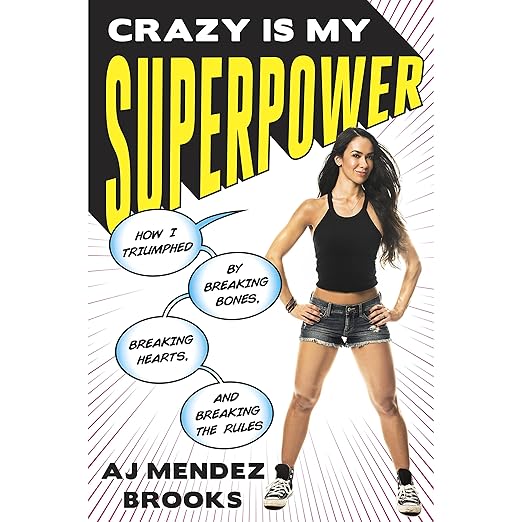
Eight hours and eleven minutes is what A. J. Mendez needs to read her own memoir aloud, and one of the five people who wrote about it sized the job up by counting pages instead. Timothy Lee expected a doorstop, found something under three hundred pages when other wrestlers' autobiographies run to nearly double that, and concluded the whole thing could be finished in an afternoon. On the audiobook the measurement is a full working day of listening, which is the first of several places where this page and its reviewers are describing different objects.
What We Made of It
AJ Lee was a WWE superstar; A. J. Mendez is the name on the byline, and the book is about the distance between those two facts. The publisher's copy lays out the childhood first: a family working through drug addiction, poverty and mental illness, and a quiet girl trying to act normal while feeling anything but, escaping into comic books and video games. Then comes the discovery that superheroes could be real, which in this telling means professional wrestling, and years of training toward a career in it.
The framing device is a list of twelve words in capitals, the labels the copy says were handed to her as weaknesses: SHORT, NERDY, SKINNY, WEAK, IMPULSIVE, UGLY, TOMBOY, POOR, REBEL, LOUD, FREAK, CRAZY. Her argument inverts the list: she became successful because of those words, and the copy is explicit that it did not happen in spite of them. The wrestling section carries its own conflict, with industry pressure to play the damsel in distress and dress more provocatively for male fans, and an alter ego built in response that the copy describes as nerdy, enthusiastic and a little bit crazy.
The author field and the narration field on this listing hold the same name, and for this particular book that is not a small detail. A memoir whose central subject is being told to perform a version of yourself for other people gains something specific when the person doing the telling is also the person doing the reading. Julie Klam, quoted on the page as the bestselling author of Friendkeeping, calls the book "at once breathtakingly honest, hilariously funny, self-deprecating, and incredibly inspiring", and three of those four adjectives are things a voice can either deliver or lose.
The Best Parts of Crazy Is My Superpower
Lisa G. describes the newcomer's route in: a love of professional wrestling picked up a couple of years ago, no idea who AJ Lee was until a recent return to the ring, then this book. That path matters because it tells you the memoir does not assume you followed the promotion. You are not required to know a single match to follow the story it tells about a family, a diagnosis and a job that happens to involve a ring.
Alexander von der Linden makes the sharpest case, and it is a warning as much as a recommendation. This is not the tell-all about her time in the WWE, and not a compendium of wrestling anecdotes; it is an in-depth look at how upbringing and mental illness can shape a person's life, written in a conversational tone that bounces around. Anyone buying eight hours expecting backstage gossip is buying the wrong thing, and anyone buying it for the mental-health writing is buying exactly the right one.
Jason Robert Bink reports laughing out loud within the first few pages and then repeatedly, alongside sad passages about growing up with mental illness in the family and a period of homelessness. That tonal swing is where self-narration earns its keep in principle: comic timing and grief have to live in the same voice, and the person who wrote both is the one delivering them. What that sounds like in practice is not documented anywhere on this listing, so the credit is a reason for optimism rather than a guarantee.
What Might Not Land
One number here is simply broken. The badge shows 4.8 while the vote counter beside it shows 1, and a single whole-star vote can only ever display as a whole star. Underneath, five written responses are visible and every one of them carries a five-star grade, so every readable opinion sits above the average being advertised. The reviews are real and consistent; the average is not describing them.
Pacing is the one substantive criticism available, and it arrives in print units. Jason Robert Bink puts the first real wrestling talk at about a hundred and sixty pages in, and Timothy Lee measured the whole book at under three hundred, so the career arrives past the midpoint. That reviewer treats the delay as a feature. Buyers whose interest is the WWE and only the WWE should work out in advance which book they actually want, because the first several hours belong to the memoir.
The filing is odd enough to mention. A memoir about bipolar disorder, poverty and a family in crisis sits under sports and outdoors with a Combat Sports and Self-Defense tag, which is accurate about the day job and misleading about the content. Treat the categories as a shelving decision, never as a description, and go in prepared for material on addiction, mental illness and homelessness handled with humor but not softened.
Who Should Listen to Crazy Is My Superpower
If you want a mental-health memoir with jokes in it, this is the one, and the same applies to anyone who has been handed a list of things wrong with them and would like to hear a career built out of that list. Wrestling fans get their material too, later than they might expect. Households where a teenager is working out what a diagnosis means will find the tone approachable and the honesty unusual for a celebrity book.
Shoppers after locker-room stories should pass, and anyone who needs a memoir to stay light should know the childhood chapters do not. Buyers who care about production polish will find no information on this page beyond the running time and a name that also appears on the cover. The memoir's own voice reading its own worst days is the strongest argument this listing makes, and it is the only argument the credit can actually support.
Key Details
- Read by: A. J. Mendez reads her own book, so the author field and the narration credit carry the same name across eight hours and eleven minutes.
- At its heart: Bipolar disorder, family addiction and poverty, professional wrestling, self-acceptance.
- Vibe: Funny and raw by turns, confessional without self-pity.
- Short version: Recommended for the mental-health writing first and the WWE material second, which is the order the book itself uses.