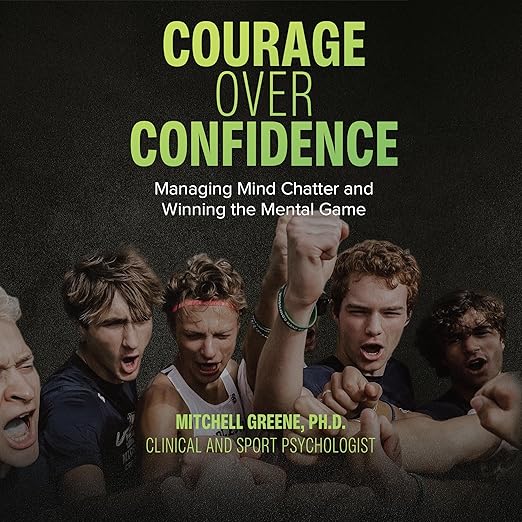
Dr. Mitchell Greene's central argument in this audiobook, that confidence is not a prerequisite for athletic success and may in fact be an obstacle to it, is the kind of counterintuitive claim that the sports psychology genre needs more of, and 'Courage Over Confidence' delivers it in a tightly organized three-and-a-half-hour format that earns its brevity.
First, the Big Picture
Greene is a clinical and sport psychologist, and the book carries that credential without leaning on it unnecessarily. His central target is what he calls 'mind chatter': the doom-and-gloom internal commentary that high-stakes competition generates, and that most sports psychology approaches attempt to manage by replacing negative thoughts with positive ones. Greene argues that this substitution strategy fails repeatedly because positive thinking under pressure is not a natural cognitive state but a performed one, and performance under pressure is already what the athlete is trying to achieve. Adding a second layer of cognitive performance to an already demanding situation compounds rather than reduces the load.
The alternative Greene proposes is not affirmation but acceptance. 'Joining forces' with the negative voice rather than battling it means acknowledging its presence, understanding its function as a threat-detection system, and then acting despite it rather than after it has been silenced. Courage, in this framework, is not the absence of doubt but the decision to compete in its presence. The reframing is elegant and, for athletes who have tried positive-thinking approaches without sustained success, it offers a genuinely different cognitive strategy rather than a variation on the same approach.
Greene self-narrates, and the self-narration works because the material is drawn from his clinical practice and the examples carry the weight of his direct experience with competitive athletes at every level. When he describes the pattern of athletes who excel in practice and collapse on game day, the description has the specificity of accumulated observation rather than theoretical illustration. The narration is not produced at the level of a professional audio performance, but the authenticity of someone speaking from within their own professional expertise compensates for the occasional flatness of delivery in purely expository sections.
The Best Parts of Courage Over Confidence
The strongest argument for this audiobook is its practical orientation. Greene does not spend the majority of his three hours building theoretical foundations; he moves quickly to the actionable content, which suits both the athletic audience he addresses and the format's natural pace. Listeners who have read extensively in the self-help or sports psychology space will recognize some of the underlying cognitive frameworks, particularly elements adjacent to acceptance and commitment therapy, but Greene applies them specifically to competitive performance in ways that general mental wellness books do not.
The audiobook's scope is broad in terms of audience without feeling generic. Greene addresses competitive young athletes, professionals, and Olympians in the same framework, and the examples span basketball, marathon running, endurance sports, and other competitive contexts. Listeners across disciplines will find the core framework applicable even when the sport-specific examples do not match their own practice. Several reviewers confirmed this cross-discipline utility; the marathon runner and the team-sport athlete arrived at the same core insight by the same route.
Coaches and parents of competitive athletes represent a specific audience Greene addresses directly, and the book's usefulness extends beyond the athlete themselves. Understanding why an athlete who performs brilliantly in practice becomes unreliable in competition is a question coaches face regularly, and Greene provides a framework for that conversation that is less likely to damage the athlete's self-assessment than conventional confidence-building approaches.
A Few Reservations
The brevity of the audiobook is both its strength and its structural limit. At three hours and thirty-seven minutes, Greene covers his framework with efficiency but does not have room to develop each athlete archetype or competitive context at length. Listeners who want extended case studies or granular implementation guides will find the book gestures toward those details rather than providing them fully. The framework is complete; the scaffolding is lean.
Greene's decision to write for athletes at every level of competition from beginners to Olympians means the examples occasionally feel generic rather than sport-specific. Competitive professionals who want precision about how the framework applies in the final seconds of a playoff game may find the abstraction level appropriate for a broad audience but not quite calibrated to their particular situation. The core insight transfers across contexts, but the application detail remains the reader's work to complete.
The self-narration in the most technically clinical sections, where Greene explains the cognitive mechanics of mind chatter, is occasionally flat compared to the sections drawn from clinical anecdote. Listeners who process technical content better through text may want to note that this is an area where the audio format serves the book's engaging examples better than its more clinical explanations.
The Right Listener for Courage Over Confidence
Competitive athletes at any level who have experienced the practice-competition gap, performing well in training but underperforming when it matters, will find this audiobook directly addressed to their situation. The framework is actionable rather than inspirational, and the three-hour format makes it a genuinely practical investment rather than a multi-session commitment.
Coaches, sports parents, and mental performance consultants working with athletes who overthink under pressure will find the conceptual vocabulary Greene develops useful for diagnosis and for conversation with the athletes they support. Listeners who want a confident, positivity-based approach to athletic preparation should know that Greene explicitly argues against that framework; his audience is people who have tried it and found it insufficient, not people committed to it.
- Narrator: Dr. Greene self-narrates with clinical authenticity; examples from his practice carry conviction even when delivery in purely expository sections is occasionally flat.
- Subjects: Mind chatter, the practice-competition gap, courage versus confidence, acceptance-based performance, and the psychology of high-stakes competition.
- Tone: Direct and practical; Greene cuts to the actionable content efficiently and keeps the tone grounded in competitive experience rather than aspirational rhetoric.
- Bottom line: A sharp, efficiently structured audiobook that offers a genuinely different cognitive framework for competitive athletes, worth the three-and-a-half-hour investment for anyone who has struggled with game-day performance.
Good to Know
Is this audiobook useful for non-athletes or primarily for competitive sports contexts?
Greene acknowledges the framework applies beyond sport, and several reviewers confirmed using it in non-athletic competitive contexts including public speaking and high-stakes professional situations. The examples are sport-focused, but the cognitive principles transfer to any performance context where pressure activates self-doubt.
Is the audiobook appropriate for young athletes or is it pitched primarily at adults?
Greene writes for competitive young athletes as well as professionals and Olympians. The examples are accessible to high school athletes and above, and the coaches-and-parents sections make it practical for adults supporting younger competitors. The framework is age-appropriate from early competitive levels upward.
At three and a half hours, does this audiobook cover the topic comprehensively?
It covers the core framework comprehensively and the implementation at a high level. Listeners who want extended case studies or sport-specific application guides will find the book leaner on those details. The brevity is a deliberate design choice; Greene values efficiency, and the framework is complete within the runtime even if the scaffolding is lean.