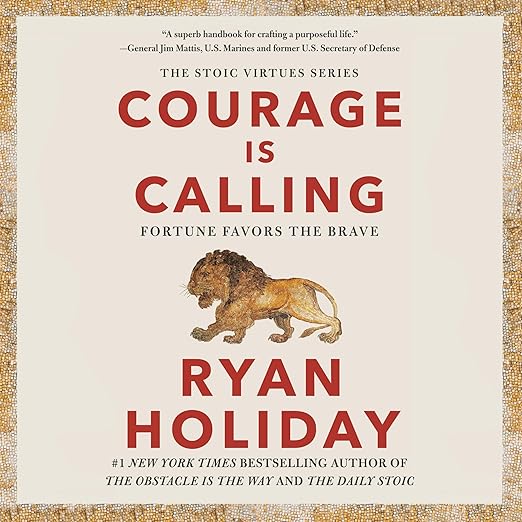
I came to Courage Is Calling in the middle of a stretch of weeks when I was actively avoiding several decisions I knew I needed to make. I am not sure that was an accident. Holiday's books have a way of finding readers at the right moment, or maybe the right moment creates a particular kind of readerly openness, and the books are simply always there. Courage Is Calling is the first in a new series on the cardinal Stoic virtues, following the trilogy that made Holiday one of the most widely read popularizers of ancient philosophy working today. It covers the virtue that the Stoics considered foundational to all the others: the ability to act rightly in the face of fear.
The structure is organized around three movements: fear, courage, and heroism. Each section draws on historical examples that Holiday researches with genuine care, Charles de Gaulle's stubborn resistance in the face of military and political catastrophe, Florence Nightingale's institutional battles as formidable as any battlefield she faced, Frank Serpico's decision to testify against the NYPD's corruption at enormous personal cost, a Roman senator named Helvidius Priscus who chose death over compliance with an emperor he regarded as a tyrant. The examples are not decoration. They are the argument.
What We Made of It
Holiday's trilogy, The Obstacle Is the Way, Ego Is the Enemy, Stillness Is the Key, found its audience among professional athletes, military leaders, and executives partly because it made Stoic philosophy feel immediately applicable rather than merely historically interesting. Courage Is Calling carries that same ambition. The goal is not to produce readers who know about Stoic courage but readers who practice it.
Reviewer Beguiled By Books, who has followed Holiday since 2018 and places him consistently on their best-books lists, notes that this new series represents a deepening rather than a departure. The virtue framework, Courage, Temperance, Justice, Wisdom, gives the Incerto-style Stoic project a more structured architecture than the trilogy had. Each book will be able to stand alone, but they are designed to accumulate into something larger.
Why Courage Is Calling Works as an Audiobook
Holiday's self-narration is the right choice for the same reasons it worked in the Stillness Is the Key recording, he reads these books as if the stakes are real, because for him they are. The historical passages benefit particularly from his delivery. When he describes Helvidius Priscus's final confrontation with Vespasian, or Serpico's isolation after the NYPD turned against him, the narrative urgency in Holiday's voice carries the moral weight of the story more effectively than a neutral narrator could.
At just over six hours, the runtime is appropriate for the content. Holiday writes in scenes and arguments rather than in sustained analysis, and the audio format suits that episodic construction. Each historical example functions as a complete unit, which makes this easy to listen to in segments without losing the thread.
What Might Not Land
The section on Frederick Douglass and the slave named Nelly is the book's most powerful sequence. Holiday uses the story of Nelly's resistance against her captors, and Douglass's account of how witnessing it changed his understanding of what was possible, to make an argument about how courage propagates through example rather than instruction. It is the most emotionally direct passage in the book and the one most likely to stay with the listener.
Reviewer Rob offered a careful observation about Holiday's relationship to Stoicism, that he writes as a student of Stoic virtue rather than a philosopher, and that the Stoic tradition itself would probably resist anyone who claimed to have attained the rank of philosopher. That self-awareness, whether explicit or implicit in Holiday's approach, is what keeps the books from tipping into self-help posturing.
Who Should Pick Up Courage Is Calling
Readers who worked through Holiday's previous trilogy and found it useful will find this a natural continuation, the voice, the method, and the historical depth are all consistent with what made those books work. Those new to Holiday can start here; the new series is designed to be accessible without prior exposure to the Stoic trilogy.
Those who find the self-help register frustrating, or who want a more rigorous philosophical treatment of Stoic courage, should look toward primary sources, Marcus Aurelius, Epictetus, or academic secondary literature. Holiday is a gateway, and a very good one, but his books are primers rather than comprehensive treatments.
In Brief
- Read by: Ryan Holiday narrates his own work, the Stoic gravity he brings to the delivery makes the historical examples feel like dispatches from a tradition rather than illustrations for an argument.
- At its heart: Stoic courage, fear as the root obstacle, heroism in ordinary and extraordinary contexts
- Vibe: Serious and galvanizing, the book wants something from you
- Short version: A well-constructed entry into Holiday's new virtue series, strongest in its historical storytelling and most useful when read as practice rather than theory.
A Few Questions About Courage Is Calling
Does Courage Is Calling require familiarity with Ryan Holiday's earlier Stoic trilogy?
No. It is the first book of a new series and is designed to work as a standalone entry into Holiday's treatment of Stoic philosophy. The earlier trilogy is complementary but not prerequisite.
How does the historical storytelling in Courage Is Calling work, are the examples well-researched?
Holiday is a careful researcher by the standards of popular nonfiction. The figures he profiles, de Gaulle, Nightingale, Serpico, Helvidius Priscus, are historically documented, and the book treats their situations with specificity rather than using them as loose inspirational analogies.
Is this book Stoic philosophy, self-help, or something between the two?
Something between. Holiday uses Stoic philosophy as his organizing framework but writes for a general audience rather than an academic one. The goal is practical application rather than philosophical rigor.
How does Courage Is Calling handle the distinction between physical courage and moral or civic courage?
Holiday treats courage as a spectrum and gives significant attention to moral and civic forms, whistleblowers, activists, politicians who resist unjust authority. Physical bravery appears but is not the book's dominant concern.