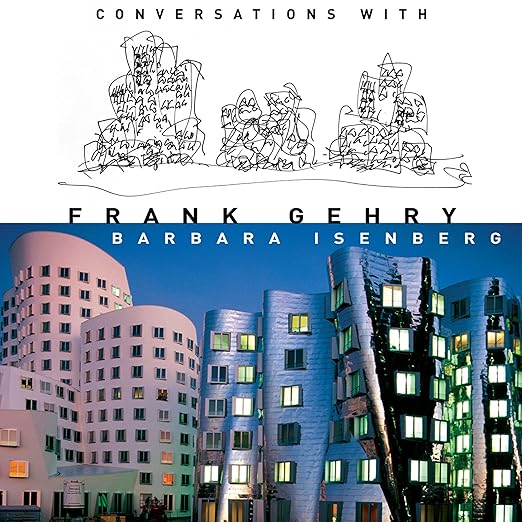
Barbara Isenberg spent twenty years in conversation with Frank Gehry before assembling those exchanges into Conversations with Frank Gehry, and that accumulation shows. This audiobook, narrated by Stefan Rudnicki across seven hours and eight minutes, is not a traditional architecture biography. It does not follow a linear chronology from the kitchen floor where young Gehry built cities with his grandmother's wooden blocks to the titanium curves of the Guggenheim Bilbao. It is something more interesting and more candid: a portrait assembled from sustained attention over two decades, during which Isenberg earned the kind of trust that produces real disclosure rather than polished reputation management.
Rudnicki's narration suits the conversational architecture of the book precisely. His voice carries a quality of settled authority that matches the subject matter without competing with it, and his pacing through the longer passages in which Isenberg contextualizes Gehry's responses reflects a reader who understands that this book is less interested in dramatic arc than in gradual revelation. For listeners who have spent time with Rudnicki's other narrations, this performance will confirm what his body of work suggests: he is especially skilled at nonfiction that requires the narrator to feel like a knowledgeable guide rather than a performer.
What Gehry Saw in Scribbles Nobody Else Could
The book's deepest value lies in Gehry's account of his creative process, specifically the gap between the early drawing and the finished building. Isenberg describes a moment in the early Guggenheim Bilbao development when the building's now-famous undulating curves were mere scribbles on a page, and Gehry's explanation of what he was thinking at that moment, what he saw in those scribbles that his clients and collaborators could not yet see, is the kind of insight that architectural theory rarely delivers because it requires candor that formal writing discourages. Gehry is candid here because Isenberg has spent twenty years becoming someone he trusts, and that relationship changes what is possible in the exchange.
His discussion of what makes a great client is one of the audiobook's most useful stretches. Gehry has worked with clients ranging from the accommodating to the obstructive, and his taxonomy of the relationship between architect and patron is specific and illuminating. The distinctions he draws between clients who trust the creative process and those who manage it into mediocrity apply well beyond architecture, and listeners outside the design world will find these sections as resonant as those specifically about buildings.
Influences Surface When They Become Relevant
The design of the book, structured around conversation rather than biography, means that Gehry's influences surface as they become relevant rather than in the chronological order a conventional biography would impose. His engagement with Le Corbusier and Frank Lloyd Wright appears alongside his work on specific buildings. His relationship with Michelangelo, Rembrandt, and Rauschenberg emerges from discussions about specific design problems rather than from a chapter titled Influences. This organic structure makes the audiobook feel more like gaining access to a mind than receiving instruction about a career.
Rudnicki's narration handles the project-specific sections, covering the Guggenheim Bilbao, the Walt Disney Concert Hall, Atlantic Yards, Grand Avenue in Los Angeles, and ongoing work in Toronto, Paris, and Abu Dhabi, with enough informational clarity that listeners without architectural training will follow the discussions without feeling excluded. The audiobook does not require a viewer's relationship with the buildings; Isenberg describes the design logic in sufficient detail that listening alone creates a workable mental picture.
The Sketches This Audiobook Cannot Show You
The print edition of this book contains sketches, models, and computer images provided by Gehry himself that document how his landmark buildings moved from conception to construction. The audiobook cannot reproduce these visuals, which means some of the book's most compelling moments, particularly the early Bilbao drawings described in Isenberg's text, lose their direct reference point in the audio format. Listeners who want to engage with those visual materials alongside the audio will need to consult the print edition or seek out the images online, where much of Gehry's early sketch work is publicly documented.
The conversational format also means the book does not build toward a single culminating argument. Isenberg is not making a case about Gehry so much as presenting him, and readers who want the analytical framework of a critical biography may find the absence of a persistent thesis slightly unsatisfying. What the format sacrifices in argumentative architecture, it recovers in candor. Gehry says things here that a more formal biography would have disciplined out of the record, and that candor is the book's most valuable quality.
Lateral Movement Through a Great Mind's Thinking
Listeners with an existing interest in architecture, whether professional or general, will find this audiobook a rare kind of access. Design professionals who have studied Gehry's buildings in formal contexts will find his own account of the decision-making process behind them revelatory in ways that technical analysis does not permit. General listeners drawn to long-form creative biography, to the question of how distinctive work gets made by distinctive people, will find Isenberg's twenty-year relationship with her subject producing insights that shorter access never could.
Those who need a narrative through-line and prefer audiobooks with clear dramatic arc may find the conversational structure less propulsive than they want. The book moves laterally through Gehry's life and work rather than building toward a climax. For listeners who find that lateral movement through a great mind's thinking more interesting than any conventional biography could be, Rudnicki and Isenberg deliver an essential listening experience.
The Short Version
- Performance: Stefan Rudnicki brings the right gravitas and unhurried pacing to a book structured around extended conversation, honoring the texture of Isenberg's twenty-year relationship with Gehry without overdramatizing it.
- What it covers: The architecture of creativity, client relationships and creative compromise, the gap between the sketch and the building
- Feel: Intimate and intellectually spacious, like sitting in on a long conversation between two people who trust each other
- Our call: For anyone drawn to how iconic buildings actually get made, this audiobook offers access to a mind that rarely speaks this candidly about its own process.